





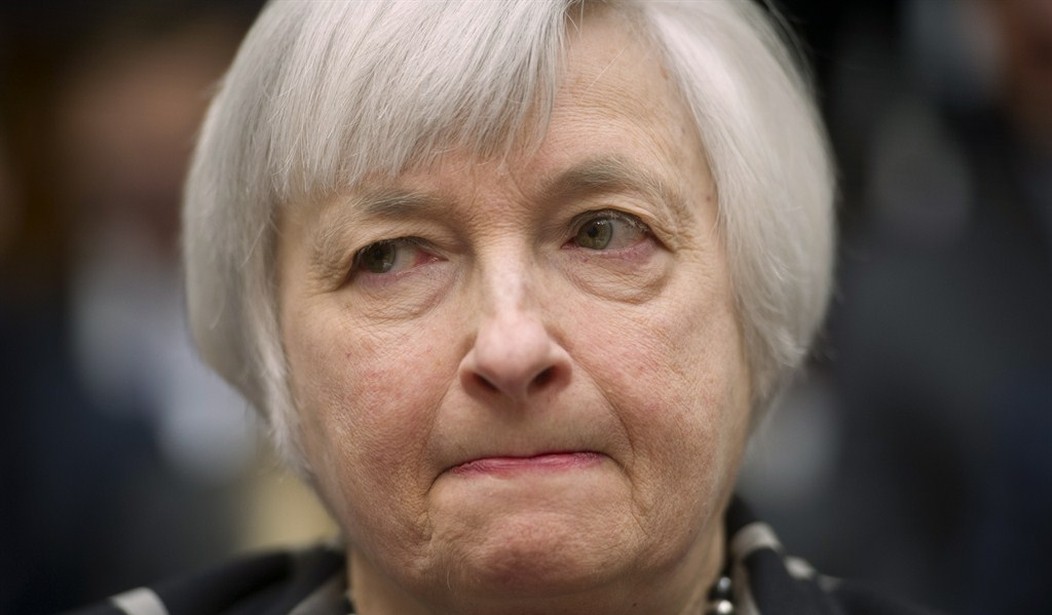
Stock markets cheered Janet Yellen's maiden congressional testimony this past week, as the new Fed chair emphasized the word "continuity" and offered no boat-rocking surprises. Continuity? I assume she means a steady diet of tapered bond purchases that will lead to the end of QE3 this autumn. In other words, investors seemed to think QE has run its course, probably overstayed its welcome, and that it's time the Fed got out of the bond-buying business, since that policy isn't doing much good and may be doing harm.
Ever the Keynesian who subscribes to the non-existent, long-term trade-off between employment and inflation, Ms. Yellen did express worries about long-term layoffs and the shrinking size of the labor-participation rate. She's right about that. The labor situation is subpar.
The employment-to-population ratio is only 58.5 percent, way below its year-2000 peak of 65 percent. The participation rate is a low 62.8 percent, way below its modern average. The Joint Economic Committee estimates that jobs are 4.5 million below the employment trend line since 1960, and 7 million below Ronald Reagan's recovery rate. And average monthly private-payroll increases are only 178,000 in Obama's recovery. Compare that with the Reagan monthly rate of 330,000.
So Yellen is right to be worried about jobs. But she's wrong to think the Fed can do much about this.
Holding back growth and jobs are a series of tax and regulatory barriers that must be fixed if we are to move from secular stagnation back to traditional American prosperity. Obamacare is at the top of the list. The CBO puts the essential job loss at 2.5 million. It will be worse unless Obamacare is repealed.
Perverse Obamacare incentives will penalize industrious people as they climb the ladder of opportunity. They will lose their health-care subsidies and land in higher income-tax brackets. This steep subsidy cliff is a work trap that becomes a poverty trap.
If it pays less to work, people will work less. The Fed has nothing to do with this.
But there's more holding back the economy than Obamacare. A recent report by Tax Foundation president Scott Hodge shows that the U.S. has the worst corporate and capital-gains tax structures among the OECD developed countries. The EPA is going to destroy the coal industry. The Obama administration refuses to open up federal lands for oil-and-gas fracking and drilling, even though the energy revolution is a high-paying job creator. And the National Labor Relations Board is pushing for snap "ambush elections" to promote unionization.
These are all job killers, but the Fed has nothing to do with them.
But the Fed does control inflation, which is a monetary phenomenon. And I'll give Yellen and her predecessor Ben Bernanke plenty of credit for today's low 1 percent inflation rate. But I don't understand why the Fed's planners want to raise inflation to around 2.5 percent. Higher inflation is a tax on consumers, families, investors, jobs, and growth.
Paul Volcker made this point in a recent speech at the Economic Club of New York. Price stability, not monetary fine-tuning, is good for growth. And price stability, which ultimately means protecting King Dollar, requires clear monetary rules to maintain credibility.
But I'm not seeing any rules.
The Fed has already dropped its 6.5 percent unemployment threshold, which would have signaled a higher fed funds target rate with cash withdrawals from the banking system. No rule has replaced this. And in the fifth year of economic recovery, you have to ask why the Fed central planners are still operating a so-called unconventional policy. Instead, they need to lay the groundwork for normalization, which means higher rates.
Professor Allan Meltzer points out that more than 95 percent of the reserves that the Fed supplied under QE2 and QE3 sit idle on bank balance sheets. That money is not circulating through the economy. M2 money growth hasn't budged from its 5 to 6 range. That $2.5 trillion in excess reserves has got to be whittled down gradually.
Yet Yellen made no attempt to pave the way for a transition to normalcy. And that includes interest rates. The Taylor rule suggests a 1.25 percent federal funds rate would be appropriate today. And a return to normal interest rates and the end of Fed credit-channeling would help the economy grow.
For most of the time under Paul Volcker and Alan Greenspan, the Fed operated a market-price rule that used gold, commodities, bond spreads, and the dollar to guide the money supply and interest rates. It worked. Many now believe a nominal GDP rule would also help. Unfortunately, Yellen has backed away from any of these rules.
It's the job of Congress and the president to create jobs by reforming taxes, regulations, and Obamacare. Ms. Yellen should limit her focus to stable prices and a reliable Kling Dollar.
-- Larry Kudlow, NRO's economics editor, is host of CNBC's The Kudlow Report and author of the daily web log, Kudlow's Money Politic$.



Join the Conversation
VIP members get the ability to comment on articles.