





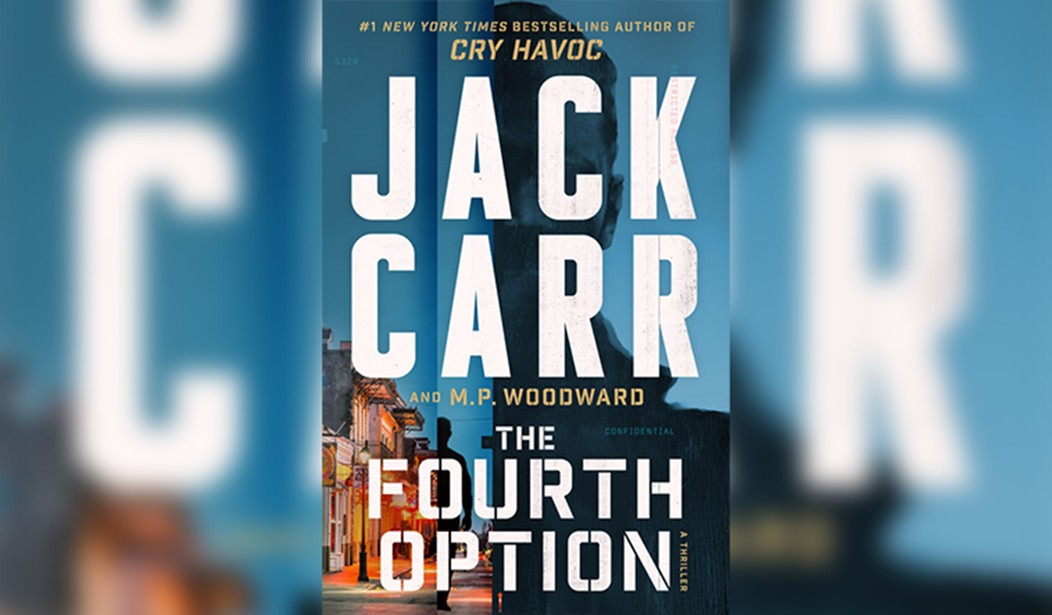
There are thriller writers who produce books at an industrial pace, and then there are thriller writers who still approach storytelling like craftsmen refining steel at a forge. Jack Carr belongs decisively to the latter category. His latest novel, "The Fourth Option," co-written with M.P. Woodward, is not simply another entry in the James Reece universe. It is something more ambitious — a darker, more reflective exploration of justice, institutional failure, and the moral terrain occupied by those forced to operate in the gray.
During my recent conversation with Carr for Episode 15 of The First Draft Podcast, we set out to discuss the mechanics of the novel. What emerged instead was a broader discussion about writing as craft, authenticity in storytelling, and the enduring tension between justice and the systems meant to uphold it. That conversation mirrors the novel itself.
Chris Walker is a permutation within the Jack Carr ecosystem of apex predators. A modern interpretation of the great Western gunslinger, charged by the laws of nature to bring retribution and balance to the lawless expanse of the frontier. Though the long arm of the law has long since tamed the blood red and boundless horizons of the West, the murderous spirit of Dodge City still lurks within the precincts and wards of our inner cities. Metropolises whose sighing streets long for an avenger of blood — a man of the gun — who can expunge the grief of injustice.
Walker exists in a world where lawful order, competent policy, and moral justice no longer move in alignment.
We first encounter him staring into the abyss of the cold forged barrel of a Colt 1911, preparing to end his life inside an aging Volkswagen Westfalia Vanagon. It is vintage Carr — tactile, atmospheric, psychologically layered, and grounded in detail. Every object serves narrative purpose. Every piece of gear tells a story.
Carr told Townhall, “Gear… tells a story…It tells me something about their level of training and competency.” Lesser writers use technical details as decoration. Carr uses them diagnostically. A weapon, vehicle, or watch becomes shorthand for identity, capability, and worldview. The details never overwhelm the story because they are always in service to character.
That discipline extends to Carr’s broader commitment to authenticity. “All of these are going to get my whole heart and soul into every single word…That’s what I owe that reader who’s trusting me with their time.” That ethos is visible on every page. Carr consults FBI personnel, EOD experts, K9 handlers, and military operators not to impress casual readers, but to avoid violating authenticity with those who actually know the world he is depicting.
That authenticity becomes especially evident in the novel’s treatment of the FBI through the character of Agent Jarrett Stanton. Analytical, disciplined, and constitutionally grounded, Stanton represents something modern media too often abandons: the honorable federal agent.
A rare 1790 souvenir print of the Constitution sits prominently behind Stanton’s desk because his loyalty is not to bureaucracy or politics, but to the principles underlying the Republic itself. Stanton rings true because men and women like him still exist. In an era where portrayals of federal law enforcement often collapse into caricature, Carr accomplishes something rare — he portrays institutional service without romanticizing institutional perfection.
Carr does the men and women of the FBI a great service by not just getting the details correct about FBI minutia, but far more importantly, by capturing the spirit and dignity of the G-man as manifested not just in legend, but in the men and women of today’s FBI.
That distinction matters because "The Fourth Option" is ultimately a novel about the limitations of systems. Carr frames the title through a familiar escalation ladder: “First option is diplomacy. Second option, overt military action. Third option, covert action… and now we have the fourth option.”
That unnamed fourth option resonates deeply with anyone who has spent meaningful time inside the system. Law enforcement professionals understand this tension intimately. We believe in institutions because the civil society requires them. Yet we also understand the painful reality that justice is not always achieved cleanly through process alone. Carr does not simplify that moral conflict. He leans directly into it.
What makes the novel particularly effective is that Walker is not simply a revenge archetype. He is a man confronting the psychological consequences of violence while simultaneously recognizing its necessity in a fallen world. Carr avoids simplistic moral binaries. Walker exists in the gray — a place where justice, vengeance, duty, and survival begin bleeding together.
The novel also reflects Carr’s increasingly mature approach to storytelling itself. His process is notably organic. He told Townhall, “I don’t know them yet,” he said of his characters. “I get to know them when I put them in conversation with somebody else.” That approach produces characters who feel discovered rather than engineered. Walker and Stanton emerge naturally through friction, conflict, and dialogue.
Perhaps the most sobering part of our discussion, however, had little to do with the novel itself. Carr reflected on the collapse of reading culture in the algorithm age. “Readers are just dropping off a cliff… because of these devices that we carry around,” he observed. He’s right. We’re living in a culture increasingly shaped by distraction, outrage algorithms, and fragmented attention spans. Long-form reading requires discipline and contemplation — precisely the cognitive muscles modern platforms systematically erode.
Carr made an observation that reaches far beyond publishing: “You’re developing compassion and empathy through reading… which you’re not getting as you’re being controlled by an algorithm.” That statement touches something deeper about the condition of modern culture itself, and underscores why books like his still matter.
"The Fourth Option" is beautifully written, deeply researched, psychologically resonant, and thematically ambitious. Most importantly, it understands something essential about civilization itself: order is fragile, evil is real, and sometimes the line separating the two is carried by flawed men willing to walk into the gray places others fear to enter. "The Fourth Option" is available today!
Editor's Note: Do you enjoy Townhall's conservative reporting that takes on the radical left and woke media? Support our work so that we can continue to bring you the truth.
Join Townhall VIP and use promo code FIGHT to receive 60% off your membership.



Join the Conversation
VIP members get the ability to comment on articles.