





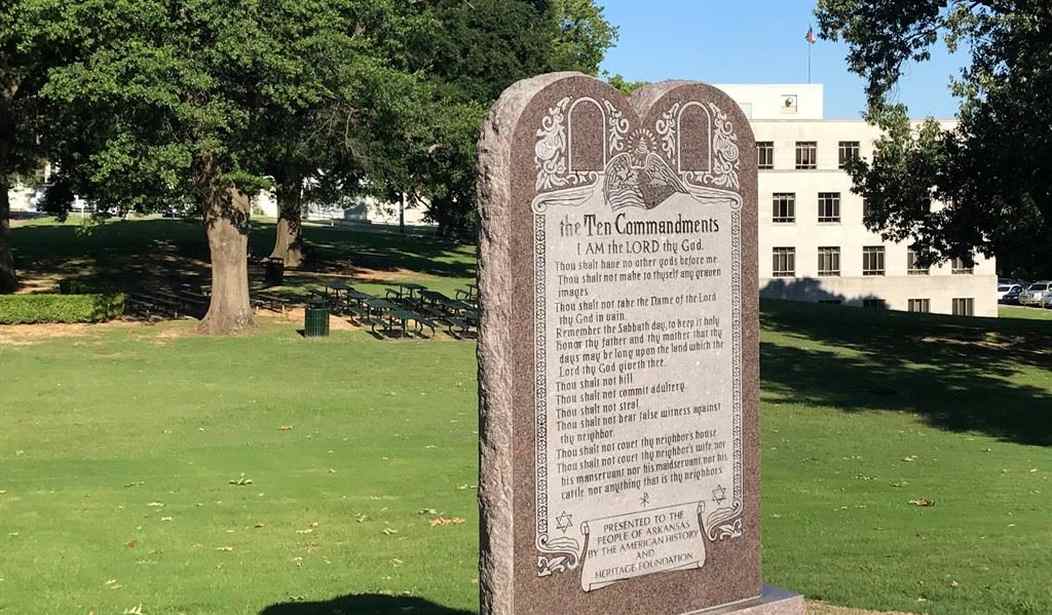
A lively oral argument filled the en banc courtroom of the U.S. Court of Appeals for the Fifth Circuit on Tuesday afternoon in New Orleans, to address this simple question: may states require the posting of the Ten Commandments in public school classrooms? Louisiana, Texas, and Arkansas have enacted new laws requiring this, which had been banned throughout the United States since 1980.
That was when a 5-4 Supreme Court held, in Stone v. Graham, that state legislatures could not require the posting of the Ten Commandments in public school classrooms, even if privately funded. That decision was based on a judicial finding of a religious purpose, which the Court held rendered it in violation of the Establishment Clause.
The Supreme Court has since repudiated the use of a religious purpose test to evaluate state legislation under the Establishment Clause. The entire Lemon test, which was promulgated in 1971 by the Supreme Court in Lemon v. Kurtzman, is no longer good law.
The ACLU argues that a Ten Commandments display in every classroom would have a coercive effect on students. It objects to the use of the King James Version of the Ten Commandments, as found in the Book of Exodus Chapter 20, rather than Jewish or Catholic translations.
Judges peppered the ACLU side with questions about whether it would be unconstitutional to require posting the Declaration of Independence or President Abraham Lincoln’s Second Inaugural Address. President Lincoln quoted verbatim from the King James Version of the Gospel of Matthew, “Woe unto the world because of offences! for it must needs be that offences come; but woe to that man by whom the offence cometh!”
The Court sought historical examples of any impermissible establishment of a religion that was remotely similar to displaying the Ten Commandments in classrooms. The New England Primer, which is called America’s first textbook, sold millions of copies for public elementary school students and included explicit teachings about the Ten Commandments.
A dilemma for the Fifth Circuit as it deliberates in the city called the Big Easy, the birthplace of jazz, is whether to discard Stone v. Graham, which was an unsigned per curiam decision written by liberal Justice William Brennan without oral argument. A majority of the outspoken judges on the Fifth Circuit indicated that they plan not to cast the first stone, an expression from the Bible, but to cast Stone aside and take the chance that the Supreme Court might admonish them for acting so boldly.
A judge opposed to the posting of the Ten Commandments fretted about a child who “believes in a multitude of deities.” In other words, some would grant a heckler’s veto to just one child who might be polytheistic, and allow that view to require taking down the monotheistic Ten Commandments liked by everyone else.
The Pledge of Allegiance is monotheistic, and Texas requires students to recite it in public school without problems. In 1789, George Washington issued his Thanksgiving Proclamation with the words, “Whereas it is the duty of all Nations to acknowledge the providence of Almighty God, to obey his will,” as an attorney defending the classroom display of the Ten Commandments pointed out.
Yet opponents of the Ten Commandments display requirement complain that this will be in every public school classroom at every level, visible from everywhere in each classroom. This will have a coercive effect, they insist, but a Fifth Circuit judge pointed out that the Stone v. Graham decision said nothing about any coercion caused by a display in a classroom.
Some prayer is allowed at public school football games now, and religious objections to pro-transgender mandates are upheld today. Amish elementary schools that were fined more than $100,000 for not requiring the children to be vaccinated were just given a second chance by the Supreme Court to overturn those penalties in lower courts.
Public school enrollment and attendance have been in a free fall, collapsing at an alarming rate. A post-Covid record was just set in Colorado with a 10,000-student annual decline in enrollment, while Broward County public schools north of Miami in Florida face a potential takeover by the state after disclosure that they are losing nearly $100 million.
Schoolchildren need the benefits of the Ten Commandments in their classrooms now, and should not have to wait for years before the good Louisiana law, which was supposed to take effect at the beginning of 2025, is implemented for their benefit.
Excluding all religious symbols from classrooms has turned them into depressing, valueless places where many kids loathe to be. Chronic absenteeism – missing more than a tenth of the school days – is rampant now and, just as Gen Z is reading the Bible more than their prior generation, posting the Ten Commandments might help boost school attendance too.
John and Andy Schlafly are sons of Phyllis Schlafly (1924-2016) and lead the continuing Phyllis Schlafly Eagles organizations with writing and policy work.



Join the Conversation
VIP members get the ability to comment on articles.