





In contemplating bombing Syria, we are looking at a limited military action and the possibility of a considered accidental all-out war with Russia – or as we are prone to say, World War Three.
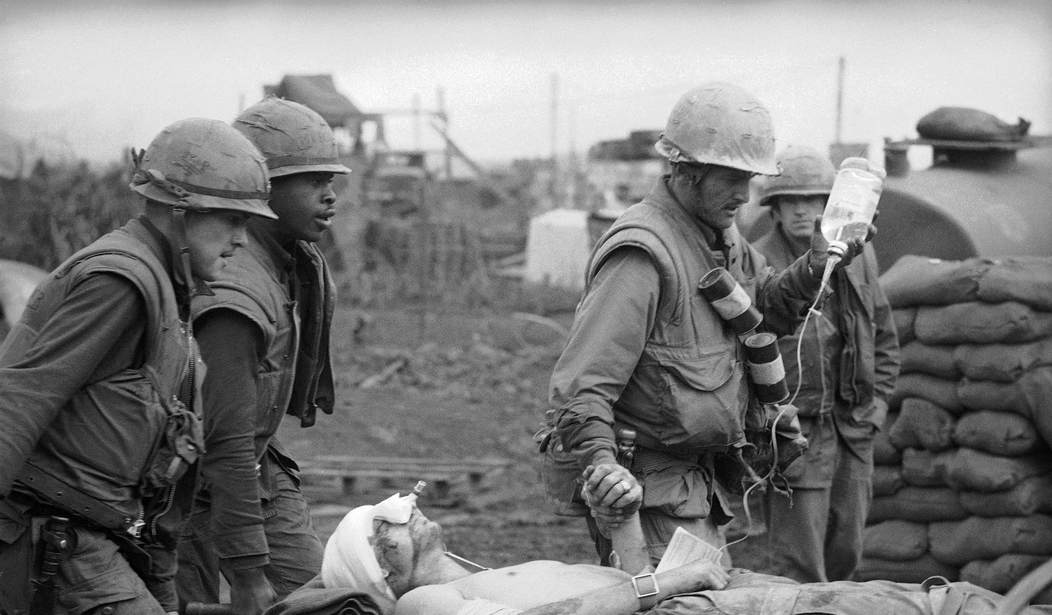
Even as we initially ponder bombing a Russian client state, we are once again considering limitations on military strategy. As a consequence of a political choice not to bomb Russian assets and Russian personnel, we would unnecessarily be putting American lives in danger. These considerations are eerily similar to those that the U.S. government imposed during the Vietnam conflict, which led to a protracted politically managed military fiasco.
In Vietnam the American military was hampered by Rules of Engagement (ROEs) that hampered effective military action.
On the ground, the war was conducted mostly with no defined front lines and severe combat restrictions. This resulted in tactical limitations and tremendous frustration of not being able to engage those believed to be aiding the enemy. There were also initial restrictions as to the combat zone itself, wherein American combatants were not permitted to follow the NVT back into their safe havens in Laos and Cambodia.
In the air, during Operation Rolling Thunder, American pilots were restricted from attacking areas where Russian or Chinese Advisors might be harmed. This included Russian shipping in Haiphong Harbor. Also initially restricted were SAM (Surface to Air Missile) sites while under construction; or if completed only after the site had launched a missile against US planes.
These Rules of Engagement changed frequently, sometimes on a daily basis, sometimes as a result of presidential dictates.
As a result of the severe limitations for sundry reasons, many more American lives were lost, with less successful results.
In spite of thousands of Americans killed, hundreds of thousands wounded and maimed, billions of dollars spent and years of domestic unrest and turmoil, the Vietnam conflict was a military disaster.
More armament was expended in Vietnam than in the entirety of World War Two. Still our objective of subduing the Communist North was never met. Counting the fact that beginning in 1954 the U.S. contributed more than 90 percent of the funding to fight the North Vietnamese, had thousands of advisors on the ground, and we spent more than ten years in Vietnam as an army – we were involved for more than 20 years.
After more than a decade, we are still in Afghanistan. This is also a war without strictly defined front lines. This is a war fought in the middle of a country, where it is difficult to define friend from foe.
War is not a clean tidy business. It leaves in its path death and destruction as a matter of its raison d'être.
Therefore, when war is considered as a necessary unavoidable option, it must be considered in terms of its effectiveness vis à vis its intended results.
The decision by the United States government to enter into a bombing campaign must be based on considerations of what military actions will be required to bring success.
If the killing of civilians through the use of gas weapons by its own government is something for which it is worth fighting in Syria, then the U.S. and its allies must be willing to fight an all-out war – which means risking World War Three. If the US government is only looking to send a message, it would be better done by hiring a Madison Avenue ad agency and have them develop an ad campaign criticizing Bashar al-Assad and the Russians.
Of course, the reality of governments killing their own citizens is not just confined to Syria. And, sometimes these killings are done in a most horrific manner – and yet we have not been urged to go to war in any of these other countries. Therefore, as day follows night, there must be other factors involved than those being reported or discussed.
It must be made clear to the American public what the reason is for the military action. This reason must not hide the geo-strategic considerations of an increased Russian/Iranian military build-up in the Middle East, which must also take into account Russia's long standing association with a country only 200 miles from its border.
To once again enter into a war with American combatants’ hands tied behind their backs means we are either dumb for not looking at the recent past, or the reason for the war as a matter of national security – either imminent or long term - is not justified.



Join the Conversation
VIP members get the ability to comment on articles.