







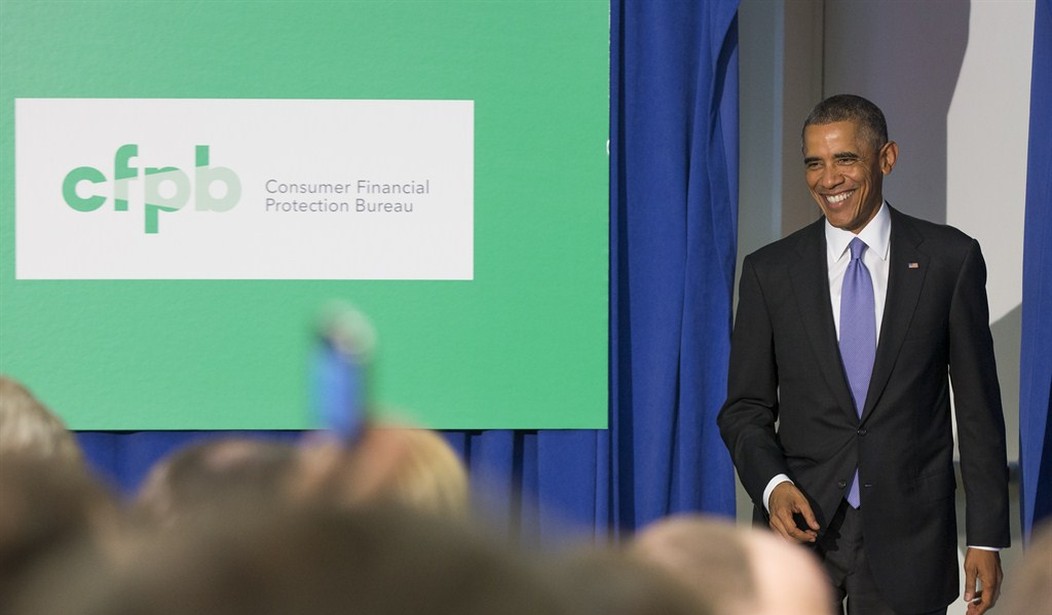
The Consumer Financial Protection Bureau (CFPB) has been called a lot of things. President Obama called it “a consumer watchdog who is charged with protecting everyday Americans from being taken advantage of by mortgage lenders.” House Speaker Paul Ryan said it “supposedly exists to protect you, but instead it tries to micromanage your everyday life.”
On Tuesday, the United States Court of Appeals for the D.C. Circuit called it something else: Unconstitutional.
That’s right. The federal court ruled that one of the hallmark accomplishments of the Obama administration’s last eight years does not pass constitutional muster.
Passed as part of the sweeping Dodd-Frank Act in 2010 and instituted in 2011, the CFPB was designed to be a regulatory body that, autonomous of both the executive and legislative branches, would have independent power to regulate large swaths of the financial services industry.
But as the court ruled on Tuesday, this independence was a bridge too far. The decision reads like a civics textbook, with clear explications of constitutional theory and no less than four references to the Federalist Papers. In his opinion for the court, Judge Kavanaugh writes that “The U.S. Government’s executive power to enforce federal law against private citizens – for example, to bring criminal prosecutions and civil enforcement actions – is essential to societal order and progress, but simultaneously a grave threat to individual liberty.” This threat to liberty, therefore, must be checked and balanced by countervailing constitutional or statutory forces. In the case of the CFPB, neither exists as an effective check.
The power of government agencies has traditionally been checked either by the president himself or commissioners and/or board members, but the CFPB’s director answers to neither. Judge Kavanagh writes, “the Director enjoys more unilateral authority than any other officer in any of the three branches of the U.S. Government, other than the President.” This unprecedented power poses a serious threat to constitutional order and individual liberty.
A year ago my organization, Consumers’ Research, filed an amicus brief in a case challenging the constitutional authority of the CFPB. We emphasized that the CFPB was unconstitutional because it exists independent of the congressional appropriations process. Tuesday’s decision doesn’t reject that argument, but neither does it fully embrace it. Judge Kavanaugh suggested that Congress might alter the CFPB’s appropriations cycle, and said that this problematic feature of the CFPB’s structure is “at most just ‘extra icing on’ an unconstitutional ‘cake already frosted.”
If Congress wants to make the CFPB sufficiently accountable, it can take pages from other agencies. First, it should be restructured, replacing the position of Director with a 5-person bipartisan commission similar to other agencies of the same stature. Supporters like President Obama and Senator Warren revere this lack of accountability as a feature of the CFPB, not a bug that needs correcting. (Yet Warren herself originally proposed the CFPB as a five-member commission, modeled after the Consumer Product Safety Commission.)
Congress also needs to set limits on the CFPB’s power and discretion. The CFPB has sadly lived up to its critics' worst fears in the five years it has existed, becoming the poster child for federal overreach. It has overstepped its bounds, for example, by expanding into the regulation of the automotive loan industry, a purview it was explicitly denied in Dodd-Frank. The absence of congressional control over appropriations for its budget and standard financial oversight has led to cost overruns that are obscene even by Washington standards. Their new offices, originally projected to cost $55 million have currently cost over $215 million and are still incomplete.
Finally, Congress needs to force the CFPB to listen. To date, the CFPB’s heretofore unique status outside both executive and legislative authority bred an arrogance that is reflected both in their mission overreach and overbearing attitude.
Dodd-Frank gave the CFPB an unprecedented mandate to operate without Congressional oversight. This lack of accountability has allowed the agency to stray from its mission and openly flout attempts to oversee its operations. This week’s ruling was an important first step in reining in the CFPB, but more work must be done to protect the American consumer and preserve accountability in Washington, DC.


Join the Conversation
VIP members get the ability to comment on articles.