







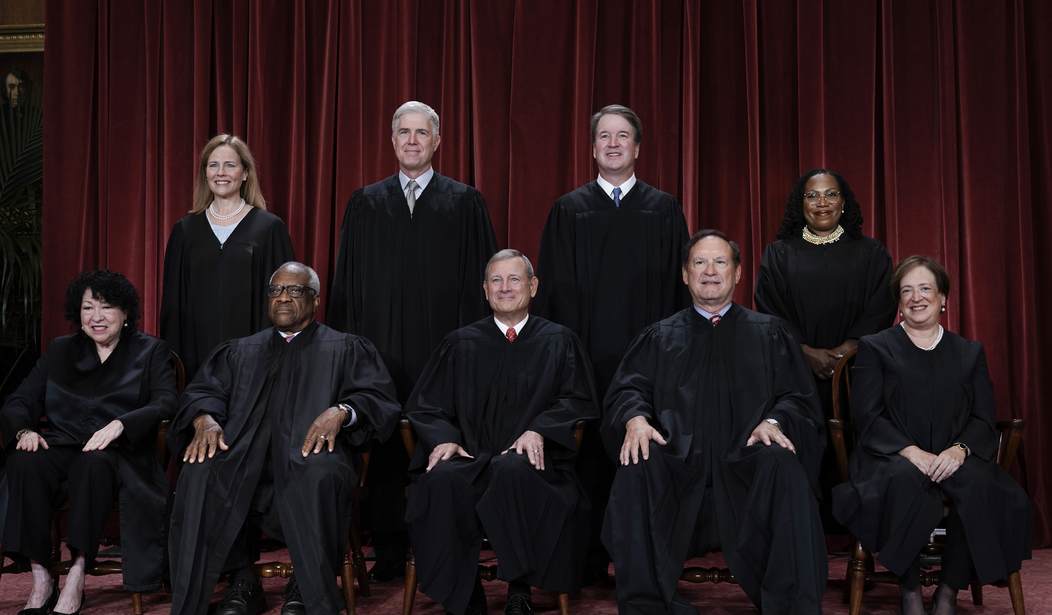
Two years ago, New York Times columnist David French complains, the Supreme Court "created a jurisprudential mess that scrambled American gun laws" by saying they must be "consistent with this Nation's historical tradition of firearm regulation." Last week, French suggests, the court drew back from the precipice when it upheld a federal law that disarms people who are subject to domestic violence restraining orders.
That take is somewhat misleading, since all eight justices who voted to uphold that law plausibly claimed to be following the approach the Court prescribed in the 2022 case New York State Rifle & Pistol Association v. Bruen. Yet French is by no means the only Second Amendment supporter who thinks that test is impractical.
Bruen explicitly rejected "interest-balancing" tests that weigh a gun law's burdens against its purported benefits -- an approach that gave judges a license to approve any regulations they deemed sensible. But critics of Bruen argue that it replaced one kind of unbridled discretion with another, inviting judges to express their personal biases when they decide whether a challenged law is "relevantly similar" to a "historical analogue" identified by the government.
Writing for the majority last week in United States v. Rahimi, Chief Justice John Roberts concluded that "our tradition of firearm regulation allows the Government to disarm individuals who present a credible threat to the physical safety of others" -- a description that applies to at least some people covered by the federal ban, including the defendant in this case. Roberts saw a precedent for that policy in "surety" laws, which required allegedly threatening individuals to post bonds that would be forfeited if they "broke the peace."
Justice Clarence Thomas, who wrote the majority opinion in Bruen and the sole dissent in Rahimi, conceded that surety laws "shared a common justification" with the statute that disarms people based on restraining orders. But he argued that they were not "relevantly similar" because "they imposed a far less onerous burden."
Despite this disagreement, Roberts et al. reaffirmed the Bruen test, noting that it does not demand a "dead ringer" or "historical twin," a requirement that would "suggest a law trapped in amber." And the fact that the justices disagreed about how to apply a constitutional standard, which happens all the time, does not by itself mean this one is unworkable.
In a concurring opinion, however, Justice Ketanji Brown Jackson noted that "lower courts are struggling" to apply Bruen consistently, "diverging in both approach and outcome." A new study by three law professors -- Rebecca Brown, Lee Epstein, and Mitu Gulati -- reinforces that impression.
After Bruen, they report, the number of Second Amendment challenges heard by federal courts rose, and so did the share that were successful. But they found that "judicial discretion, as measured by partisanship, has not been constrained."
To the contrary, Brown et al. say, the correspondence between judges' conclusions and the party of the president who appointed them has increased. They conclude that Bruen "places considerable unguided discretion in judges, inviting partisan bias."
The Cato Institute's Clark Neily, who submitted a brief in Rahimi criticizing the challenged law on due process grounds, argues that the Supreme Court, despite its rejection of "interest-balancing" analysis, is taking essentially the same approach under the guise of "text/history/tradition." He predicts that "pragmatism will play an enormous, if unacknowledged, role in driving case outcomes."
It nevertheless seems clear that Bruen has constrained judicial discretion in at least some cases. Confronted by a wave of state laws that banned guns from long lists of "sensitive places," for example, federal judges predictably disagreed about the validity of the government's historical analogies, but there was some encouraging consistency between Republican and Democratic appointees.
Despite its drawbacks, the Bruen test has been undeniably effective in defeating constitutionally dubious firearm regulations. Whether that counts in its favor depends on whether you view the Second Amendment as an inconvenient relic or a vital guarantee of a fundamental right.


Join the Conversation
VIP members get the ability to comment on articles.