





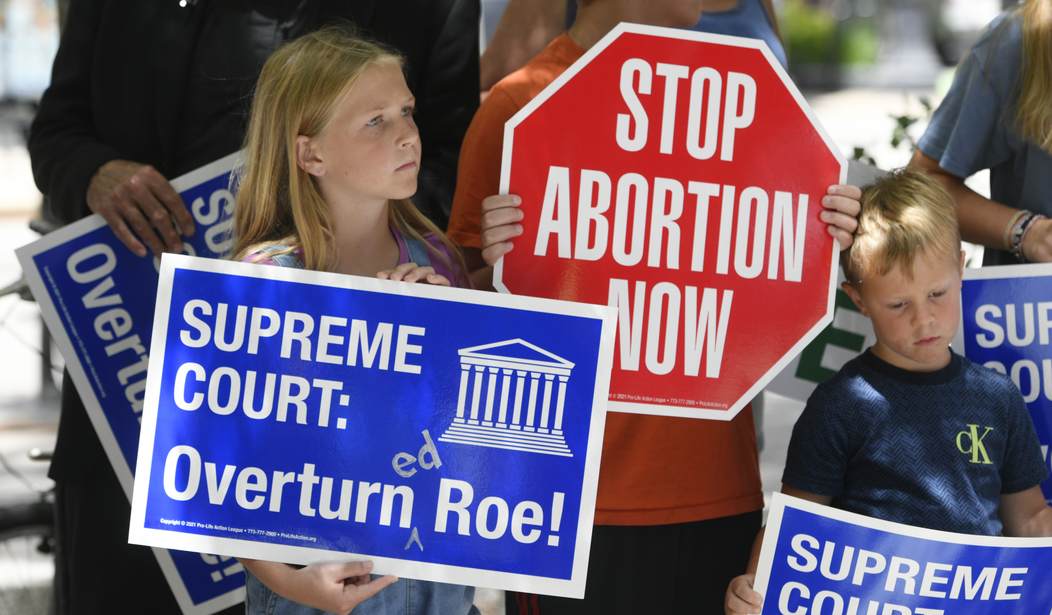
When the Supreme Court overturned Roe v. Wade last week, it ostensibly freed states to regulate abortion as they see fit. But that won't be possible if Congress manages to impose one abortion policy on the entire country or if states succeed in applying their own laws beyond their territory.
Both power moves are constitutionally dubious. They threaten to undermine or negate the federalist approach that was supposed to convert a winner-take-all national controversy into state-by-state debates that leave room for a diversity of policies based on a diversity of opinions.
If Democrats had the necessary votes in the Senate, they would codify a right to abortion that goes even further than the limits that Roe imposed on state legislators. You might wonder where Congress gets the authority to dictate abortion policies across the country.
A bill that the House passed last year locates that authority in the power to regulate interstate commerce. "Abortion restrictions substantially affect interstate commerce in numerous ways," it says, citing the interstate purchase of equipment and drugs used to terminate pregnancies.
Republicans can play this game, too. The 2003 Partial-Birth Abortion Ban Act, for instance, notionally applies to abortions "in or affecting interstate or foreign commerce."
As Independence Institute scholar David Kopel and University of Tennessee law professor Glenn Reynolds noted in 1997, that language is baffling "to any person not familiar with the Commerce Clause sophistries of twentieth century jurisprudence," since "it is not really possible to perform an abortion 'in or affecting interstate or foreign commerce'" unless "a physician is operating a mobile abortion clinic on the Metroliner."
Those sophistries were epitomized by a 2005 decision in which the Supreme Court said the Commerce Clause was broad enough to encompass state-authorized medical marijuana that was never sold and never crossed state lines or even left the grower's property. "If Congress can regulate this under the Commerce Clause," Justice Clarence Thomas warned in his dissent, "then it can regulate virtually anything -- and the Federal Government is no longer one of limited and enumerated powers."
Thomas, who last week joined four other justices in overturning Roe, might nevertheless be skeptical of the federal abortion ban that some Republicans would like to pass. When the Supreme Court upheld the Partial-Birth Abortion Ban Act as consistent with Roe in 2007, Thomas left open the possibility that the law might not be "a permissible exercise of Congress' power under the Commerce Clause."
Thomas' willingness to enforce constitutional limits on the federal government's powers could make him an ally of Democrats who view him as an enemy. But such cross-ideological alliances are not possible as long as Democrats are committed to the absurdly expansive reading of the Commerce Clause on which they rely for much of their agenda. If Congress can force states to allow abortion, it can also prevent them from allowing it.
Justice Brett Kavanaugh, who also voted to renounce Roe, is another unlikely ally of pro-choice Democrats. In his concurring opinion, Kavanaugh said "the constitutional right to interstate travel" would preclude states from standing in the way of women seeking abortions in jurisdictions where they remain legal.
Neither that constraint nor the general rule against extraterritorial application of state laws has deterred legislators from trying to stop abortions in places that allow them. A 2021 Missouri bill, for example, would impose that state's restrictions on all abortions obtained by Missouri residents, no matter where they are performed.
Pro-choice states have responded with legislation that aims to frustrate such threats. Those interstate disputes pose complicated issues that will play out in the courts for years.
The late Justice Antonin Scalia complained that Roe "destroyed the compromises of the past, rendered compromise impossible for the future, and required the entire issue to be resolved uniformly, at the national level." The compromise that Scalia envisioned -- letting states go their own way on abortion -- is today threatened by maximalists on both sides of the issue.


Join the Conversation
VIP members get the ability to comment on articles.