





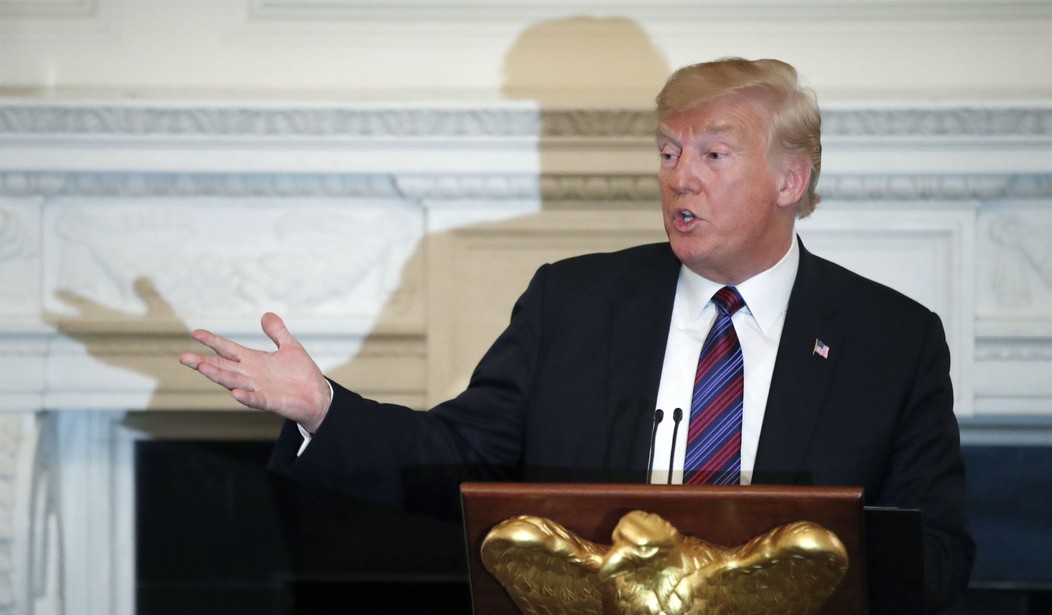
Donald Trump's critics say his defense of hush payments to women who claim to have had sex with him betrays a misunderstanding of campaign finance law. If so, it is hard to see how the president could have "knowingly and willfully" violated the law, as required for a criminal conviction.
Last week, Michael Cohen, Trump's former personal lawyer, pleaded guilty to making an excessive campaign contribution by paying porn star Stephanie Clifford, aka Stormy Daniels, $130,000 in exchange for her silence about her alleged affair with Trump. Cohen also admitted he caused an illegal corporate campaign donation by arranging for The National Enquirer to pay former Playboy model Karen McDougal $150,000 for her story about sex with Trump, which it kept under wraps.
"Those two counts aren't even a crime," Trump claimed in a Fox News interview. He emphasized that he reimbursed Cohen with his own money, as opposed to campaign funds, the latter of which "could be a little dicey."
Responding to those comments, CNN political correspondent Chris Cillizza observed, "What Trump doesn't know about campaign finance law is, um, a whole lot." Yet Cillizza himself seemed confused, saying in one article that Trump "was making an illegal loan to his campaign," and saying in another piece published the next day, "What Trump did is effectively make a campaign loan to Cohen."
Trevor Potter, who as a former chairman of the Federal Election Commission, or FEC, should know, clarified the point in a Washington Post op-ed piece. Trump's reimbursement, Potter explained, "would just make Cohen's payment a loan to the Trump campaign. And federal law treats a loan to a campaign as a contribution, subject to contribution limits and disclosure requirements."
Trump's confusion on this point suggests he did not deliberately flout the rules, which is the difference between a civil and a criminal violation of the Federal Election Campaign Act, or FECA. Nor is it clear that Trump needed to handle the Clifford payment the way he did to keep it hidden from voters: Another former FEC chairman, Brad Smith, suggests Trump could have reported the payment as a campaign expenditure under the boring heading of "legal services."
Smith is not convinced the hush payment should have been treated as a campaign expenditure. While Cohen said he paid Clifford "for the principal purpose of influencing the election," Smith notes that FECA prohibits the use of campaign funds "to fulfill any commitment, obligation or expense of any person that would exist irrespective of the candidate's campaign."
Even if paying Clifford helped Trump win the election, then treating it as a campaign expense would have been illegal unless it happened only because he was running for president. "At a minimum," Smith wrote in a Reason magazine essay, "it is unclear whether paying blackmail to a mistress is 'for the purpose of influencing an election,' and so must be paid with campaign funds, or a 'personal use,' and so prohibited from being paid with campaign funds."
As the disagreement between Potter and Smith suggests, campaign finance law is complicated. Since even experts argue about what FECA requires, it is plausible that Trump, who shows little interest in fine points of law or policy, did not know.
The Justice Department has long taken the position that a sitting president cannot be indicted. But the question of whether Trump committed a crime under FECA could figure in impeachment discussions, in which case the evidence that he was genuinely clueless should count for something.
While Trump may benefit from the excuse of ignorance, he refuses to cut Hillary Clinton the same slack. Two years ago, then-FBI Director James Comey said prosecuting Clinton for her "extremely careless" handling of emails containing classified information, which arguably amounted to "gross negligence" under the Espionage Act, would have been unjust without evidence that she knew she was breaking the law.
Trump is still complaining about that decision. Last week on Twitter, he argued that Clinton benefited from a "Double Standard."


Join the Conversation
VIP members get the ability to comment on articles.