





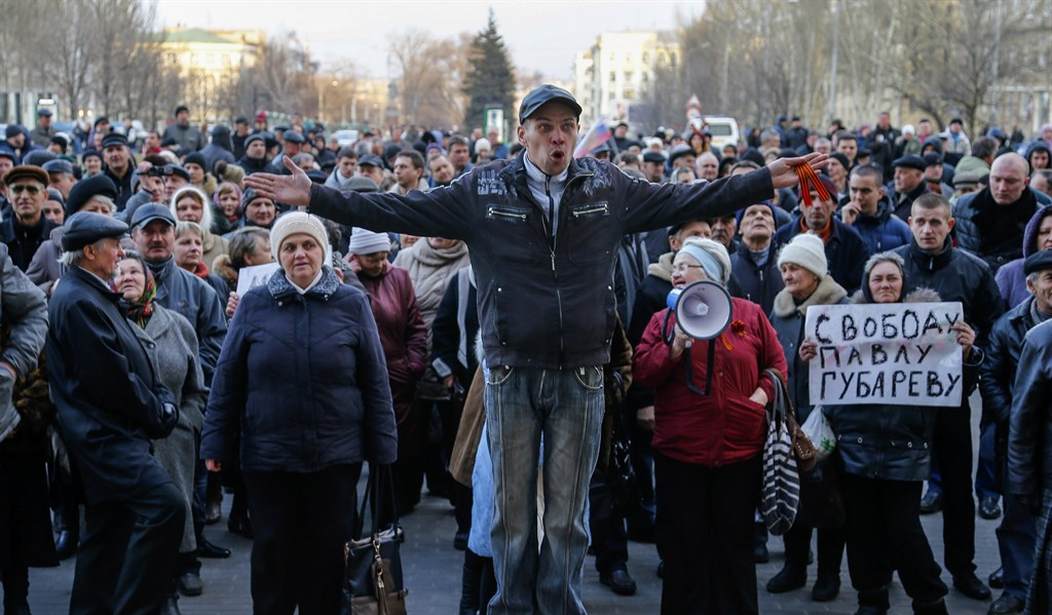
Next Sunday the people of Crimea are scheduled to vote on whether to secede from Ukraine and become part of Russia. President Obama says the referendum is illegitimate because it violates the Ukrainian constitution. But the president's respect for the Ukrainian constitution is highly selective, and that document's relevance is dubious in any case.
It is true that Ukraine's constitution does not allow Crimea's regional parliament to unilaterally hold a plebiscite on secession (even leaving aside the question of whether a free and fair vote can take place while Russian forces control the peninsula). But neither does the constitution allow the national parliament to peremptorily remove the president from office, as legislators purported to do with Viktor Yanukovych last month.
The constitution specifies an impeachment procedure, including appointment of an investigative commission, a two-thirds parliamentary vote to bring charges, a three-quarters vote to convict, and review by the Constitutional Court. Legislators did not follow that procedure. Instead they declared Yanukovych unable to perform his duties, a move authorized only if the incapacity is due to "health reasons."
Obama nevertheless recognizes the current regime as "the legitimate government of Ukraine" and declares, "We are well beyond the days when borders can be redrawn over the heads of democratic leaders." Yanukovych may be a corrupt thug, but he was democratically elected, and his removal was unconstitutional.
Does that matter? Maybe not. The Ukrainian constitution, which replaced the Soviet-era version, was itself approved by legislators in 1996. What gave them the authority to do that?
If legitimacy is based on the consent of the governed, there is an obvious problem with any constitution approved by a less than unanimous vote of elected representatives. Even if we assume that each legislator inerrantly represents the will of his constituents, all of whom are of one mind, a minority clearly has not agreed to abide by what will henceforth be treated as the supreme law.
Imagine a club that includes only people who voluntarily join. If the members all agree to basic rules for the club's operation (including rules for changing the rules), no member can reasonably call a decision by the club illegitimate, as long as the rules are followed.
Not so with constitutions approved by a mere majority. The legislators who voted against the current Ukrainian constitution did not approve it, and no doubt many citizens, including ethnic Russians in Crimea who would prefer to be part of Russia, would have voted no, as well.
If Crimea's Russian majority approves secession, of course, they also will be overriding the will of a minority, including dissenting Russians, as well as Tatars and ethnic Ukrainians. But when Obama says a vote cannot decide the region's fate because the Ukrainian constitution forbids it, why should his argument carry any weight with people who never consented to that constitution?
Don't get me wrong. All constitutions -- including our own, as Lysander Spooner pointed out -- have similar legitimacy problems. They can nevertheless be useful as restraints on government power and protections against the tyranny of the majority. But it makes no sense to cite one of these documents as a reason to accept a particular government's dominion over a particular territory.
Obama also claims to be "standing up for the principle of state sovereignty." But that principle is little more than deference to the status quo, including the territorial claims of one of the most brutal and oppressive regimes on Earth. And although such deference may help maintain order and discourage war, it tends to fall by the wayside when it proves inconvenient (in Serbia, Iraq, Libya, Afghanistan, Pakistan and Yemen, for example).
In this case, Russia, which controlled Crimea from 1783 until Nikita Khrushchev arbitrarily assigned it to the Ukrainian Soviet Socialist Republic in 1954, could argue that reversing the transfer upholds the principle of state sovereignty, even as it respects democracy and the right to self-determination. We like all of those things, right?

Join the Conversation
VIP members get the ability to comment on articles.