





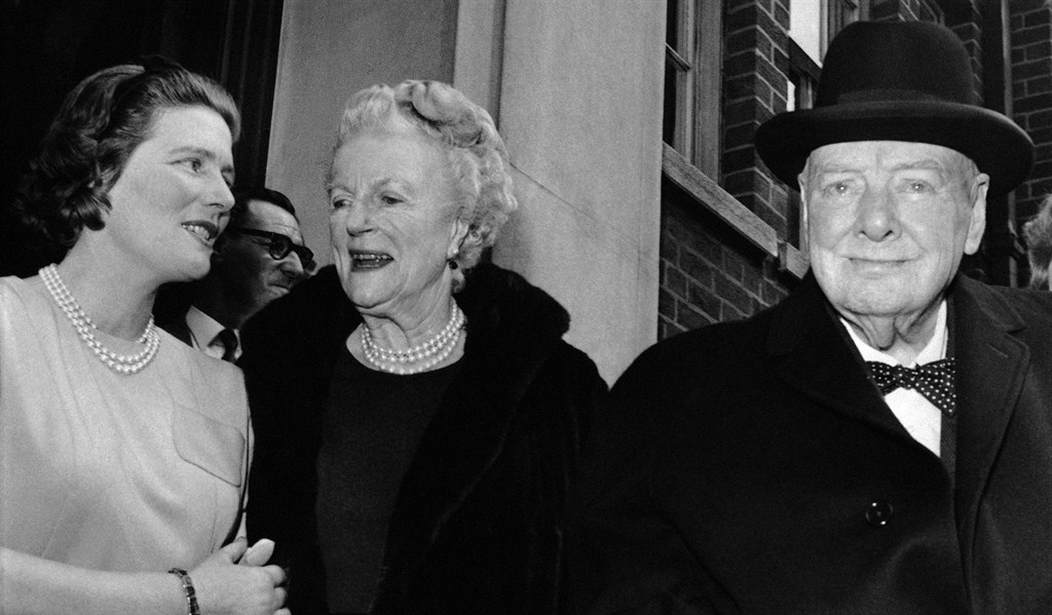
This week marks the 50th anniversary of the death of Sir Winston Churchill, Britain's prime minister during World War II. Churchill took up painting as a hobby in 1915, after the Gallipoli debacle, where 46,000 allied lives were lost over nine months of the campaign. He went on to paint more than 500 paintings during his lifetime. As wartime prime minister, he took a break from painting, focusing instead on the task at hand -- winning the war, no matter the cost.
Churchill's output and accomplishments were extraordinary. He "produces more published words than Shakespeare and Dickens combined, wins the Nobel prize for literature, kills umpteen people in armed conflict on four continents, serves in every great office of state including prime minister (twice), is indispensable in victory in two world wars and then posthumously sell his paintings for a million dollars," wrote Boris Johnson in "The Churchill Factor: How One Man Made History."
His first speech as the wartime prime minister laid out his vision for war policy: "You ask, what is our policy? I can say: It is to wage war, by sea, land and air, with all our might and with all the strength that God can give us; to wage war against a monstrous tyranny, never surpassed in the dark, lamentable catalogue of human crime. That is our policy."
Always aware that his speeches were meant not only for listeners in Great Britain but also for audiences on the other side of the Atlantic, where his mother was from, the United States.
When he spoke at the United States Capitol, on Dec. 26, 1941, shortly after the Japanese bombed Pearl Harbor, which pulled the United States into the War, Churchill used language to connect the United States and Great Britain into one body. "Here we are together facing a group of mighty foes who seek our ruin; here we are together defending all that to free men is dear. Twice in a single generation the catastrophe of world war has fallen upon us; twice in our lifetime has the long arm of fate reached across the ocean to bring the United States into the forefront of the battle."
Churchill made one exception to his break from his hobby, painting a sunset in January of 1943 at Marrakech, Morocco, "The Tower of the Koutoubia Mosque." Rather than representing a relief from the pressures of the war, this painting, given to President Franklin Roosevelt, was a gesture of friendship that served to tighten the bond between the two leaders. Churchill had persuaded Roosevelt to visit Marrakech after the two held a summit meeting in Casablanca.
It was in Casablanca that the two leaders agreed upon and adopted the policy of demanding unconditional surrender. This connected the United States and Great Britain together until the end of the war. Stalin, who was tied up fighting the Nazis on the Eastern side of the war, did not attend the summit. Churchill was determined to strengthen his ties with Roosevelt, who had recently entered the war a little more than a year earlier, when the Japanese bombed Pearl Harbor.
It wasn't just that Churchill made history; it was that he shaped history. He had recognized the threat posed by Nazi Germany in the 1930s while in the political wilderness and clearly identified the coming threat of Communism in a speech in Fulton, Missouri, on March 5, 1946. Though he had just lost his bid to serve as prime minister of Great Britain, he did not let his personal defeat prevent him from declaring that, "From Stettin in the Baltic to Trieste in the Adriatic, an iron curtain has descended across the continent."
The Iron Man labeled the Iron Curtain.
He understood that "success consists of going from failure to failure without loss of enthusiasm," and enthusiastic he was.
Possibly it was his belief in democracy and freedom that drove him forward, or it may have been the reprieve and restoration he received from painting. Whatever drove him, we can't know. But we can take from his life, and his achievements, that failure often happens to the best of us. And we can learn a valuable lesson: A person is defined not by any failure, but by what he or she does after the failure.


Join the Conversation
VIP members get the ability to comment on articles.