





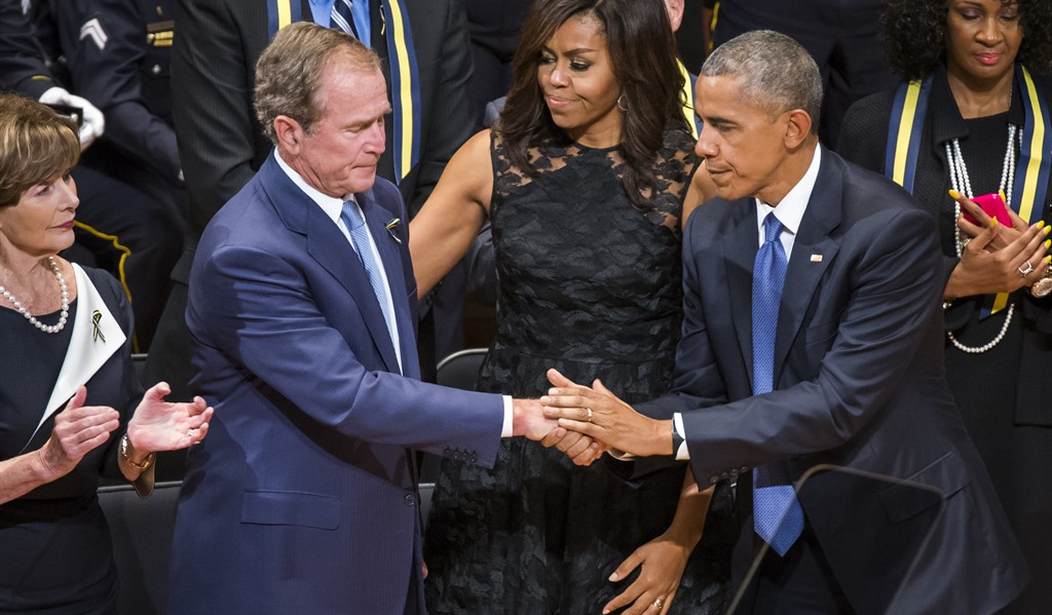
The president claimed it is easier for kids to buy guns than either computers or books. The only people who say such things are people who have never tried to buy guns. It is simply not true. The problem is not that the president said it, but that the president used a nonpartisan memorial service for dead police officers to lie in the name of his preferred public policy.
While Democrats may appreciate President Obama's pursuit of taking away Americans' guns, half the nation does not. Our president, instead of using an opportunity to unite the nation in mourning and appreciation for lives well-lived decided to strike a divisive, partisan tone. That service was not the time to do so.
Ruth Bader Ginsburg, a sitting justice on the United States Supreme Court, decided to speak about her opposition to Donald Trump's presidential campaign. Even the liberal New York Times derided her decision to do so. But the president's administration praised her. Justices on the Supreme Court are supposed to be outside politics and keep their opinions on active campaigns to themselves. Bush v. Gore is a case within living memory and Ginsburg might very well be called upon to exercise judgment in a current electoral case. But she has disqualified herself and may yet refuse to step aside if such a case arose.
Hillary Clinton violated both law and regulation to keep a private email server and use it to send and receive classified information. An investigation found that not only had she failed to hand over evidence, but that she and her legal team deleted evidence. On top of that, she allowed lawyers without security clearances to review classified information. But no one will punish her because she is a major party figure running for President of the United States.
At Yale, an employee took a broomstick and smashed a historic stained glass window, the bottom of which depicted slaves carrying cotton. While the employee was dismissed, he will not be prosecuted, nor will the University seek restitution for the damage. At other universities, students and faculty are getting away with vandalism because the vandalism is against out of favor symbols and subjects.
Taken individually, these events are a bit meaningless. But together they point to a break down in social civility, law and order. When the president no longer understands that some events should not be politicized; when Supreme Court justices are emboldened to go beyond the bounds of decorum; when the public sees public officials are above the law; and when criminals are given passes because their crime was against out of favor subjects, we as a society begin to collapse. It may sound dramatic, but each is an indication that the boundaries around civil society and discourse have collapse. Each is an indication that merit is outfoxed by stations in life.
Theologian Tim Keller quoted Yale professor Arthur Leff in his book, "The Reason for God." Leff said, "When would it be impermissible to make the formal intellectual equivalent of what is know in barrooms and schoolyards as 'the grand Sez Who?' In the absence of God...each...ethical and legal system...will be differentiated by the answer it chooses to give to one key question: who among us...ought to be able to declare "law" that ought to be obeyed? Stated that baldly, the question is so intellectually unsettling that one would expect to find a noticeable number of legal and ethical thinkers trying not to come to grips with it...Either God exists or He does not, but if He does not, nothing and no one else can take His place."
A society premised on common morals is premised on universal rights and wrongs. Once society throws off those morals, it descends into a survival of the fittest, or most powerful. We are arriving at that point in our American society.
Join the Conversation
VIP members get the ability to comment on articles.