





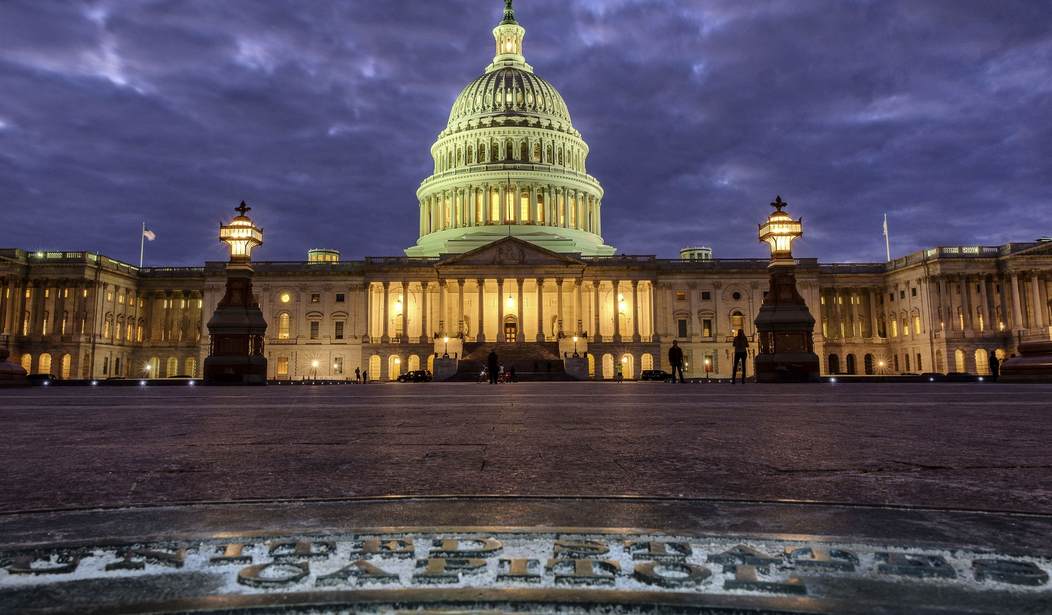
Last week, the House Energy and Commerce Committee took a major step in supporting the modernization of our country’s telecommunications infrastructure and rectifying a government oversight that could have been a gross injustice to broadcasters and American consumers across the country.
The House Energy and Commerce Committee, in a notable bipartisan action in an otherwise hyper-polarized D.C., unanimously voted for H.
Included among the various provisions was an essential clause authorizing C
As previously reported by Townhall, the history behind the problem that H.R. 4986 solves is quite complex and spans over half a decade. Back in 2012, Congress voted to permit the FCC to oversee a market-based auction of our country’s wireless spectrum in a bid to update and upgrade our long-outdated telecommunic
The wireless spectrum auction closed in 2017, netting the U.S. government over $7.3 billion in profit, of which a $1.75 billion fund was allocated to help the country’s broadcasters transit
However, it was quickly found that the $1.75 billion to the hundreds of broadcasters nationwide affected was grossly insufficient. Local TV stations receiving inadequate funding from the relocation fund is one of the problems, but government officials also didn’t recognize that local radio stations – many of which are co-located on TV antennas – would be affected by this government mandate. Washington has thus far provided no rectification for its interference with their signals.
Members on both sides of the aisle agreed that this unintended oversight required action; nonetheless, it has taken a significant amount of time for the actual legislative allocation to make it through the process.
On Feb. 14, the House Energy and Commerce Committee finally provided the authorizing language to make it happen. Once the committee’s FCC reauthorization bill is passed, the FCC will then formally determine whether the original $1.75 billion reimbursement was sufficient – an answer it already gave in legislative hearings - or whether more should be authorized. From there, Congress is expected to respond by fixing the unfunded government mandate once and for all.
While telecommunications infrastruct
The spectrum auction itself was widely considered an incredibly innovative policy achievement, even a “revolutionary approach,” having combined free-market-based functions with immensely complex technical requirements. Yet it is precisely because it was so transformative that the negative externalities from the transition could have been extremely disruptive.
When the government creates negative externalities and problems for businesses that have done no fault of their own, it is only right for the government to reimburse those hurt. This has traditionally almost always been a rule followed by past government policy, and the principle is even embodied in our nation’s Constitution in the Fifth Amendment’s Takings Clause.
By ensuring that broadcasters will receive the assistance they believed they would be getting from the harm stemming from the government’s wireless spectrum reorganization, the members of the House Energy and Commerce Committee are ensuring that just compensation is paid and future technological innovation policies will not face a lack of public trust. Now, it’s time for Congress to respond to the committee’s call by formally putting this issue to bed.


Join the Conversation
VIP members get the ability to comment on articles.