





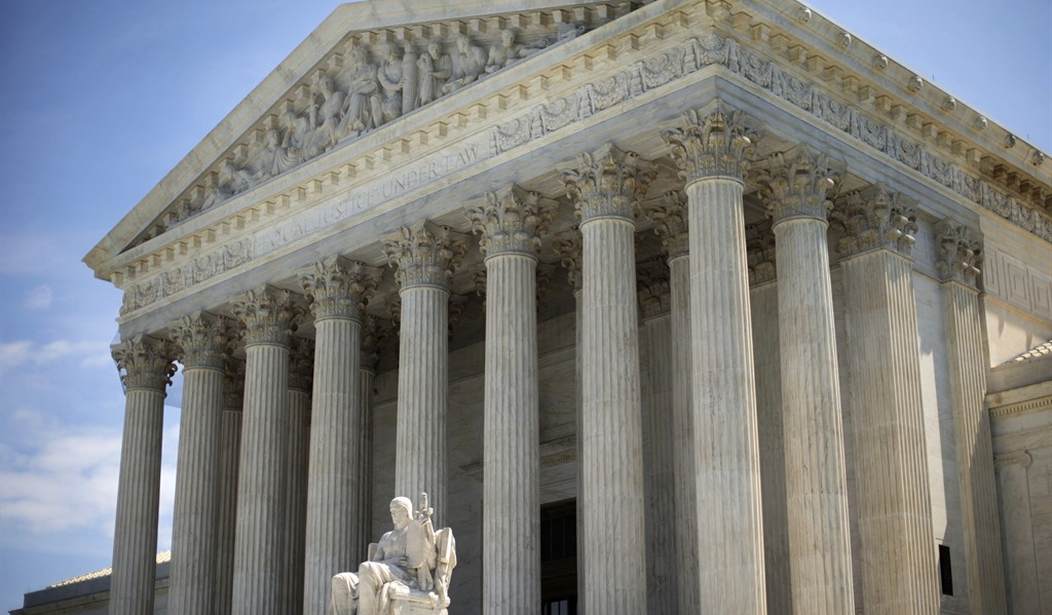
So raise a toast to the Washington Times -- known in my circle as the Good Times -- for telling the rest of the story. It did so a few weeks back, when Bradford Richardson reported that there is hardly a word about the life of Supreme Court Justice Clarence Thomas in the recently opened National Museum of African American History and Culture. Justice Thurgood Marshall, the Supreme Court's first black justice, is mentioned, as is his role as an attorney in Brown v. Board of Education of Topeka, the groundbreaking 1954 case that triggered desegregation in public schools across America. But the life of Justice Thomas, the Court's second black justice and the first black to plot a conservative course, is not mentioned at all, save for one disturbing instance.
Justice Thomas' name comes up in the museum's display concerning the story of Anita Hill, the black lawyer who claimed she was sexually harassed by Thomas while they worked at the Equal Employment Opportunity Commission back in the 1980s. Apparently, she was not believed by the majority of the Senate, because Thomas won confirmation and is now in his 25th year as one of the court's conservative stalwarts. Nonetheless, the museum has on display a button reading "I Believe Anita Hill." There is no pro-Thomas button or any pro-Thomas memorabilia.
When asked about this imbalance -- pitting a disgruntled former employee against the second black to be raised to the court -- a spokeswoman for the museum said, "We do not have plans to create an exhibition on Justice Clarence Thomas or any Supreme Court Justice as part of the museum's exhibitions." She added, "The museum's exhibitions are based on themes, not individuals."
You see, the spreading civil rights movement of the post-World War II period that led to Justice Thomas -- and before him, Justice Marshall -- being nominated to the court was part of a theme. The theme included Anita Hill's attempt to block Justice Thomas' nomination, along with Marshall's role in Brown v. Board of Education. You will have to go down to the museum to learn what the rest of the theme includes. It could include almost anything (the Times mentions the Black Panthers and the recent Black Lives Matter movement), but it does not include the two justices' elevation to the court. I think it is part of the ongoing theme of the American left's supposed domination of history. That is to say, the left is represented by heroes, and the right is represented by flawed humanity. In truth, Justice Thomas is the hero.
Born into poverty, raised by a grandfather who deserves especial praise, Thomas climbed steadily as an independent thinker. He has achieved about all one could ever expect of a citizen in a free society. His legal opinions show intelligence, independence, principle and originality. All are on display in his 2005 dissent in Kelo v. City of New London. In that case, the court's majority granted a local government the right to seize an entire neighborhood for private development, despite the fact that the Fifth Amendment grants the government authority to take private property only for "public use." Thomas said no.
He has also written about his life, from his earliest years in rustic Pin Point, Georgia, to his years at our nation's capital, in a moving memoir titled "My Grandfather's Son." It is one of the finest memoirs to come out of Thomas' generation. The book itself should earn him a place in the museum.
Is there anything that can be done to redress this politicization of the American experience? Well, I just happen to have in my hands a list of the board members of the Smithsonian, which oversees the National Museum of African American History and Culture. And do you know who serves as the board's chancellor? John G. Roberts Jr., the chief justice of the Supreme Court. Surely, Chief Justice Roberts could play a role in recognizing the achievements of Justice Thomas.


Join the Conversation
VIP members get the ability to comment on articles.