





Saying anything you like -- or refraining from saying whatever you want -- is one of the most fundamental rights in a free nation. Without it, the First Amendment is worthless.
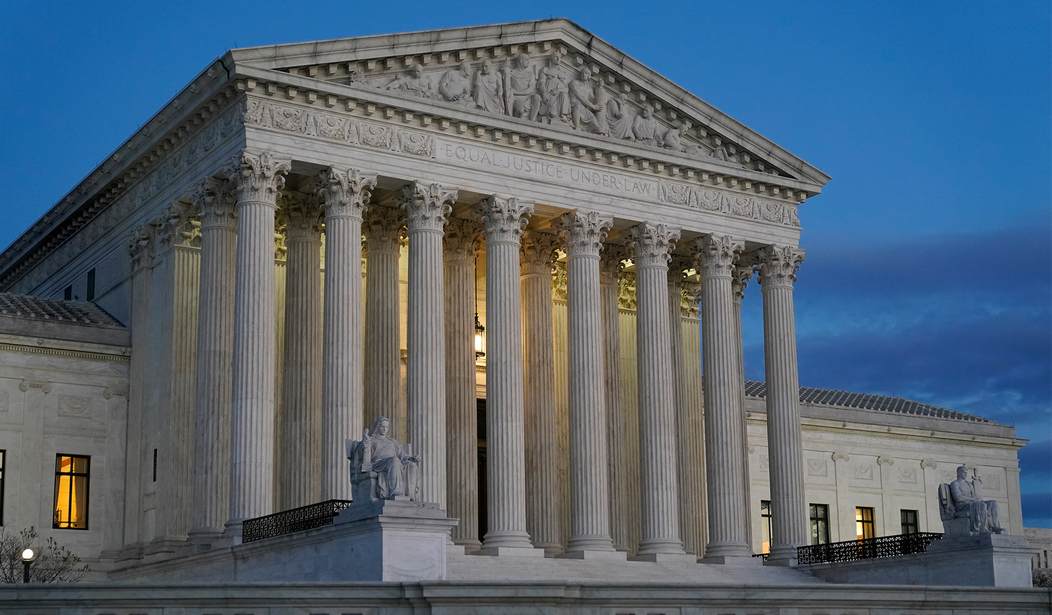
This week, the Supreme Court is hearing arguments in 303 Creative LLC v. Elenis, the case of Lorie Smith, a Colorado designer who refuses to create websites with messages that conflict with her faith -- among them, gay wedding announcements and celebrations. The case not only gives the court the opportunity to strengthen the right to free expression but to fix its useless Masterpiece Cakeshop v. Colorado Civil Rights Commission decision, which empowered the government to level debilitating fines against Christian businesses just as long as bureaucrats didn't openly convey any animus toward their victims.
Monday in The New York Times, David Cole, the national legal director of the American Civil Liberties Union -- which has come a long way since defending the Nazis of Skokie on neutral principle grounds -- says "The First Amendment Is Not a License to Discriminate" (before the headline was edited post-publication). Why? Because otherwise, "interior decorators, landscape architects, tattoo parlors, sign painters and beauty salons, among countless other businesses whose services contain some expressive element, would all be free to hang out signs refusing to serve Muslims, women, the disabled, African Americans or any other group." During Monday's arguments, Justice Sonia Sotomayor similarly claimed that the case would be "the first time in the Supreme Court's history" that it would allow a business to "refuse to serve a customer based on race, sex, religion or sexual orientation."
This is the lie at the heart of the debate.
First off, if leftists insist on framing the speech debate as a binary choice between compulsion and discrimination ... then yes, free expression, explicitly laid out in the Constitution, should trump the right of a stranger to walk into a store and demand the owner say something he does not believe. Using Sotomayor's identitarian calculus, a shopkeeper would never be able to refuse the demands of any customer who happened to be gay.
But neither Lorie Smith nor Masterpiece Cakeshop owner Jack Phillips turned away any customer because of an immutable characteristic or sexual preference or religious belief. Rather, they refused to create a message that conflicted with sincere convictions. If a straight cousin of a groom asked for a same-sex wedding site, Smith would have turned that person away, as well. If a gay customer wanted a website for his business, Smith would have created it. If a straight couple asked for a bawdy website or a website that declared Xenu the one true Lord of the universe, they too would have been rejected, because that idea also runs afoul of her evangelical Christian beliefs. It's a shame that Cole and Sotomayor pretend not to comprehend the distinction.
Progressives like to act like Christian (or Islamic or Jewish) opposition to same-sex marriage is some newfangled ruse cooked up by activists to allow them to put "no gays allowed" signs in the shop windows. I assure you that the notion that true marriage is exclusively between one genetic man and one genetic woman is a generational notion. Before his "evolution" on the question, Democrat icon Barack Obama had tethered his opposition to gay marriage to theology.
Whether you agree with this stance or not is entirely irrelevant when it comes to the matter of speech. There is no Hurt Feelings clause in the Constitution. Rather than dealing with the question, Cole, who has a difficult time seeing anything in nonracial terms, lists a slew of scary slippery slope hypotheticals -- among them: "Should an architecture firm that believes Black families don't deserve fancy homes be permitted to turn away Black clients because its work is 'expressive'?"
Here is a better question: Would Cole, who says the ACLU "has been this nation's leading defender of free speech for more than a century," call for the state to intervene in the case of an evangelical customer who wants to compel a gay designer to create a website for an organization that works to overturn same-sex marriage laws or preaches that acts of homosexuality are a mortal sin? Christians, after all, are also a protected group under anti-discrimination laws. The answer is: highly unlikely.
If we want a diverse and open society -- and I'm highly skeptical that's the goal of Cole or Sotomayor -- one side of the cultural divide can't be empowered to crush the economic lives of anyone who dissents. There are thousands of businesses that will bake the cake or create the website. Public-accommodation laws were meant to stop discrimination against minorities, not compel minorities to promote the political and theological positions of the majority.
David Harsanyi is a senior editor at The Federalist. Harsanyi is a nationally syndicated columnist and author of five books - the most recent, "Eurotrash: Why America Must Reject the Failed Ideas of a Dying Continent." His work has appeared in National Review, the Wall Street Journal, Washington Post, Reason, New York Post and numerous other publications. Follow him on Twitter @davidharsanyi.
Join the Conversation
VIP members get the ability to comment on articles.