








Why does the Turkish government act so aggressively against the Assad regime of Syria?
Perhaps Prime Minister Recep Tayyip Erdogan hopes that lobbing artillery shells into Syria will help bring a satellite government to power in Damascus. Maybe he expects that sending a Turkish war plane into Syrian air space <http://www.danielpipes.org/blog/2012/06/thoughts-on-the-syrian-downing-of-a-turkish>
or forcing down a Syrian civilian plane en route from Russia will win him favor in the West and bring in NATO. Conceivably, it's all a grand diversion from imminent economic crisis <http://www.meforum.org/3134/turkey-economic-miracle> due to borrowing too much.
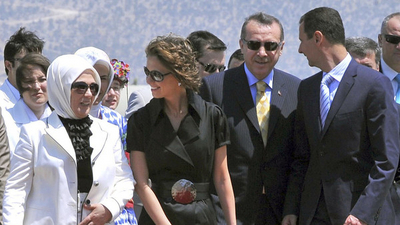
<http://www.danielpipes.org/pics/new/large/1924.jpg>
Happier times: The Asads (2nd and 4th from left) vacationed in August 2008 with the Erdogans in Bodrum, Turkey, home town of Herodotus.
Erdogan's actions fit into a context going back a half-century. During the Cold War, Ankara stood with Washington as a member of NATO even as Damascus served as Moscow's Cuba of the Middle East <http://www.danielpipes.org/170/syria-the-cuba-of-the-middle-east> , an arch-reliable client state. Bad Turkish-Syrian relations also had local sources <http://www.danielpipes.org/8132/crisis-turkish-syrian-relations> , including a border dispute, disagreement over water resources, and Syrian backing of the PKK, a Kurdish terrorist group. The two states reached the brink of war in 1998 <http://www.danielpipes.org/299/why-syria-and-turkey-gird-for-war> , when the Assad government's timely capitulation averted armed conflict.
A new era began in November 2002 when Erdogan's AKP, a clever Islamist party that avoids terrorism or rants about a global caliphate, replaced the center-right and -left parties that long had dominated Ankara. Governing competently and overseeing an unprecedented economic boom, the AKP's share of the electorate grew from one-third in 2002 to one-half in 2011. It was on track to achieving Erdogan's presumed goal of undoing the Atatürk revolution and bringing Shari'a to Turkey.
Feeling its oats, the AKP abandoned Washington's protective umbrella and struck out on an independent neo-Ottoman course, aiming to be a regional power as in centuries past. With regard to Syria, this meant ending decades-old hostilities and winning influence through good trade and other relations, symbolized by joint military exercises <http://www.haaretz.com/news/after-snubbing-israel-turkey-to-hold-defense-drills-with-syria-1.6129>
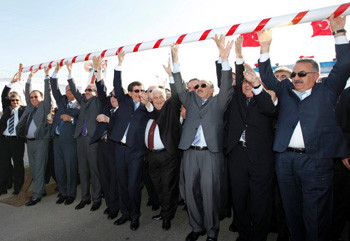
, Erdogan and Bashar al-Assad vacationing together, and a bevy of their ministers literally raising the barrier that had obstructed their mutual border.
<http://www.danielpipes.org/pics/new/large/1030.jpg>
Turkish and Syrian government ministers met in 2009 at a border crossing and symbolically eliminated the division between their two countries.
Starting in January 2011, these plans unraveled, as the Syrian people woke from forty years of Assad despotism and agitated, at first non-violently, then violently, for the overthrow of their tyrant. Erdogan initially offered constructive political advice to Bashar al-Assad, which the latter rebuffed in favor of violent repression. In response, the Sunni Erdogan emotionally denounced the Alawi Assad and began assisting the largely Sunni rebel force.
As the conflict became more ruthless, sectarian, and Islamist, effectively becoming a Sunni-Alawi civil war, with 30,000 dead, many times that injured, and even more displaced, Turkish refuge and aid became indispensible to the rebels.
What initially seemed like a masterstroke has turned into Erdogan's first major misstep. The outlandish conspiracy theories he used to jail and cow the military leadership left him with a less-than-effective fighting force.
Unwelcome Syria refugees crowded into Turkish border towns and beyond. Turks overwhelmingly oppose the war policy <http://gundem.milliyet.com.tr/turk-halki-savas-istiyor-mu-anketlerden-cikan-carpici-sonuc/gundem/gundemdetay/27.06.2012/1559454/default.htm>
vis-à-vis Syria, with special opposition coming from 'Alevis, a religious community making up 15-20 percent of Turkey's population, distinct from Syria's Alawis but sharing a Shiite heritage with them. Assad took revenge by reviving support for the PKK, whose escalating violence creates a major domestic problem for Erdogan. Indeed, Kurds – who missed their chance when the Middle East was carved up after World War I – may be the major winners from current hostilities; for the first time, the outlines of a Kurdish state <http://www.haaretz.com/misc/article-print-page/kurdistan-reaches-toward-the-sea-1.455675?trailingPath=2.169%2C2.212%2C2.414%2C>
with Turkish, Syrian, Iraqi and even Iranian components can be imagined.
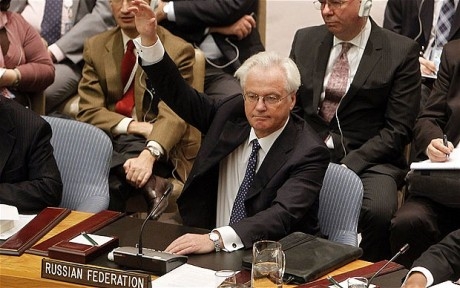
Damascus still has a great power patron in Moscow, where the government of Vladimir Putin offers its assistance via armaments and United Nations vetoes. Plus, Assad benefits from unstinting, brutal Iranian aid, which continues despite the mullah regime's deep economic problems. In contrast, Ankara may still belong, formally, to NATO and enjoy the theoretical privilege of its famous Article 5 <http://www.nato.int/terrorism/five.htm> , which promises that a military attack on one member country will lead to "such action as …necessary, including the use of armed force," but NATO heavyweights show no intention of intervening in Syria.
<http://www.danielpipes.org/pics/new/large/1935.jpg>
Vitaly Churkin, the Russian ambassador, vetoes a draft resolution at the U.N. Security Council.
A decade of success went to Erdogan's head, tempting him into a Syrian misadventure that could undermine his popularity. He might yet learn from his mistakes and backtrack, but the padishah of Ankara is doubling down on his jihad against the Assad regime, driving hard for its collapse and his salvation.
To answer my opening question: Turkish bellicosity results primarily from one man's ambition and ego. Western states should stay completely away and let him be hoist with his own petard.



Join the Conversation
VIP members get the ability to comment on articles.