





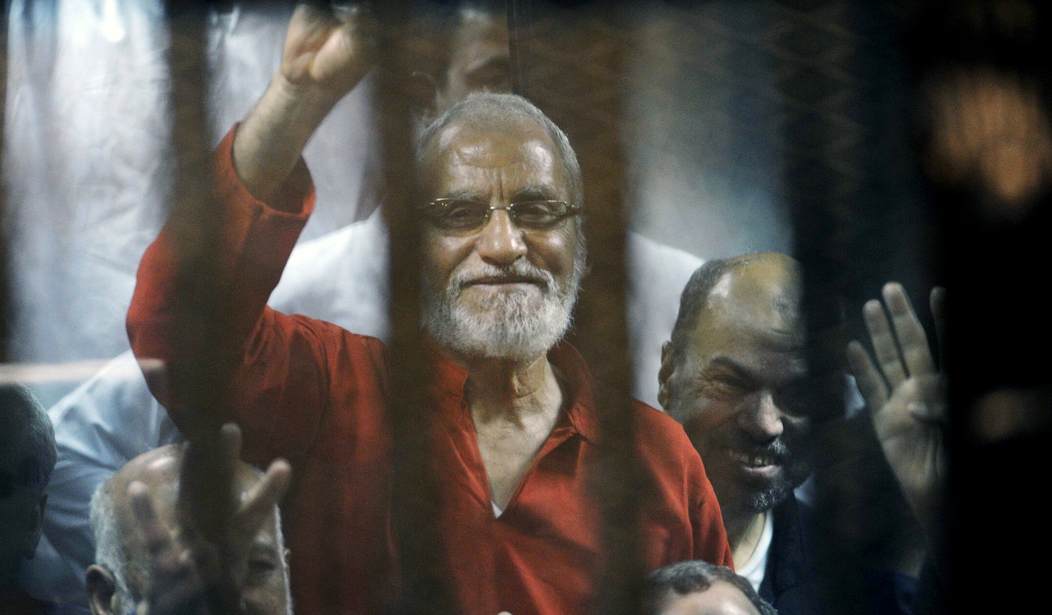
The circle is tightening around the Muslim Brotherhood networks and affiliates in the United States. Top policymakers and legislators are taking historic steps to save the future of America from an extremist ideological network that has been waging a civilizational jihad on America's liberal democratic values and open society for at least four decades. Such a historic moment carries a lot of personal meaning for me as a Muslim Egyptian woman whose life was threatened by the same extremist organization a couple of years ago. Yet, careful application of such brave decisions is necessary to avoid a backfire at home and abroad.
On November 24, 2025, the Trump administration signed an executive order that initiated the process of banning the Muslim Brotherhood, a global network of Islamist extremists who are on a "civilization jihadist" mission. The Executive Order, which specified the Brotherhood chapters in Egypt, Jordan, and Lebanon, aims "to eliminate the designated chapters' capabilities and operations, deprive them of resources, and end any threat such chapters pose to U.S. nationals and the national security of the United States."
One week later, on December 2, the U.S. House Committee on Foreign Affairs voted to pass the Muslim Brotherhood Terrorist Designation Act. The bill amends the Anti-Terrorism Act of 1987 to include the Muslim Brotherhood as a terrorist organization. Such a designation would recalibrate Washington's entire approach to political Islam, forcing federal agencies, civil society organizations, academic institutions, and foreign partners to reassess long-standing relationships built on the assumption that the Brotherhood is merely a socio-religious movement.
It would also expose the financial, legal, and diplomatic networks that have enabled the organization to operate freely in Western democracies, compelling U.S. allies, especially Qatar and Turkey, to choose between their ideological partnerships and their strategic ties to the United States. Most importantly, it would create a new legal architecture for confronting extremist narratives that have penetrated American campuses, media platforms, and grassroots organizations, marking a decisive shift from reactive counterterrorism to proactive ideological prevention.
These are tremendous first steps. However, the process of entirely banning the Brotherhood ideology and dismantling its massive empire of Islamic centers all over the United States cannot be accomplished with a single action. After dismantling the Brotherhood's network of civil society groups and community centers that indoctrinated and isolated parts of the American Muslim community, it is essential to establish effective, government-supervised alternatives. Without them, the vacuum left by the Brotherhood's retreat could allow it to regain influence if moderate groups do not step in.
In Egypt, I watched a similar scenario unfold in the aftermath of the Muslim Brotherhood's fall in 2013. Since its foundation in 1928, the Brotherhood has represented itself as a grassroots movement. It established a network of Islamic centers and charity organizations that provided the poor with basic healthcare, food, education, and other essential services in rural areas where government services were unavailable. Meanwhile, it used these centers as platforms of indoctrination with the goal of reshaping Egyptian society. It was so successful that, in 2012, in the aftermath of the Arab Spring revolution that ousted Mubarak's dictatorship, the Brotherhood took over the presidency and the parliament. A 2018 U.S. Congressional Committee on Oversight and Government Reforms hearing described then-president Morsi's tenure as using "state institutions to promote Islamic radicalism, roll back freedom of the press, and launch a wave of blasphemy prosecutions." Further, under the Muslim Brotherhood's rule, Sharia Law was used as the main source of parliamentary legislation. Through its Islamic centers ecosystem in the U.S., it hoped to achieve a similar goal, i.e., to transform American society from within and eventually take power.
In 2013, the Brotherhood was ousted from power in a popular uprising backed by the military. Shortly after, the Brotherhood was officially banned and labeled a terrorist organization, not only in Egypt, but also in Saudi Arabia, Bahrain, and the United Arab Emirates. Most recently, in 2024, Jordan also banned the group. This resulted in shutting down the Brotherhood charities and centers, arresting members of the group, and freezing its assets.
President Trump has taken a critical step in placing the Muslim Brotherhood's dastardly scheming under scrutiny. Unquestionably, its ideology has been one of the cruelest evils in the modern world, culpable in countless atrocities. Now, the administration must broaden the scope of its approach to ensure that the real nerve centers of the contemporary Brotherhood and its sponsors in Turkey and Qatar are equally targeted. In so doing, the U.S. will place itself on the path of rooting out the deepest inspiration and organizer of our greatest enemy, modern jihadism, and make the Muslim world safe for democracy.
Dalia Ziada is a Middle East scholar and the Washington, D.C. Coordinator for ISGAP - The Institute for the Study of Global Antisemitism and Policy.

Join the Conversation
VIP members get the ability to comment on articles.