





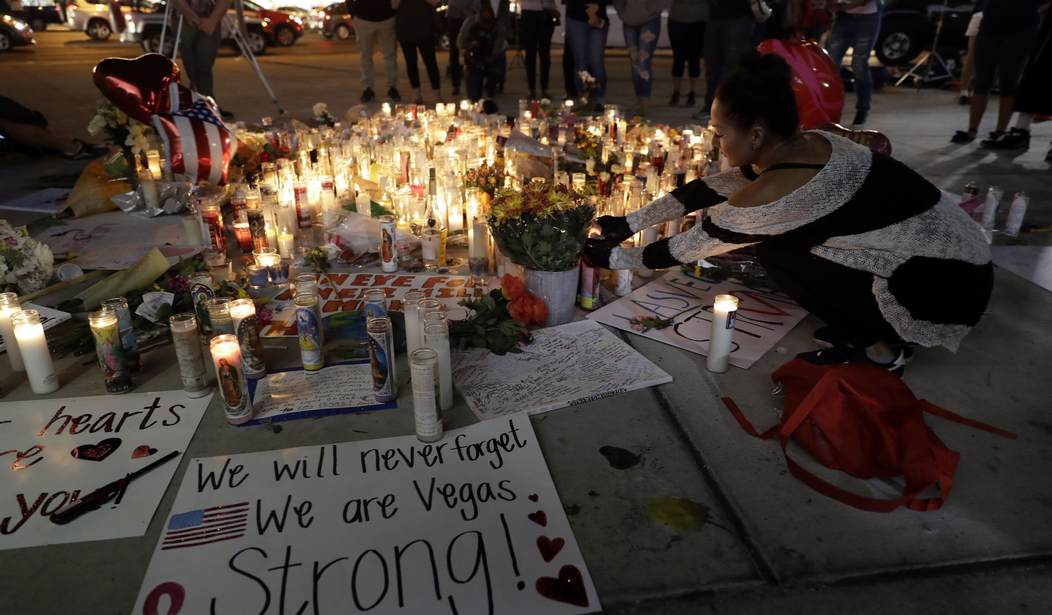
Responding to the recent Las Vegas concert shooting that killed more than 50 people and injured hundreds more, President Trump described the act as one "of pure evil."
One definition of "evil" sounds so inadequate in today's culture: "morally wrong or bad; immoral; wicked: evil deeds, an evil life."
As the Supreme Court wrestled with a 1964 obscenity case, Justice Potter Stewart struggled to define obscenity, and finally settled on his oft-quoted statement, "I know it when I see it." That seems to be the preferred attitude about evil today. Many of us can't fully define it, but we certainly know it when we see it.
On a visit to Las Vegas, I was handed a flyer on the street advertising prostitutes. All I had to do, the flyer said, was call a number. A vehicle would even transport me to the rendezvous point, presumably for an extra charge. Is this objectively evil? Who gets to decide?
On the nightly news and in nearly every Hollywood film, there are graphic scenes showing spattered blood and bodies strewn about. Big-city news broadcasts often lead with the latest shootings and body count. Do such things desensitize us to the value of human life? Where does that value come from? We've come a long way from Hollywood's "Golden Age" and TV's "Leave it to Beaver" and "Uncle Miltie." Has this been progress or regress? Does that regression promote evil, or is much of modern entertainment evil in and of itself? If you are having difficulty deciding, you may have become inured to the shift in morality and fallen victim to the zeitgeist, "the spirit of the age."
Stephen Paddock, 64, of Mesquite, Nevada, identified by police as the Las Vegas shooter, did not look evil. Except for one citation by law enforcement, he was leading a normal life. He had no criminal record. His brother and mother said they were shocked and didn't know what got into him.
Theology and mythology speak of a demonic world beyond our vision and understanding. Cold-blooded killers have been interviewed by psychologists and writers like Truman Capote to determine why they committed their evil acts. Some of these killers came from poverty, but the majority of poor people don't kill. Some of these killers came from abusive homes, but most abused children don't grow up to become mass murderers.
As with previous mass shootings, there will be the predictable calls for "gun control." It is legitimate to ask whether Paddock cleared a background check and bought his guns legally. There is no law, however, that can prevent someone from committing evil acts. If there were, wouldn't we have passed it by now?
Evil co-exists with the good. Each individual must choose which one to embrace or push away. For some, embracing good comes naturally. For others, the pushing away of evil is a lifetime struggle. Perhaps Stephen Paddock embraced evil just this once, or maybe it was waiting to ambush him just as surely as he ambushed those innocent people 32 floors below his hotel window.


Join the Conversation
VIP members get the ability to comment on articles.