





The anti-suffrage movement made many arguments. Women lacked the capacity for reasoned political judgment. Voting would corrupt feminine virtue. The domestic sphere was their proper domain. Some opponents argued that because women didn't bear arms, they had no standing to participate in civic decisions that arms might be required to enforce.
My son graduated from West Point. My brother spent a career in Army Special Forces. My wife raised three boys and worked full time while I built a business, coached youth sports, and helped run an Eagle Scout troop. That's the family credential behind the following. The argument that civic participation requires military service is one I'd debate with anyone who wants to make it. The argument that women lack the capacity for political judgment won't get a rebuttal, because it doesn't deserve one.
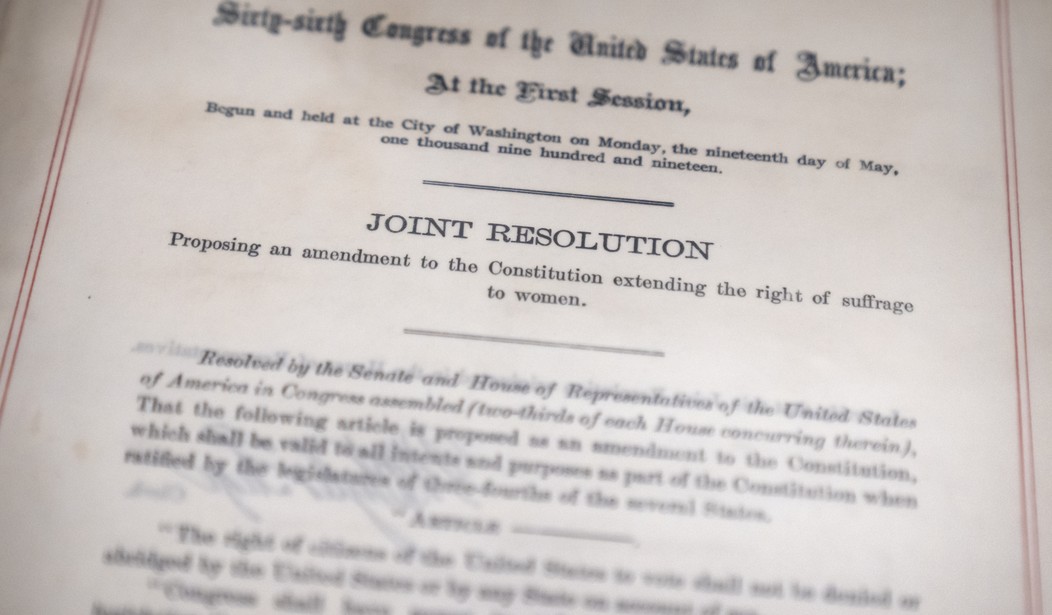
The Nineteenth Amendment was ratified in August 1920, after 72 years of organized suffragist activism that began at Seneca Falls in 1848. The suffragists' argument was simple and correct: in a republic whose founding document declared that governments derive their just powers from the consent of the governed, there was no principled basis for excluding half the population from the act of consenting. The counterarguments were motivated by interest, habit, and condescension dressed as constitutional theory. They lost because they should have lost.
This is where a conservative writer is sometimes tempted to hedge — to acknowledge the suffragists' "good intentions" while noting some abstract constitutional concern, or to pivot quickly to the ERA as the more "interesting" question. I'm not hedging. The suffragists were right. The anti-suffrage movement was wrong. The Nineteenth Amendment corrected a design flaw the Founders built into the republic because they were men of their time, with all the limitations that implies. Article V existed for exactly this kind of correction. It wasn't a concession to progressive pressure. It was the Founders' own mechanism for getting things right when they'd gotten them wrong.
The ratification path wasn't clean. By August 1920, 35 states had ratified. One more was needed. Tennessee called a special legislative session. The state senate approved ratification; in the House, the vote was tied. A 24-year-old Republican named Harry Burn had planned to vote against ratification, consistent with his district's position. On the morning of the vote, he received a letter from his mother, Febb. "Hurrah and vote for suffrage and don't keep them in doubt," she wrote, and added: "Don't forget to be a good boy." He changed his vote. The Nineteenth Amendment was ratified by a margin of one, delivered by a mother's letter to her son.
That story is genuinely moving. It's also a precise illustration of how constitutional change works in this country — not through theory, but through specific people making specific decisions in specific rooms. The suffragist movement had spent 72 years making its case through every channel the republic provided. When the final vote came, it came down to one letter.
The ERA question is where the amendment's legacy meets present-day constitutional argument. The Equal Rights Amendment — which bars denial of rights on account of sex — was proposed by Congress in 1972, ratified by 35 states by 1982, then stalled. Nevada, Illinois, and Virginia ratified between 2017 and 2020, bringing the total to 38. In December 2024, the Archivist of the United States formally declined to certify the amendment, citing Justice Department opinions that the original ratification deadline is legally binding. The Supreme Court has not resolved the question.
The Nineteenth says what it says: the right to vote shall not be denied on account of sex. It doesn't compel a broader theory of sex equality beyond the ballot. Whether the Constitution already prohibits sex discrimination through the Fourteenth Amendment's equal protection clause is a question the Court has partly answered and partly avoided. The Court has applied heightened scrutiny to sex-based classifications since Craig v. Boren (1976) but has never held sex a suspect classification requiring strict scrutiny the way race does. The suffragists' argument was about political participation, not comprehensive social equality — and treating the amendment as a vehicle for claims its ratifiers didn't make is the same interpretive move conservatives rightly criticize when progressives do it elsewhere.
The Nineteenth extended the fundamental act of self-governance to half the population excluded from it; on the correct theory that exclusion was indefensible. The argument for suffrage was right in 1848 when Elizabeth Cady Stanton made it, right in 1919 when Congress proposed the amendment, and right when Harry Burn's mother put it in a letter and changed American history.
A conservative who can't say that clearly has a problem with intellectual honesty, not with the Constitution.
Jay Rogers is a financial professional with more than 30 years of experience in private equity, private credit, hedge funds, and wealth management. He has a BS from Northeastern University and has completed postgraduate studies at UCLA, UPENN, and Harvard. He writes about issues in finance, constitutional law, national security, human nature, and public policy.
Editor's Note: Do you enjoy Townhall's conservative reporting that takes on the radical Left and woke media? Support our work so that we can continue to bring you the truth.
Join Townhall VIP and use promo code FIGHT to receive 60% off your membership.



Join the Conversation
VIP members get the ability to comment on articles.