





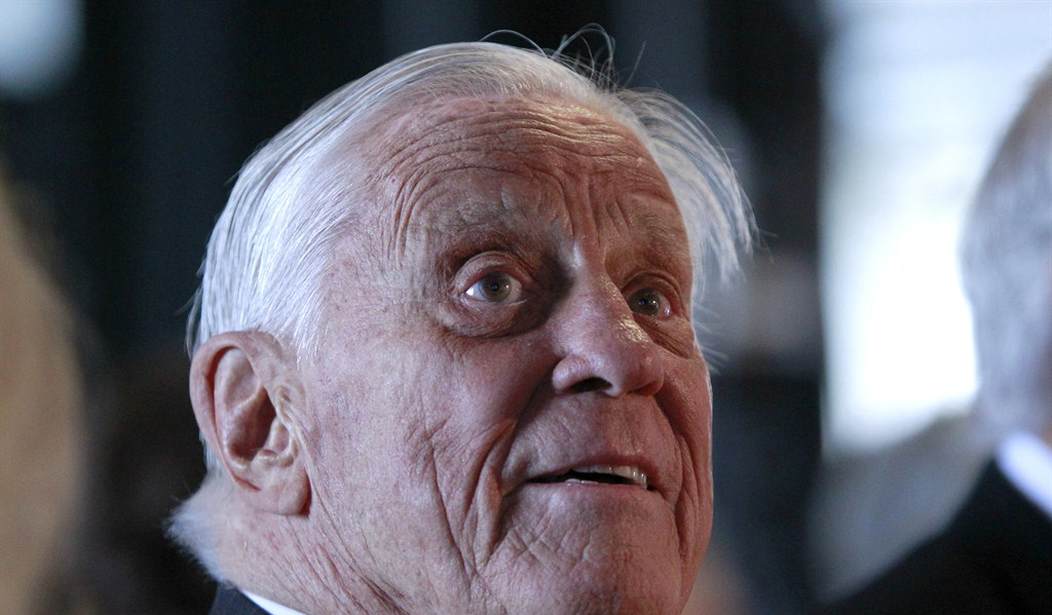
Ben Bradlee, the legendary Washington Post editor who died recently, has been widely praised for his work building up The Washington Post and bringing down Richard Nixon. His guidance of the paper's Watergate coverage thrilled a generation, and maybe two generations, of aspiring journalists.
But the many extravagant tributes to Bradlee have paid less attention to his relationship with an earlier president, John F. Kennedy. It's not that their friendship was a secret; indeed, Bradlee wrote a book about it. It's just an embarrassment, and when it came time to evaluate Bradlee's life, the sycophancy of his association with JFK did not fit the image, carefully tended by colleagues and friends, of the journalist as a courageous puncturer of inflated reputations.
Bradlee's book, "Conversations With Kennedy," told the story of his, and his wife Tony's, friendship with John and Jacqueline Kennedy from its beginning in 1958 until the JFK assassination in 1963.
For much of the book, Bradlee seemed impossibly star-struck. For example, Bradlee described flying with the Kennedys to Hyannis Port in 1959, arriving well after midnight. JFK headed to the refrigerator and hauled out a huge container of clam chowder. "We watched in fascination as he gulped down four large bowls, one after the other," Bradlee wrote. "In anyone else it would have been gluttonous."
On the night of the 1960 West Virginia primary, the Bradlees went to a movie with the Kennedys, then took a bottle of champagne to JFK's Georgetown home for a private celebration. (Bradlee was covering the race for Newsweek.) When word came of Kennedy's victory, "modest war whoops were let fly," the champagne was popped, and Kennedy asked if the Bradlees would like to join him on his private plane to West Virginia. "Would we ever!" Bradlee wrote.
Bradlee didn't tiptoe up to the line of journalistic propriety in his relationship with Kennedy; he stomped all over it. Not content to write glowing accounts of Kennedy's campaign, Bradlee also gave JFK private intel on the opposition. In May 1959, after covering a speech by Democratic rival Lyndon Johnson, Bradlee wrote a confidential strategy memo to Kennedy assessing Johnson's performance and offering advice on convention plans.
That episode isn't in "Conversations With Kennedy." It is, rather, in a 2012 biography of Bradlee by Jeff Himmelman, who noted that Bradlee "never mention(ed) having written this memo in any of his books or interviews." Himmelman found it at the Kennedy Library.
Bradlee stayed close to Kennedy as the new president took office. There were fun dinners, frequent phone calls, trips to the country. White House dances were "dazzling," Bradlee wrote: "The crowd is always young. The women are always gorgeous, and you have to pinch yourself to realize that you are in the Green Room of the White House."
Things were going great until August 1962, when Look magazine published an article with the headline "Kennedy vs. The Press: Never have so few bawled out so many so often for so little, as the Kennedys battle reporters." The piece quoted Bradlee saying, "It's almost impossible to write a story they like. Even if a story is quite favorable to their side, they'll find one paragraph to quibble with."
Big mistake. Kennedy immediately froze Bradlee out; no more fun dinners. Bradlee was wounded, writing that he went "from regular contact -- dinner at the White House once and sometimes twice a week, and telephone calls as needed in either direction -- to no contact."
Exile forced Bradlee to examine his relationship with the president. "What, in fact, was I?" he asked. "A friend, or a journalist? I wanted to be both." Eventually Bradlee behaved himself, served his time in Siberia, and was let back into JFK's good graces, without ever fully answering the question.
As a journalist, Bradlee's friendship with Kennedy brought him prestige and the envy of competitors, but nothing really worth compromising his integrity. "Kennedy never gave Ben big scoops, particularly during the (1960) campaign" wrote Himmelman, "but he handed out tidbits."
"Conversations With Kennedy," which Bradlee wrote at the height of Watergate, got some rough reviews when it came out in 1975. (And the reviewers didn't have some of the stuff Himmelman found later, which made Bradlee look even worse.) Maybe the toughest notice came from Jacqueline Kennedy, who, according to Himmelman, said to Bradlee about his writing on JFK: "It tells more about you than it does about him."
Bradlee's admirers revere him as a man not afraid to stand up to power. But that depended on who was in power; his is a mixed legacy.
After Bradlee's death, a number of remembrances noted the many journalists who wanted more than anything to be like Ben. Conversations with Kennedy is an extended lesson on why they shouldn't.


Join the Conversation
VIP members get the ability to comment on articles.