





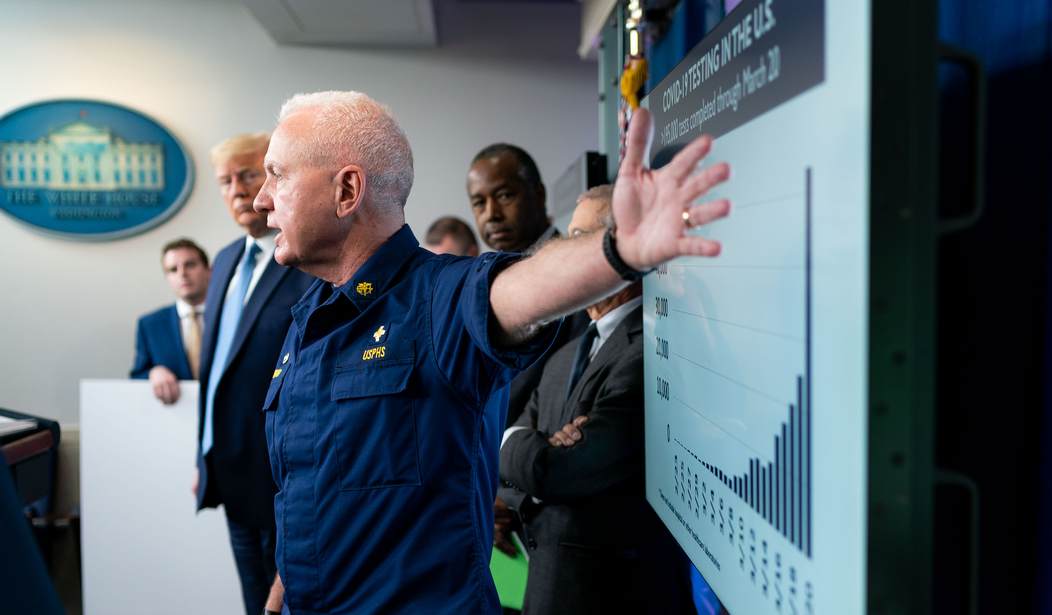
President Donald Trump is extending the nation's shutdown at least until the end of April. He's largely basing his decision on predictions from the University of Washington that even if the nation sticks to the shutdown, 83,967 Americans will die of coronavirus by early August, including 15,788 in New York state.
Deaths will likely soar over the next two weeks, with the daily toll peaking April 15, and then dropping off sharply by June. The graph of the coming death toll looks like a steep mountain peak we are just about to ascend. And that's with the shutdown continuing.
You can go here to see some of the same predictions the president is watching: covid19.healthdata.org/projections. They're adjusted every Monday based on news from foreign countries, public health officials and hospitals across the U.S. Admittedly, working off of projections involves guesswork, but it beats flying blind.
From the start, UW scientists predicted New York would be hit earliest and hardest. Governor Andrew Cuomo said on Monday, "I want to prepare for that apex." That's expected on April 9, when 73,620 hospital beds will likely be needed for coronavirus patients, and on April 10, when deaths per day are expected to max out in New York state.
The UW experts predict New York will need 9,055 ventilators. Cuomo is predicting 30,000. No problem. It's the governor's job to plan for the worst-case scenario and to stockpile for the possible return of the virus in the fall. And it's the president's job to allocate the ventilators to every state based on need. The rest is political brouhaha.
Despite speculation that warm temperatures tame the virus, Florida is predicted to be among the hardest hit, with 5,568 deaths by August. Still, that's far less than half New York's toll, though Florida is a more populous state. One reason is that Florida has enough hospital beds. When health systems are overloaded, patients have a lower chance of surviving. In Italy, more than 10% of coronavirus patients are dying. The hospital system simply can't handle them.
Survival is the issue, but here in the U.S. lives are also being threatened by layoffs and business failures, which will inevitably lead to suicides, drug overdoses and heart attacks. Many are asking why we should shut down the nation for this virus when the seasonal flu kills 60,000 Americans in a bad year. The country doesn't shut down for that.
Keep this in mind. The coronavirus is forecast to kill 80,000 Americans even with the draconian shutdown. Without it, the death toll, say some experts, could be as many as 2 million.
In part, that speculative forecast is based on the belief that coronavirus is estimated at 10 times the seasonal flu, But we don't know that for sure, because so little testing has been done. The death rate is a fraction. We know who's died -- the numerator. We don't know who has caught the virus and survived -- the denominator.
Regardless, the major reason coronavirus is more deadly is that it is overwhelming an unprepared health care system. The flu season spans almost half the year. This coronavirus is attacking in a compressed time frame, necessitating a huge supply of ventilators, masks, beds and other supplies.
Coronavirus also strains the health care system more by putting people in the hospital and on ventilators for weeks, while hospital patients with seasonal flu stay only a couple of days. The shutdown is designed to "flatten the curve," meaning slow the spread enough to allow our shamefully understocked health care systems to function.
Shamefully is the right word. For the past 20 years, through Democratic and Republican presidencies, health officials were warned about the lack of emergency medical supplies, including masks and ventilators. Ten federal reports sounded that alarm, even as the nation witnessed one pandemic after another circle the globe: SARS, MERS, avian flu, swine flu. Federal health bureaucrats dithered despite the warnings. They kept the Strategic National Stockpile budget to about $595 million, even as they spent nearly 10 times that on medical aid to Africa during the Ebola crisis.
In short, federal health officials got caught with their pants down. It's our unpreparedness, more than the virus itself, that has necessitated the shutdown.
This preparedness lesson will be key to conquering the next pandemic, or the return of coronavirus in the fall, a possibility. Thanks to American ingenuity and impressive wartime mobilization of the private sector, we will likely have drugs to treat the victims and a vaccine near completion. Most important, we'll have a supply chain of lifesaving medical equipment within reach.
Betsy McCaughey is chairman of the Committee to Reduce Infection Deaths and a former lieutenant governor of New York. Contact her at betsy@betsymccaughey.com.


Join the Conversation
VIP members get the ability to comment on articles.