





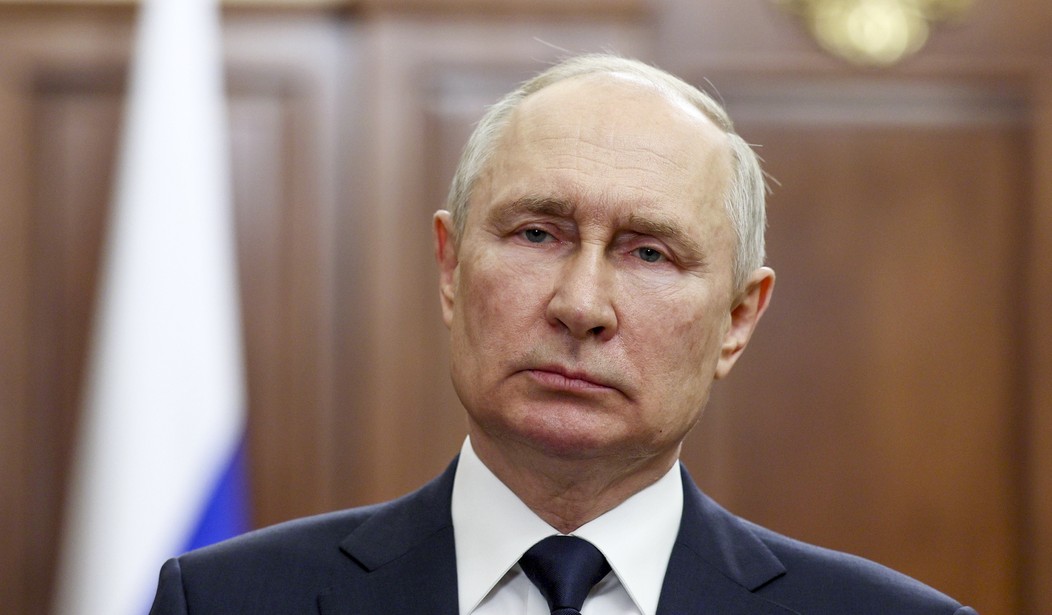
This week, Vladimir Putin finally -- allegedly -- murdered his chief political rival and critic Alexei Navalny. Navalny's death followed an attempt by Putin's operatives in 2020 to kill him by poisoning; Navalny survived the attempt, worked with online specialists to unmask the actual agents responsible for the poisoning and then returned to Russia, where he was promptly arrested on trumped-up charges and sent to a Gulag in the far north.
Now, Navalny is dead.
And Putin isn't stopping there. This week, the Russian government announced an arrest warrant for Navalny's brother, Oleg, on unspecified charges; Putin's agents likely murdered a Russia defector to the Ukrainian side, who was found riddled with bullets in Spain; Putin's government arrested a Russian-American dual citizen on treason charges for giving some $50 to a group called Razom for Ukraine, which sends medical and hospital equipment to the beleaguered country.
Meanwhile, Putin is stepping up his international outreach efforts. This week, Putin invited the terror group Hamas to Moscow to talk, along with fellow terrorist leaders from Islamic Jihad and the Palestinian Authority. He also received plaudits from far-left corrupt Brazilian president Lula Da Silva, who refused to condemn Russia for Navalny's death but found time to accuse Israel of perpetrating a new Holocaust in the Gaza Strip. And, of course, last week he hosted Tucker Carlson for an interview, in which he laid out his historic grievances against NATO and Ukraine; Carlson then followed suit by issuing a series of videos praising Russian metro stations and supermarkets, claiming that Russian food prices should "radicalize" Americans into despising their leaders.
Putin feels unbound.
And he should.
Joe Biden is a weak leader with no centralizing principles. He has slow-walked aid to Ukraine since the beginning of the war; he has insisted on continued funding for the war while refusing to articulate what an end to the war would look like; he has refused to even justify the war to Americans beyond simply repeating the word "democracy" over and over -- empty rhetoric that no longer tugs at the heartstrings in a complex world where the U.S. has non-democratic allies of its own. Biden refuses to take serious action on the southern border in order to achieve the Ukraine aid package he insists he desires; he even refuses to negotiate with the speaker of the House, Mike Johnson, on the issue. He seems to prefer tearing into Republicans for their insufficient zeal in funding Ukraine. All of this focus on Republicans allows Biden to elide the split in his own party -- a split between Wilsonian interventionists and Noam Chomsky anti-Americans, who believe the United States to be a malevolent force in the world.
Meanwhile, Republicans are split, too. There are essentially four camps into which the Republican Party has split: neo-conservative interventionists, a remaining rump from the Bush years, who have historically supported nation-building efforts in far-flung regions with the goal of cultivating democratic allies even in inhospitable places; realpolitik devotees, who seek to assess each foreign conflict and all foreign aid with an eye toward hard American interests, ranging from the economic to the military; isolationists, who oppose all American interventions, both economic and military, on principle, believing that foreign policy generally represents a betrayal of priorities closer to home; and anti-Americans, who meet with the Chomsky-ite left in a perfect example of horseshoe theory made real.
Putin sees all of these splits. He sees the fact that Americans are distracted by domestic concerns, pried apart by competing narratives of the country, at each others' throats over everything from the definition of sex to the role of the government in everyday life -- and split even on the question of whether America is a force for good or ill in the world.
Vladimir Lenin once supposedly said, "Probe with bayonets. If you find mush, you push. If you find steel, you withdraw."
Putin is probing. And he's finding nothing but mush.

Join the Conversation
VIP members get the ability to comment on articles.