





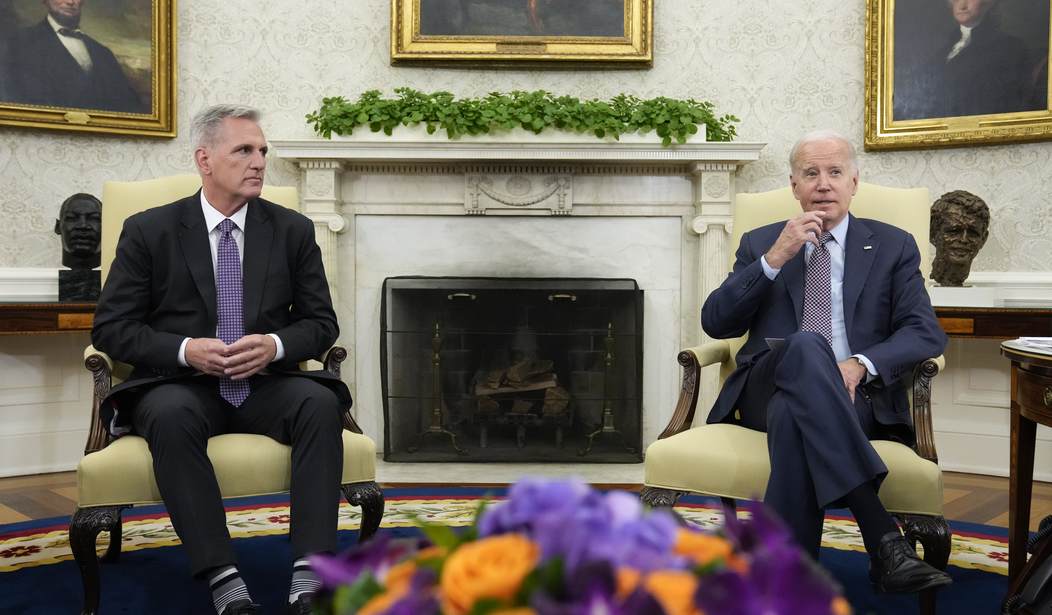
This week, Speaker of the House Kevin McCarthy, R-Calif., and President Joe Biden cut a deal to raise the debt limit. The breakthrough came after three months of Biden pledging not to even negotiate over the debt limit. Instead, Biden was forced to concede to a 1% cap on increases for non-military spending, a cutback on IRS funding, a clawback of some unspent COVID-19 allocations, and addition of work requirements for some federal aid. The compromise deal was indeed far less than House Republicans had demanded, as Rep. Nancy Mace, R-S.C., tweeted, "After factoring in a small cut to discretionary spending over the next 2 yrs, we are still talking about ~$6T more or less in spending bc of large increases in spending elsewhere. ... Govt grew massively over the past 3 years. This growth was supposed to be emergency funding only during COVID. During this time, govt grew 40% or by $2 trillion from 2019 to 2023. We went from spending just over $4T to spending just over $6T."
Every word of that critique is true. Compared to conservative ideals, the compromise bill is indeed a flaming bag of fiscal manure. But conservative ideals weren't on the table. Biden is the president. Sen. Chuck Schumer, D-N.Y. -- thanks in large part to the tender 2020 ministrations of President Donald Trump in the Georgia Senate runoffs and his further interference in the 2022 Senate races in Georgia, Arizona, New Hampshire and Pennsylvania -- is still the Senate majority leader. This means that Republicans were never going to get a big win on budgetary matters.
For that matter, Republicans couldn't even get a big win on budgetary matters from 2016 to 2018, when they controlled both houses of Congress and Trump was actually president. In fact, Trump campaigned in 2016 against changes to entitlement programs, which represent the biggest driver of our national spending addiction -- some 62% of federal spending annually. Combine that spending with 10% of our spending on net interest and another 13% or so on defense spending, and the discretionary outlays at issue represent under $1 trillion. That's a lot of money, to be sure, but making serious cuts to that number would still put our budget in the $5 trillion range.
The reality is that our budgetary debates are generally about shifting deck chairs on the fiscal Titanic. By 2053, we will be dedicating in excess of 21% of our national budget to debt service alone. Mandatory spending will constitute 58% of our spending. We aren't going to cut our way out of this problem by targeting discretionary spending in the main.
But nobody will touch the real drivers of our budgetary bloat and economic stagnation -- Social Security, Medicare and Medicaid. To do so would risk the wrath of entrenched interests in the United States. So instead, we'll simply increase the size and scope of federal spending, placing an unsustainable burden on our economy and then eventually mandating vastly increased taxes or serious austerity measures. There is no third path forward.
Our politicians know this. But they're in the business of kicking cans down the road while posturing over the placement of the deck chairs. The iceberg looms, but their reelection efforts rely almost completely on ignoring its presence as we bear down, full speed, on our fiscal doom.


Join the Conversation
VIP members get the ability to comment on articles.