





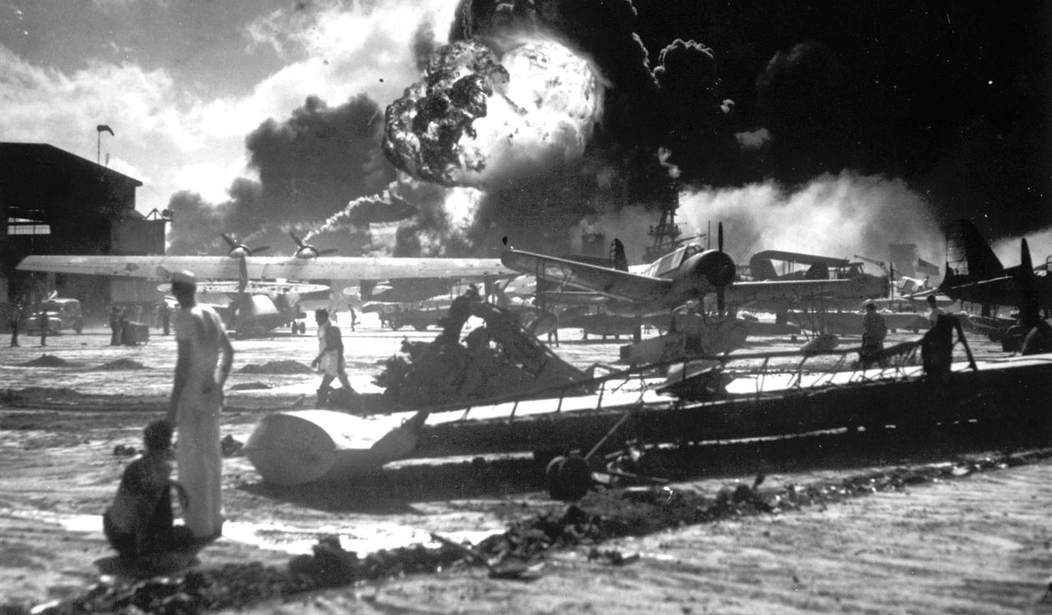
December 7, 1941. "A date which will live in infamy," President Franklin D. Roosevelt called it. The attack's 80th anniversary is this month.
Infamy. Webster's Dictionary defines infamy as: "evil reputation brought about by something grossly criminal, shocking, or brutal."
From the U.S. perspective, the Japanese 1941 sneak attack on Pearl Harbor definitely fits that definition.
The Japanese elites -- other than Adm. Isoruku Yamamoto -- thought the sneak attack would do two things. The semi-sane bean counters thought it would destroy America's Pacific Ocean fleet and make retribution (counterattack on Japan) impossible, or at least improbable.
The total whack-job, imperial-emperor virtue-signaling Tokyo elites thought the attack would utterly frighten feckless, libertine, paper-tiger American cowards into retreating from Asia and submitting to Japanese racialist-globalist superiority.
Back to Pearl. The brainy Yamamoto, who designed the tactical success at Pearl Harbor? The gifted strategist in him may not have said "don't awaken the sleeping giant" -- giant meaning the U.S. That quote may have been apocryphal, but the next one isn't. After a Pearl Harbor-type attack Yamamoto said, "I can run wild for six months ... after that, I have no expectation of success."
That's prescient fact. The Battle of Midway occurred six months after the Pearl Harbor debacle. Four Japanese carriers went to the bottom, and with their demise went Japan's offensive capacity.
"Offensive capacity" in WWII Pentagonese means being able to put Zeros over L.A. or Portland.
However, Pearl Harbor was more of a culmination than a surprise.
In the late summer of 1945, historians Samuel Eliot Morison and Henry Steele Commager reflected on the WWII's origins. In a short article published in November 1945, they wrote, "The explanation (for WWII) was to be found in the breakdown in the system of collective security and the growth of international anarchy, moral and political, in the post-war years." Post-war meant post-WWI, the war to end all wars.
Collective insecurity sounds so academic, and so I'll translate: The more sober and more good failed to stand up to the fanatics.
Did Pearl Harbor start WWII? No. Let's go to Mukden (Shenyang), China, Sept. 19, 1931, when Japanese soldiers attacked the Chinese Mukden garrison and invaded Manchuria.
There's a very good case Mukden is the surprise attack that started WWII.
The Mukden attack was what current observers call "an emerging threat." Emerging? It was a threat that Washington could ignore. So was the Nanking Massacre, commonly called the Rape of Nanking, an imperial Japanese mass atrocity committed against the Chinese in 1937.
Dead history? No, instructive history. In 2021 America and its allies -- including a democratic Japan -- face emerging threats that are, frankly, deadly threats thrust in our collective face.
In November communist China fired what the Pentagon calls a "fractional orbital bombardment system" (FOBS) carrying a hypersonic glide vehicle. Translation: Beijing can hit Los Angeles and Honolulu fast and from all directions.
More threats from Beijing: According to AFP, in November communist Chinese warplanes made 159 incursions into Taiwan's air defense zone. The French news agency called that the second-highest month on record.
Self-ruled, democratic Taiwan lives under the constant threat of invasion by China's communist dictatorship. Is an actual attack a surprise?
Let's move to Eastern Europe. In 2014 Russia invaded Ukraine's Crimean Peninsula and annexed it. Bottom line: Military aggression in Europe by a major European power led to political annexation and territorial expansion.
Russia's Crimean adventurism created several 21st century peace-killing facts. Russia violated a multilateral diplomatic agreement, the Budapest Memorandum of 1994.The agreement guaranteed Ukraine's territorial integrity in exchange for Ukraine's denuclearization.
Got that? Give us your nukes, Moscow said, and we give you peace.
Except -- Russia lied.
Now Russia, still led by Vladimir Putin, threatens Ukraine with another fatal invasion. On Nov. 30 NATO Secretary General Jens Stoltenberg warned that NATO must be ready for a Russian invasion of Ukraine. More than 90,000 Russian troops are poised in western Russia.
Talking heads can debate "whether the likelihood for an incursion is 20% or 80% ... We need to be prepared for the worst," Stoltenberg told reporters."

Join the Conversation
VIP members get the ability to comment on articles.