


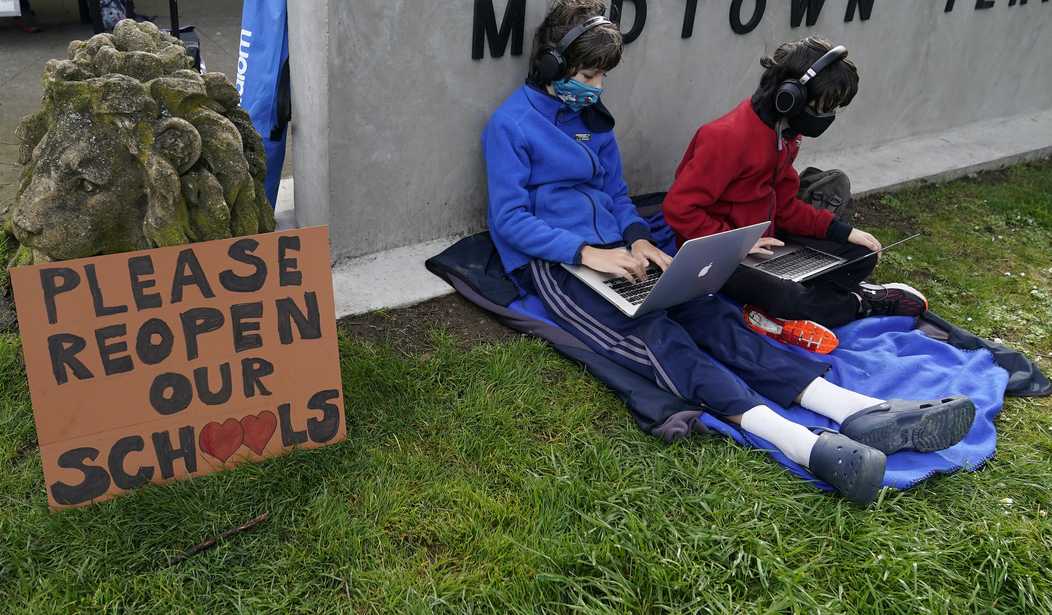
American schoolchildren suffered irreparable harm during the U.S.'s pandemic response—socially, emotionally, and of course, academically.
School closures and remote learning took a major toll on reading and math scores, which dropped to their lowest levels in decades.
According to the National Assessment of Educational Progress, math and reading scores among 9-year-olds fell across all race and income levels, though they were significantly worse among low-ranking students. Those in the 90th percentile showed a 3 percent drop in math scores, while students in the 10th percentile fell 12 points, The New York Times reports.
Reading scores also fell by the biggest margin in over 30 years.
“I was taken aback by the scope and the magnitude of the decline,” said Peggy G. Carr, commissioner of the National Center for Education Statistics, the federal agency that administered the exam earlier this year. The tests were given to a national sample of 14,800 9-year-olds and were compared with the results of tests taken by the same age group in early 2020, just before the pandemic took hold in the United States. […]
The declines in test scores mean that while many 9-year-olds can demonstrate partial understanding of what they are reading, fewer can infer a character’s feelings from what they have read. In math, students may know simple arithmetic facts, but fewer can add fractions with common denominators.
The setbacks could have powerful consequences for a generation of children who must move beyond basics in elementary school to thrive later on.
“Student test scores, even starting in first, second and third grade, are really quite predictive of their success later in school, and their educational trajectories overall,” said Susanna Loeb, the director of the Annenberg Institute at Brown University, which focuses on education inequality. (NYT)
Recommended
The only way experts believe students can make up for learning loss is through tutoring, summer school, or extended school days, which is easier said than done.
Conservatives responded to the news by arguing there must be accountability for what teachers unions and politicians did to schoolchildren during the pandemic.
Meanwhile, we are hearing zero remorse and zero accountability from the people in the science and education establishments who insisted on keeping schools closed.
— Ed Morrissey (@EdMorrissey) September 1, 2022
Florida voters will get first crack at delivering the latter, thanks to Charlie Crist's political instincts. https://t.co/MHfMoFMQIf
This should be the midterm message. "Don't forget how mad this made you. This is what they did."
— Stephen L. Miller (@redsteeze) September 1, 2022
Not hard stuff.
But others corrected the Times to note that it wasn't the pandemic that did this, but the U.S.'s response to it, which was cheered on by liberal media outlets like The New York Times.
This isn’t the pandemic. This is how we responded to it. You were cheering it on.
— Bethany S. Mandel (@bethanyshondark) September 1, 2022
It’s on you and we won’t forget it. pic.twitter.com/pC7ra47R0w
— Bethany S. Mandel (@bethanyshondark) September 1, 2022









Join the conversation as a VIP Member