





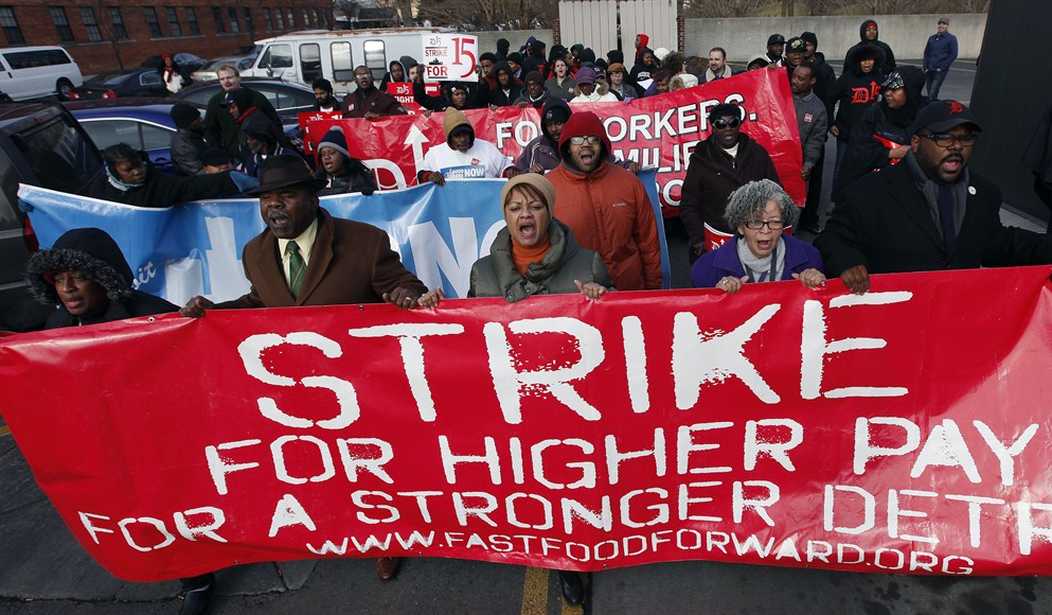
If you offer people something that is too good to be true, you will always find takers. Ask Bernie Madoff. Or ask Barack Obama. He recently proposed an increase in the minimum wage -- an idea that suits the natural predilections of many people enough to distract them from the unsentimental and unwelcome logic of economics.
One poll found that 63 percent of Americans favor raising the federal floor from the current $7.25 to $10.10, as the president recommends doing over two years. The reasons are obvious. Wages have stagnated, low-income Americans are getting a smaller share of national income and many working people are stuck in poverty despite their best efforts. A higher minimum wage is the obvious solution.
Obvious, but wrong. The proposal rests on the assumption that the government can decree the price of a commodity -- in this case, labor -- in defiance of the dictates of the market, without ill effects. But that view requires a heroic suspension of disbelief.
When stores want to move slow-selling merchandise, they cut prices. When customers clamor for more of an item than sellers can provide, they raise prices. Lower prices result in higher demand, and higher prices do the opposite.
This is not exotic free-market dogma but elementary economics. Any CEO who proposed to boost sales by jacking up prices would see the company's stock price plummet in response to this lunacy.
But supporters of a higher minimum wage would have us believe that low-wage workers are magically exempt from these phenomena. They claim companies will employ just as many employees at $10.10 an hour as they do at $7.25.
But they must doubt their own case. Otherwise, they would propose an even higher amount, confident it will be irrelevant to hiring decisions. If a minimum wage of $20 or $30 an hour would cause layoffs, though, why wouldn't $10.10? At what point on the wage scale does the law of supply and demand take effect?
Recommended
Even liberal hero Paul Krugman, a Nobel laureate in economics and columnist for The New York Times, has grudgingly acknowledged this reality. In his 1998 textbook, he wrote that "the centrist view is probably that minimum wages 'do,' in fact, reduce employment, but that the effects are small."
In the short run, McDonald's and KFC might have little choice but to keep staffing at current levels and cough up more on payday. But in the long run, employers would have a significant incentive to find ways to employ fewer workers -- by automating tasks, moving to more self-service, demanding more of each employee, cutting back store hours or closing marginal outlets.
Among liberals who have reservations about free trade, the usual complaint is that U.S. companies will migrate to Mexico or Colombia to obtain cheap foreign labor. But if one company will pack up its assembly lines and move them thousands of miles to alien lands to reduce wage costs, why wouldn't another company redesign its operations here to do the same? Why would it passively accept a hit to its bottom line?
It's been argued that restaurants are likely to absorb the increase because they can't move abroad. True enough. But shutting down is always an option. A lot of fast-food outlets are only modestly profitable anyway. Burger King, Wendy's, KFC and Arby's closed more restaurants than they opened last year. Higher labor costs will mean even more vacant buildings -- and fewer jobs.
It's true that the smaller the legislated increase the less the effect on hiring and firing. But less effect is not the same as zero effect. A small minimum wage boost would not cause a big increase in unemployment, but only because it would not produce a big increase in the earnings of the affected workers.
The plausible argument for the change is that the benefit to these workers is large enough to outweigh the effects on the newly unemployed. But even that claim is tenuous. A study by economists Joseph Sabia of American University and Richard Burkhauser of Cornell found that "minimum wage increases between 2003 and 2007 had no effect on state poverty rates."
In the picture painted by Obama and congressional Democrats, raising the minimum wage is an unmixed blessing, helping some people while harming no one. If you believe that, the next Bernie Madoff is out there, and with any luck he'll find you.






Join the conversation as a VIP Member