




While we all speculate on how long she might live, let’s speculate a little.
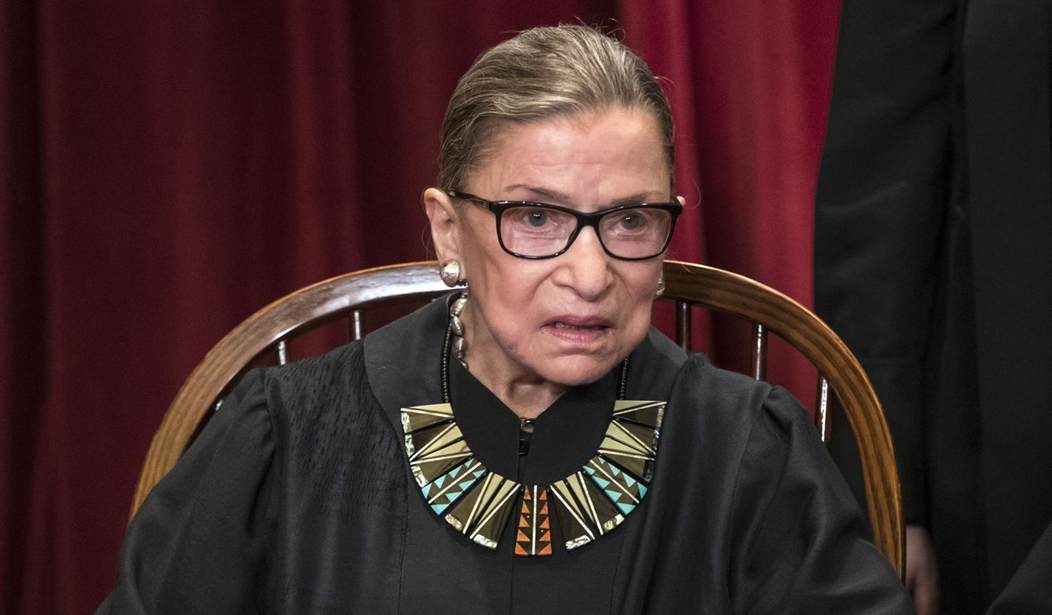
Some on the Left barely conceal their disdain for the world-changing handiwork of dead white males. Reverence for the Constitution isn’t universal even among its chief custodians. Justice Ruth Bader Ginsburg raised eyebrows when she advised Egyptian civic activists she wouldn’t look to the US Constitution as a model today. She pointed instead to the constitutions of South Africa, Canada, and the European Charter of Rights and Freedoms, praising them as “great work,” more recent and more generous in protecting “human rights.” The late Justice Thurgood Marshall also was cautious about putting too much stock in Constitutional guidance, asking a PBS interviewer: “What does the Constitution say about rocket ships?”
Actually, the Constitution says as much about rockets as it does about horses and buggies: basically nothing. The Constitution is not the US Code of Statutes, setting out the federal law. It’s more like the rule book or citizens’ owners’ manual that governs the government. It’s a uniquely successful compact in history. But it remains vital only as Americans understand it, support it, and demand politicians do likewise.
Citizens who accuse President Obama of violating the Constitution should have a clear idea what they mean. This would include being able to explain to a friend or child basic constitutional principles and describe the ways they are threatened. Here’s my attempt at a simple, easy to share explanation:
Life is hard and sometimes dangerous. Government can help protect peace and security, but it’s important to think seriously about what government should be and do, as our Framers had to when they organized America.
The big thing they realized is government is unique. Some things need governing, but others just involve voluntary cooperation. Lots of people or groups--like street preachers, hotdog vendors, corporations, your mother—have things they want you to do: repent, buy stuff, call home. But government decides things you have to do or can’t do, at the risk of fines, jail, or, at some level of resistance, getting shot.
Recommended
Government’s essence is controlling people—forbidding things, requiring things, and extracting the taxes to pay for things. Our Founders realized the power to control people, as opposed to offer or invite in voluntary exchanges is potentially dangerous. It must be limited and channeled, as in the apocryphal wisdom of George Washington: like fire, government is a dangerous servant and fearsome master.
The Founders figured out controlling people involves three different kinds of power: making rules, enforcing rules, and resolving disputes between people and between the enforcers and the people. They also realized the controllers could be kept honest and fair only if those different powers were kept apart: the people who make the rules shouldn’t be the ones who enforce them; the enforcers shouldn’t decide disputes between themselves and the people.
That’s why the Founders arranged separation of powers. They created Congress in Article I, the Executive in Article II, and the Supreme Court and judiciary in Article III.
Our Founders also realized the young nation sat at the edge of a continent it might grow to fill. Even the 13 colonies had a diverse mix of heritage, religion, resources, climate, industry, and so forth. They determined people should govern themselves as locally as possible. Daily government was left with the states. The national government would be limited to matters that truly needed to be nationally uniform. It was delegated only enumerated powers.
The Founders crowned their structure with a Bill of Rights, identifying some, but not all, of the sacred liberties and protections needed for the free pursuit of happiness. The finished work was an intellectual revolution more spectacular than the military revolution that made it possible. The path has not always been smooth or safe. But most people agree, it’s the most successful system of governing ever designed.
Some clever and sophisticated people today say the Constitution is outdated. It was designed for a small, simple society. Our modern world needs something more complex. This claim is curious, both as a matter of observable history and of theory.
If you hear such criticism, you might challenge it. Historically, ask if any other national system has lasted longer, or produced better fruits, including freedom, due process, stable government, opportunity, prosperity, and a magnetic draw to people around the world.
On theory, ask what has changed in the world or human nature that suggests government’s controlling powers shouldn’t be limited. Or why it makes sense to mix the powers to legislate, enforce, and judge. Ask too, if rigid, centralized government across diverse states and communities, geography, cultures, and economies makes any more sense than before.
The critics likely will talk about how things should be different; but they won’t show that anything has ever worked better than the United States Constitution. But the Transformer and his supporters find it very inconvenient. And for some, that’s all that matters.







Join the conversation as a VIP Member