





Human beings are hard-wired to protect young children. That's the easiest explanation of the rush of Europeans -- especially, but not only, elites -- to welcome huge numbers of refugees after publication of the picture of a dead three-year-old boy on a Turkish beach.
In response, Chancellor Angela Merkel said Germany would take in 800,000 as refugees. That's 1 percent of Germany's population. The proportionate equivalent in the United States would be 3 million -- three times the level of legal immigration.
But within days Germany was barring migrants at the Austrian border, and Hungary finished a 12-foot fence blocking migrants from Syria. Slovakia and the Netherlands imposed border controls. Sympathy turned to caution and fear.
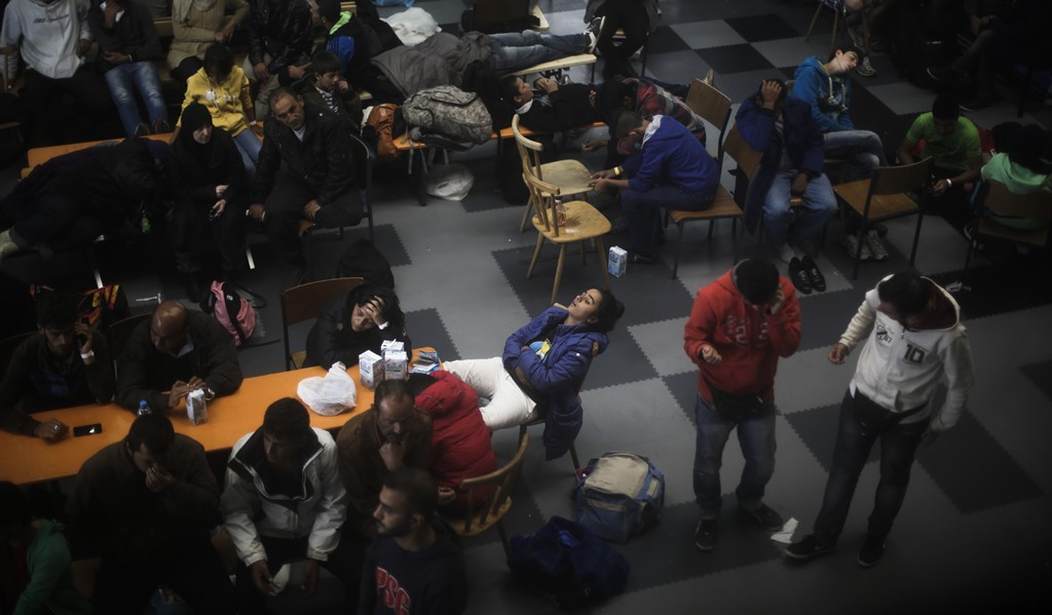
The reason is obvious: Europe faces a flood of migrants far beyond its capacity to absorb. Some 4 million people have fled Syria's civil war and 10 million have been displaced. Thousands have been ferried across the Mediterranean and Aegean seas by smugglers. Hundreds have died in transit.
Most of the would-be migrants are young men, seeking economic gain rather than political refuge. Most are Muslim, with far different cultural attitudes than Europeans. Some -- no one knows how many -- are undoubtedly terrorists or susceptible to terrorism.
Some Europeans congratulated themselves on their open-handed approach. Some Americans reacted similarly, remembering the words of Emma Lazarus inscribed on the base of the Statue of Liberty: "Give me your tired, your poor, your huddled masses yearning to breathe free, the wretched refuse of your teeming shore."
But that's a misleading comparison. The very poorest seldom migrate, because they can't afford it or, as in Syria today, can't get away. And the huge flow of immigration to America from the opening of Ellis Island in 1892 to World War I -- triple, as a percentage of population, the 1982-2007 surge -- was not of the poor with economic motives.
Most Ellis Island-era immigrants came from the multiethnic Russian, Austro-Hungarian and German empires, where they were second-class citizens -- Jews, Poles, Czechs, Slovaks, Slovenes, Serbs, Croats -- in an age of surging nationalism.
America's tradition of civic equality beckoned. Here, they believed, they would be equals with everyone else. They came not to oppose American culture but to partake of it. American elites from Theodore Roosevelt to Henry Ford endorsed this idea of common citizenship and pushed successfully for assimilation in schools and workplaces.
American elites today are less certain of the worthiness of our national culture and have retarded assimilation of immigrants. European elites are worse, laden with guilt of past sins exaggerated (imperialism) and all too real (Nazism). Germans in particular understand that their history imposes special burdens on them, and have tried to shoulder them honorably.
That helps explain Merkel's promise to accept 800,000 migrants. Unhappily, it doesn't make it practical. Successful countries have advanced not because they have fertile farmland or natural resources -- some, such as Switzerland and Singapore, have neither -- but because of the strengths of their national cultures. It's sensible for them therefore to fashion their immigration policies to build on those strengths.
The United States has fallen short of this with immigration laws that have favored low-skill immigrants rather than the high-skill people the nation always needs, and by incompetent enforcement of those laws. Europe has fallen farther short by encouraging, through "multiculturalism," separate enclaves controlled by Muslim and other immigrants who oppose national norms of tolerance and order.
And both the U.S. and Europe have allowed uprisings and civil wars in Syria and Libya to go on, generating hundreds of thousands of refugees and opening the flow of migrants across the Mediterranean. America and Europe may be uninterested in foreign disorders, but foreign disorders are interested in us.
It's not surprising that Eastern European nations, with their experience of culture-crushing Communism, resist elites' calls to allow thousands of aliens to live in their midst. It's not surprising that other European nations did not echo Merkel's call to admit hundreds of thousands of migrants -- or that Germany has found it necessary to close its borders as well.
It's natural for civilized people to offer help when they see a drowned child wash up on a beach. But it's not always wise to offer to let anyone in who shows up. Such offers risk incentivizing literally millions to break the law and to risk -- and sometimes lose -- their lives. That's not humanitarian.
Join the Conversation
VIP members get the ability to comment on articles.