







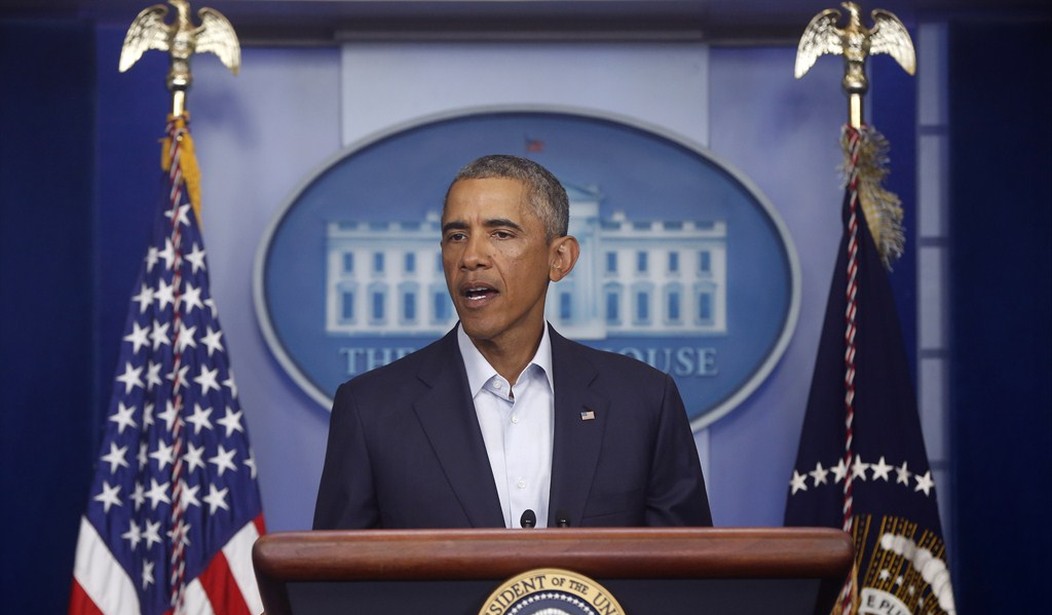
"I should have anticipated the optics," President Obama said by way of acknowledging that golfing right after making a statement about the beheading of James Foley looked bad. "Part of this job is also the theater of it," he said. "It's not something that always comes naturally to me. But it matters."
For those who remember that this is the same guy with the Greek pillars, the campaign stop in Berlin, the newly minted "seal" of the president-elect, it was an odd confession. Obama likes theater just fine; he just doesn't like having to read from a script not of his choosing.
That is probably why it took him so many tries to come up with the right words for what we will do about the Islamic State. One wonders whether he looked at the prepared remarks, turned to Valerie Jarrett and asked, "What's my motivation?"
Sen. Rand Paul (R-Ky.) has a similar problem. Much like Obama in 2007-08, he has been enjoying swimming with the current on foreign policy. War-weary, fed up with Arab countries hating us for trying to help and convinced that our priorities are closer to home, Paul's noninterventionism was sounding just right to many Americans.
Then, some jihadi punks beheaded two Americans and taunted the U.S. in the process. The same jihadis conquered and enslaved territories Americans fought, bled and died to liberate. They boasted that they beat us in a war and vowed -- ridiculously -- that their flag would fly over our White House. Lo and behold, it turns out that Americans don't like that sort of thing.
Attitudes, particularly among the very patriotic and pro-military Tea Party crowd, suddenly and predictably shifted. This time last year only 18 percent of Republicans told pollsters for the Pew Research Center that the U.S. does "too little" abroad. That number had more than doubled according to a similar poll last week. And a new Washington Post/ABC News poll shows 71 percent of Americans favor strikes in Iraq and 65 percent favor them in Syria.
Suddenly, Paul, who just weeks ago was calling Hillary Clinton a warmonger, is doing some mongering himself.
As much as it shocks me to say it, the politician whose instincts were best calibrated to the moment was none other than Vice President Joe Biden, who vowed that we would chase these barbarians to "the gates of hell."
Any analysis that fails to appreciate national honor fails to take into account what actually motivates nations. The Scots seem poised to secede from Britain, and the foreign policy establishment seems baffled by the idea. Don't the Scots understand that such a move is not in their economic self-interest?
Lurking behind such questions is an assumption that we are all Homo economicus, that we act only on a narrow, largely financial definition of self-interest. Maybe we should, but we don't and never will. If Palestinians acted solely on their rational self-interest, their conflict with Israel would have ended before it began. And there is a very strong case to be made for Obama's view that Vladimir Putin's empire-building will be bad for Russia in the long run. The only problem: Putin and a huge majority of Putin-worshipping Russians do not care.
"The mistake of the 'realists' is not their interest in the struggle for power but their deliberate neglect of everything else, especially the non-scientific, contingent, very human feelings and beliefs that most powerfully move people," Donald Kagan writes in "Honor Among Nations: Intangible Interests and Foreign Policy."
The neglect of such considerations can have enormous costs (as can too much consideration; see World War, First). The Ukrainians sent troops to fight with us in Iraq and Afghanistan. Now, in their moment of need, all they want from us are weapons to fend off the Russians. Our refusal is not merely dishonorable in some poetic sense; it is dangerous because it sends the signal that we are not a reliable friend. That is why Obama had to issue the mother of all red lines in the Baltics last week, vowing unconditional support for our allies.
He was right to do so. But at this point it is an open question around the world whether America is the sort of country that will deliver on such commitments given that the president has made it clear he considers such things mere theatrics.


Join the Conversation
VIP members get the ability to comment on articles.