





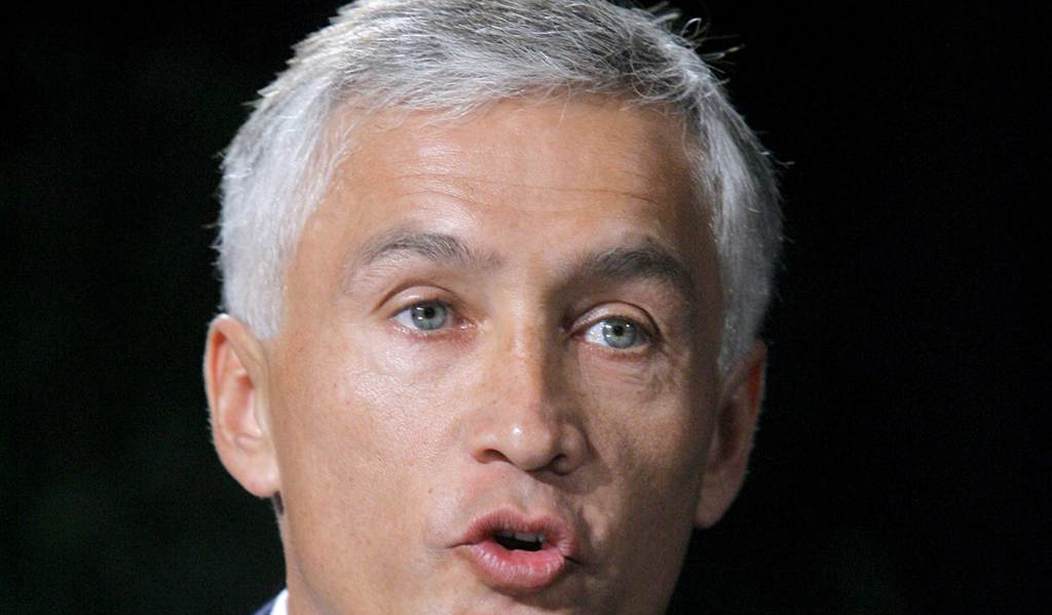
JOURNALISTS, SAYS Jorge Ramos, shouldn't make a fetish of accuracy and impartiality.
Speaking last month at the International Press Freedom Awards, Univision's influential news anchor told his audience that while he has "nothing against objectivity," journalism is meant to be wielded as "a weapon for a higher purpose: justice." To be sure, he said, it is important to get the facts right — five deaths should be reported as five, not six or seven. But "the best of journalism happens when we, purposely, stop pretending that we are neutral and recognize that we have a moral obligation to tell truth to power."
As it happens, Ramos delivered those remarks soon after the publication of Sabrina Erdely's 9,000-word story in Rolling Stone vividly describing the alleged gang rape of a freshman named Jackie at a University of Virginia fraternity party. Erdely had reportedly spent months researching the story, and its explosive impact was — at first — everything a tell-truth-to-power journalist could have wished: national attention, public outrage, campus protests, suspension of UVA's fraternities, and a new "zero-tolerance" policy on sexual assault.
But Rolling Stone's blockbuster has imploded, undone by independent reporting at The Washington Post that found glaring contradictions and irregularities with the story, and egregious failures in the way it was written and edited. Erdely, it turns out, had taken Jackie's horrific accusations on faith, never contacting the alleged rapists for a comment or response. In a rueful "Note to Our Readers," managing editor Will Dana writes: "[W]e have come to the conclusion … that the truth would have been better served by getting the other side of the story."
To a layman, that "conclusion" might seem so excruciatingly self-evident that Rolling Stone's debacle can only be explained as gross negligence, or a reckless disregard for the truth. But much of the journalistic priesthood holds to a different standard, one that elevates the higher truth of an overarching "narrative" — in this case, that a brutal and callous "rape culture" pervades American college campuses — above the mundane details of fact. Erdely had set out in search of a grim sexual-assault story, and settled on Jackie's account of being savaged by five men (or was it seven?) at a fraternity bash was just the vehicle she'd been looking for. Why get tangled in conflicting particulars?
"Maybe [Erdely] was too credulous," suggests longtime media critic Howard Kurtz in a piece on Rolling Stone's journalistic train wreck. "Along with her editors."
Or maybe this is what happens when newsrooms and journalism schools decide, like Jorge Ramos, that although they have "nothing against objectivity," their real aspiration is to use journalism "as a weapon for a higher purpose." Somehow it didn't come as a shock to learn that when Dana was invited to lecture at Middlebury College in 2006, his speech was titled: "A Defense of Biased Reporting."
Even after the UVA story began to collapse, voices were raised in defense of the narrative over mere fact.
"This is not to say that it does not matter whether or not Jackie's story is accurate," Julia Horowitz, an assistant managing editor at the University of Virginia's student newspaper,
Well, if the "narrative" is what matters most, checking the facts too closely can indeed be a huge mistake. Because facts, those stubborn things, have a tendency to undermine cherished narratives — particularly narratives grounded in emotionalism, memory, or ideology.
It's a temptation to which journalists have always been susceptible. In the 1930s, to mention one notorious example, Walter Duranty recycled Soviet propaganda, assuring his New York Times readers that no mass murders were occurring under Stalin's humane and enlightened rule. Duranty is reviled today. But the willingness to subordinate a passion for accuracy to a supposedly higher passion for "justice" (or "equality" or "fairness" or "diversity" or "peace" or "the environment") persists.
Has the time come to give up on the ideal of objective, unbiased journalism? Would media bias openly acknowledged be an improvement over news media that only pretend not to take sides?
This much is clear: The public isn't deceived. Trust in the media has been drifting downward for years. According to Gallup, Americans' confidence that news is being reported "fully, accurately, and fairly" reached an all-time low this year. Would you be astonished to see that number sink even further next year? Me neither.

Join the Conversation
VIP members get the ability to comment on articles.