



When speaking about the difference between the private sector and the government, I sometimes emphasize that mistakes and errors are inevitable, and that the propensity to screw up may be just as prevalent in the private sector as it is in the public sector.
I actually think the government is more likely to screw up, for reasons outlined here, here, and here, but let’s bend over backwards to be fair and assume similar levels of mistakes.
The key difference between capitalism and government, though, is the feedback mechanism.
Private firms that make errors are quickly penalized. They lose customers, which means they lose profits. Or perhaps they even fail and go out of business (remember, capitalism without bankruptcy is like religion without hell).
This tends to concentrate the mind. Executives work harder, shareholders and bondholders focus more on promoting good corporate governance. All of which benefits the rest of us in our roles as workers and consumers.
But mistakes in the public sector rarely lead to negative feedback. Indeed, agencies and departments that make mistakes sometimes get rewarded with even bigger budgets. This means the rest of us are doubly victimized because we are taxpayers and we have to rely on certain government services.
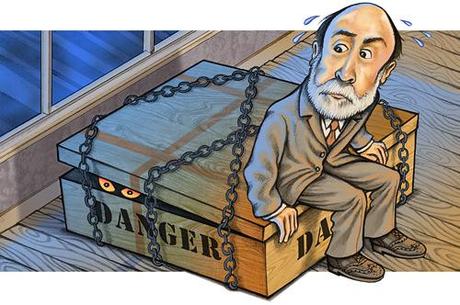
Citing the Federal Reserve as an example, Thomas Sowell explains how this process works. He starts with a look at the Fed’s recent failures and asks some basic questions about why we should reward the central bank with more power.
The recent release of the Federal Reserve Board’s transcripts of its deliberations back in 2007 shows that their economic prophecies were way off. How much faith should we put in their prophecies today — or the policies based on those prophecies?
Recommended

Here’s another example.
Ben Bernanke said in 2007, “The impact on the broader economy and financial markets of the problems in the subprime market seems likely to be contained.” It turned out that financial disasters in the housing market were not “contained,” but spread out to affect the whole American economy and economies overseas.
And here’s the icing on the cake.
Bernanke said: “It is an interesting question why what looks like $100 billion or so of credit losses in the subprime market has been reflected in multiple trillions of dollars of losses in paper wealth.” What is an even more interesting question is why we should put such faith and such power in the hands of a man and an institution that have been so wrong before.
Sowell acknowledges that we all make errors, but then makes the key point about the risks of giving more and more power to a central bank that has such a dismal track record.
We all make mistakes. But we don’t all have the enormous and growing power of the Federal Reserve System — or the seemingly boundless confidence that Fed Chairman Ben Bernanke still shows as he intervenes in the economy on a massive scale.
Sowell then highlights some of the reasons why we should worry about concentrating more power into the hands of a few central bankers.
Being wrong is nothing new for the Federal Reserve System. Since this year is the one hundredth anniversary of the Fed’s founding, it may be worth looking back at its history. …In the hundred years before there was a Federal Reserve System, inflation was less than half of what it became in the hundred years after the Fed was founded. The biggest deflation in the history of the country came after the Fed was founded, and that deflation contributed to the Great Depression of the 1930s.
If you want a more detailed examination of the Fed’s performance, this George Selgin video is withering indictment.
 In other words, instead of giving the Fed more power, we should be looking at ways of clipping its wings.
I realize my fantasy of competitive currencies isn’t going to be realized anytime soon, and I’ve already explained why we should be very leery of trusting the government to operate a gold standard.
So I’m not sure whether I have any firm recommendations – other than perhaps hoping to convince policy makers that easy money is the not the right way of boosting an economy that is listless because of bad fiscal and regulatory policy.








Join the conversation as a VIP Member