






Two Democrats running for open Senate seats uncomfortably declined to answer a very simple question posed by MSNBC hosts: If you had been a member of Congress in 2009 and 2010, would you have voted for Obamacare? West Virginia's Natalie Tennant wanted viewers to know that she didn't vote for Obamacare, but she wouldn't say how she would have cast her vote, instead mumbling about "standing up for West Virginia:"
Michelle Nunn in Georgia also took a pass, bizarrely claiming that it's "impossible" to make that sort of retrospective judgment, a transparent dodge that even Chuck Todd and Mika Brzezinsky couldn't swallow:
Alison Lundergan Grimes in Kentucky has similarly wrestled with how best to not answer this question. Allow me to translate for Tennant, Nunn and Grimes: "Yes, of course I would have saluted Harry Reid and Barack Obama by voting in lock step with my entire party to pass Obamacare, despite the fact that the people of my state didn't want it. Now that the law has proven harmful to millions and enduringly unpopular, I don't want to admit that I would have voted for it, but I don't want to say no, either. Not because I'm uncomfortable misleading voters on what should be a slam-dunk hypothetical, but because I can't afford to alienate the Democratic base in my state -- which explains why I'm doing interviews on MSNBC." Dan wrote up the top lines of Politico's freshly-released battleground state poll, the results of which are pretty bruising for Democrats. Republicans hold statistically-significant leads on the generic House and Senate ballots, thanks in large part to the president and Obamacare remaining enormous liabilities. On the healthcare overhaul, respondents in this poll aren't big fans. Politico doesn't ask the binary approve/disapprove question, but only a small fraction support the law as is, with a heavy plurality backing full repeal:
Recommended

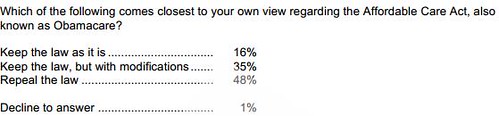
For the umpteenth time, a sizable chunk of the "modify it" crowd includes people who'd back changes that would excise huge elements of the law, including the deeply unpopular individual mandate tax. Eighty-nine percent of voters surveyed say Obamacare will be an important factor in their 2014 ballot choices. Of those impacted by the law, just 12 percent say it's been a net positive for their family, as opposed to 28 percent who say they've been hurt by it. These voters also reject President Obama's "the Obamacare debate is over" decree by a lopsided (39/60) margin. Both Dan and Ed Morrissey over at Hot Air have expressed grain-of-salt skepticism over the partisan sample of Politico's survey, suggesting that R+5 (D/R/I - 34/39/26) is unusually generous to the GOP. After all, the electorate in 2010's wave year was (35/35/29), or D+0. While I agree that R+5 may be a bit much, I'm not sure the methodology is necessarily as suspect as others have implied. With my "unskewing the polls" caveat firmly in place, I'll simply say that a Republican-leaning sample within this poll in particular makes sense. This isn't a national poll. Politico specifically surveyed voters in states and districts considered to be 2014 battlegrounds. What does that landscape look like?
Likely voters were surveyed in the following states with competitive Senate elections: Alaska, Arkansas, Colorado, Georgia, Iowa, Kentucky, Louisiana, Michigan, Minnesota, Montana, North Carolina, New Hampshire, Oregon, South Dakota, Virginia and West Virginia. Additionally, likely voters were surveyed in the following competitive House districts.
Of those 16 states, nine voted for Mitt Romney, and only three are generally considered to be perennially "blue." This poll basically doesn't measure any voters in places like San Francisco, New York City, Chicago, Seattle, Los Angeles, Boston, etc. Factor in the more conservative tilt of the midterm electorate, plus the enthusiasm gap, and R+5 doesn't seem too far-fetched. Democrats are in real trouble -- theoretically at least -- in the places that matter most this year. But before conservatives get cocky, they should read the end of this post, and recognize that not a single Senate Democrat incumbent is clearly trailing his or her GOP opponent at this stage in the race, with this possible exception.







Join the conversation as a VIP Member