





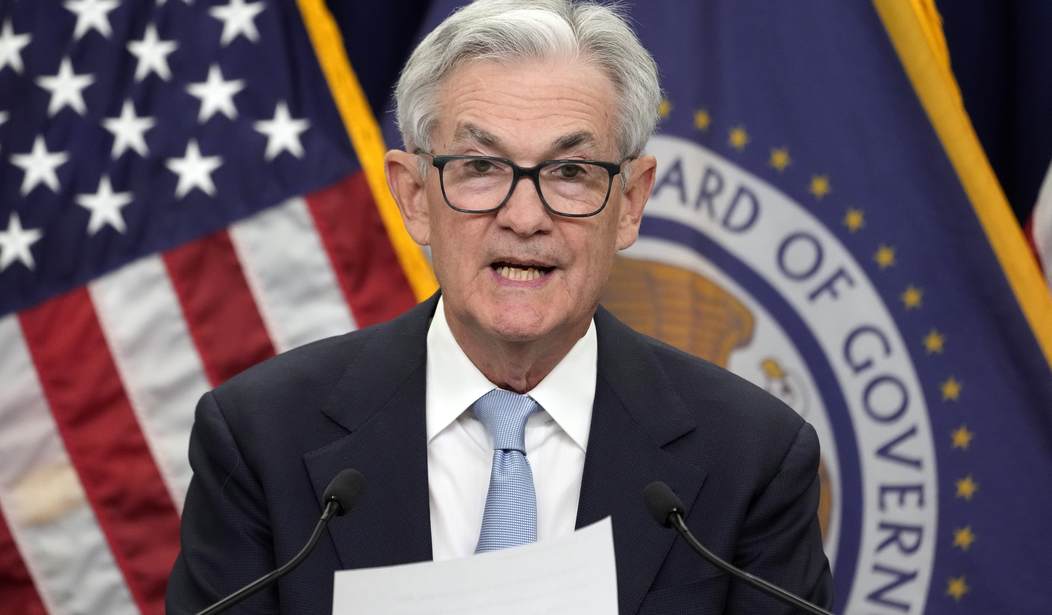
The Federal Reserve's Open Market Committee announced on Wednesday that it would leave interest rates unchanged again, continuing a pause following more than a year of increases that saw rates hit their highest level since early 2001.
In its usual statement following its decision on interest rates, the Fed said that "indicators suggest that growth of economic activity has slowed from its strong pace in the third quarter" while job gains have "moderated since earlier in the year" and inflation "remains elevated."
The Fed also insisted that the U.S. banking system "is sound and resilient" and that "[t]ighter financial and credit conditions for households and businesses are likely to weigh on economic activity, hiring, and inflation" though the "extent of these effects remains uncertain."
More from the Fed's announcement:
The Committee seeks to achieve maximum employment and inflation at the rate of 2 percent over the longer run. In support of these goals, the Committee decided to maintain the target range for the federal funds rate at 5-1/4 to 5-1/2 percent. The Committee will continue to assess additional information and its implications for monetary policy. In determining the extent of any additional policy firming that may be appropriate to return inflation to 2 percent over time, the Committee will take into account the cumulative tightening of monetary policy, the lags with which monetary policy affects economic activity and inflation, and economic and financial developments. In addition, the Committee will continue reducing its holdings of Treasury securities and agency debt and agency mortgage-backed securities, as described in its previously announced plans. The Committee is strongly committed to returning inflation to its 2 percent objective.
In assessing the appropriate stance of monetary policy, the Committee will continue to monitor the implications of incoming information for the economic outlook. The Committee would be prepared to adjust the stance of monetary policy as appropriate if risks emerge that could impede the attainment of the Committee's goals. The Committee's assessments will take into account a wide range of information, including readings on labor market conditions, inflation pressures and inflation expectations, and financial and international developments.
While the Fed left rates unchanged at its last meeting of 2023, it suggested that three rate cuts could be on the horizon in 2024, though there's a lot that could change between now and those meetings.
As expected, the Fed left interest rates unchanged at 5.25-5.5%. But pencils in three rate cuts (down to 4.6%) in 2024.
— Ben Casselman (@bencasselman) December 13, 2023
Statement: https://t.co/QSodmIiggL
Full coverage: https://t.co/Bb5KGUcXGp
Despite the Fed's efforts, Americans still weathered more than 24 consecutive months with negative real wages as inflation continued to outpace wage growth, and Americans are now paying more than 17 percent more for goods and services than they were when President Biden took office in January 2021.
The Fed's reaction to inflation caused by Biden and congressional Democrats' inflationary policies has driven the average nationwide mortgage rate to a level not seen in more than 20 years as Americans' credit card debt surged past $1 trillion.
This is a developing story and may be updated.


Join the Conversation
VIP members get the ability to comment on articles.