





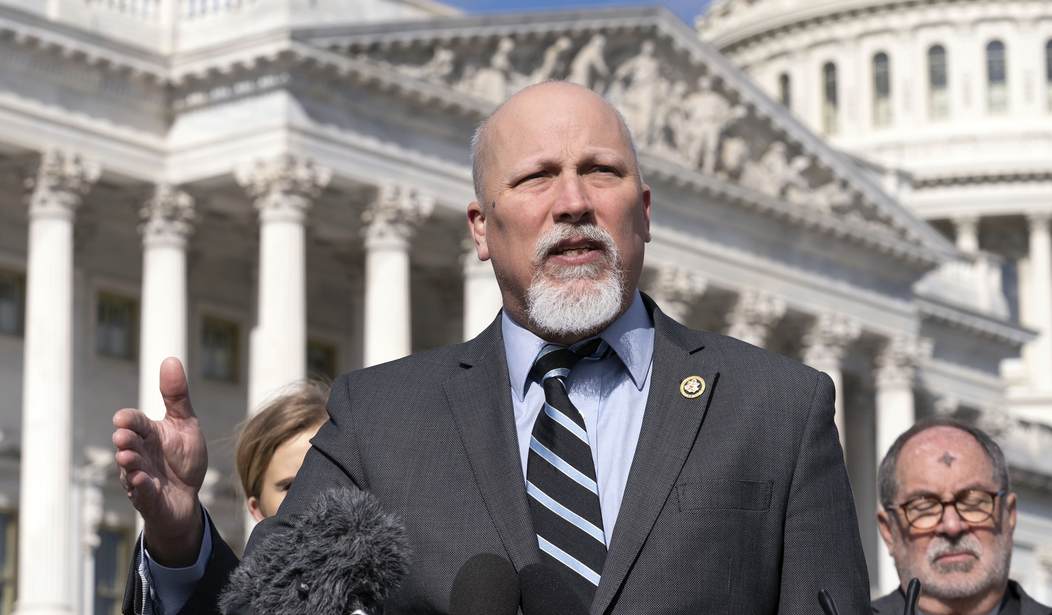
As the March for Life approaches this week, Rep. Chip Roy (R-TX) is reintroducing a bill to protect life on college campuses--both born and unborn--from dangerous abortion-inducing drugs. Townhall received an exclusive sneak peak of the legislation.
Roy has introduced the bill in years' past as well. The bill, Protecting Life on College Campus Act of 2025, currently enjoys 119 cosponsors in the House and also has wide support from groups such as American Principles Project and Citizens for Renewing America.
Under the bill, federal funds cannot go to "an institution of higher education that hosts or is affiliated with a student-based service site that provides abortion drugs or abortions to students of the institution or to employees." As the bill also makes clear, money cannot indirectly go to the institution, either. The text mentions in parenthesis that this means "directly or indirectly, including through a contract or subcontract."
The bill also contains a section making clear that institutions must "submit an annual report to the Secretary of Education and the Secretary of Health and Human Services certifying that no such site provides abortion drugs or abortions to students of the institution or to employees of the institution or site."
In a statement for Townhall, Roy raised some key issues about this method. "The American people should not be forced to fund the destruction of innocent life through DIY abortions with their hard-earned tax money to begin with. We especially should not be funding colleges that dole these dangerous pills out to students to use in their dorms without medical supervision," he said. "The abortion industry doesn’t care about patients; it cares about profits. We need to push back hard against their radical push for abortion anywhere, at any time, for any reason, and doing that starts here with the Protecting Lives on College Campuses Act."
Such a bill is necessary as the chemical abortion method is increasing in use and has actually led to an increase of abortions, even after Roe v. Wade was overturned by the Dobbs v. Jackson decision in 2022.
Further, as common as the method is, it is a widely misunderstood and particularly dangerous method. The process involves the woman receiving the first part of the abortion-inducing drug regimen, and then she is sent off to finish the process at home, alone. The first drug blocks progesterone and starves the unborn child of key nutrients. Then, 24-48-hours later, after enduring symptoms such as cramping, bleeding, and contractions, a woman expels the deceased child, which at this point may already have some key features visible, into the toilet.
In this instance, a teen girl or young woman at a college campus may thus end up giving birth to her deceased child in her dorm room or campus bathroom, without any medical assistance. Women are told the experience will be like a heavy period, though the bleeding often lasts for weeks and can lead to complications.
In addition to the side effects mentioned above, most women experience abdominal pain and may also experience nausea and vomiting, diarrhea, and a headache. Women may need surgery to repeat the procedure if the method is incomplete.
Under the former Biden-Harris administration, which was particularly pro-abortion, the method only became more dangerous.
The Food and Drug Administration (FDA) relaxed regulations in December 2021 so that women do not need to acquire the medication through a doctor's visit, but rather can do so online or through the mail. This prevents doctors from being able to confirm that the woman is even pregnant or that she is eligible for the method. Doctors also cannot ensure that the woman is not experiencing an ectopic pregnancy, which this method will not treat. Such is a nonviable pregnancy, which can kill the woman if not removed and is not an abortion, as Roy's bill also makes clear.
Such a method was approved for up to seven weeks in 2000 and then up to 10 weeks in 2016. The farther along in pregnancy the woman is when she undergoes such a method, the more dangerous it can be.
In November 2021, shortly before the FDA relaxed regulations, the Charlotte Lozier Institute released their study showing how particularly dangerous the method is. According to Medicaid claims data, visits to the emergency room following this method increased by 507 percent from 2002 to 2015. Most of these ER visits, over 60 percent, were miscoded as spontaneous miscarriages.
Legal battles over the FDA approving the method went all the way to the U.S. Supreme Court. However, the justices unanimously ruled last June that the plaintiff, the Alliance for Hippocratic Medicine, lacked standing to sue the FDA.
In the Senate, Sen. Steve Daines (R-MT) is leading the charge on such a bill. Daines has served as the chair of the first Senate Pro-Life Caucus.



Join the Conversation
VIP members get the ability to comment on articles.