





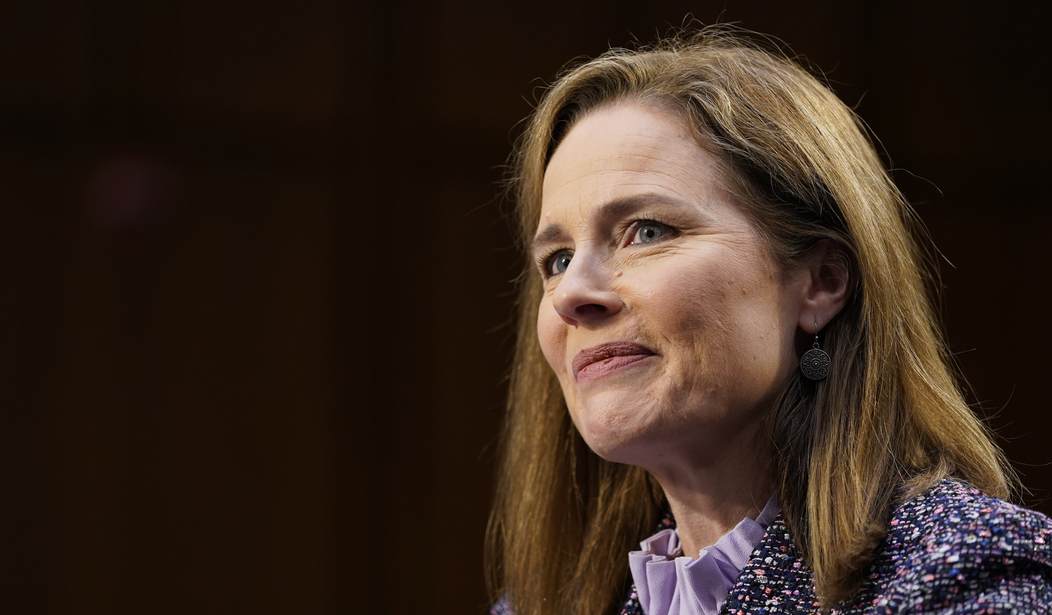
Was putting Justice Amy Coney Barrett on the Supreme Court a mistake? It wouldn’t be the first. John Roberts was a blunder. David Souter was another, the late Ted Kennedy and John Kerry tried to smear Souter as a right-wing nut. We used to call her Notorious ACB—the anti-Ruth Bader Ginsburg: conservative and Catholic. Liberals melted down when Donald Trump pushed her through in 2020.
Now, she’s been one to hand us some brutal defeats on serious constitutional questions, like allowing district courts to paralyze the executive. Jeff wrote about the Supreme Court compelling the Trump administration to unfreeze the aid which was placed under a 90-day moratorium by the president:
The Supreme Court has rejected the Trump administration’s request to vacate a lower court order requiring it to release about $2 billion in foreign aid that it had previously frozen.
The dispute centered on whether the district court possessed the authority to override President Donald Trump’s pause on the disbursement of foreign aid. The court let the ruling stand by a slim majority.
The debate over the matter began when President Trump decided to halt foreign aid disbursements. The U.S. District Court for the District of Columbia issued a temporary restraining order on February 13 preventing the administration from making this move. The same court issued an order on February 25 compelling the White House to release the $2 billion payments for services that had already been rendered.
The White House appealed the ruling to the Supreme Court, arguing that the district court lacked the authority to issue the ruling.
This ruling initially stayed a district court’s overreach on the subject. Justice Samuel Alito torched his colleagues.
And now Justice Barrett is getting praise from leftist law professors:
Conservatives are frequently disappointed with Amy Coney Barrett, but the New York Times loves her, so she's got that going for her. Here's left-wing professor Stephen Vladeck praising her. pic.twitter.com/G8hjuyPqOZ
— Mollie (@MZHemingway) March 5, 2025
Jack Posobiec rehashed his criticism that Barrett was a GOP DEI SCOTUS nominee, and he went line-by-line regarding her record of failure and disappointment in reaffirming the constitutional principles she swore to uphold, especially in the face of some of the most explicit politically-motivated lawfare against a presidential candidate:
Barrett’s track record since then has been a rollercoaster of disappointment, with too many stops on the liberal side of the tracks. This isn’t just a critique—it’s a red alert for Republicans: stop playing DEI games with judicial picks, or we’ll keep getting burned.
Take her freshest misstep: March 5, 2025. The Supreme Court ruled 5-4 that Trump’s admin can’t block nearly $2 billion in USAID payments to foreign aid contractors—funds for work already done, sure, but cash Trump aimed to redirect under his America First agenda. Barrett joined Chief Justice Roberts and the court’s three liberals, forcing the money out the door despite Trump’s efforts to gut a bloated agency. The dissent—Thomas, Alito, Gorsuch, Kavanaugh—saw it for what it was: a judicial overreach trampling executive power. Barrett’s vote didn’t just defy Trump, who gave her the robe; it propped up a globalist system conservatives have long despised. That’s not a one-off—it’s a pattern.
Look at the smoking gun from January 2025. The Supreme Court rejected Donald Trump’s bid to delay sentencing in his New York felony case—34 counts tied to hush money and business records brought by openly Trump-hating Manhattan DA Alvin Bragg. The 5-4 ruling forced the president-elect to face the music before Inauguration Day. Who sided with the court’s three liberals to make it happen? Barrett, alongside Chief Justice John Roberts. The conservative bloc—Thomas, Alito, Gorsuch—dissented, seeing the move for what it was: a partisan jab at Trump. Barrett’s vote didn’t just green-light a political hit job; it undermined the man who put her on the bench. That’s not loyalty to the Constitution—that’s a nod to the left’s lawfare playbook.
Then there’s the January 6 cases. In Fischer v. United States (2024), the court narrowed the scope of an obstruction law used against Capitol riot defendants. Barrett dissented again, siding with the liberals to keep prosecutors’ tools intact. She argued the majority’s reading was too restrictive—fair enough if you’re a law professor, but this was a real-world win for the DOJ’s witch hunt against Trump supporters. Contrast that with her concurrence in Trump v. Anderson (2024), where she refused to join the majority’s full reasoning on keeping Trump off Colorado’s ballot, aligning partly with the liberals’ narrower take. She scolded both sides for turning up the “national temperature,” but her waffling diluted a clear conservative victory.
And some are theorizing that when angry left-wing mobs targeted the justices, Barrett might have been shaken up by the assassination threats. We’ll see about that, but Robert and Barrett’s stock is dropping.
Many conservatives believe Justice Amy Coney Barrett deliberately lied and intentionally misled the vetting team during her confirmation.
— Tony Seruga (@TonySeruga) March 5, 2025
But it isn’t just about her ideology, though. It is becoming very obvious Justice Amy Coney Barrett is also compromised out of fear for her… pic.twitter.com/gpjiq9G6yv
We might have another problem.


Join the Conversation
VIP members get the ability to comment on articles.