





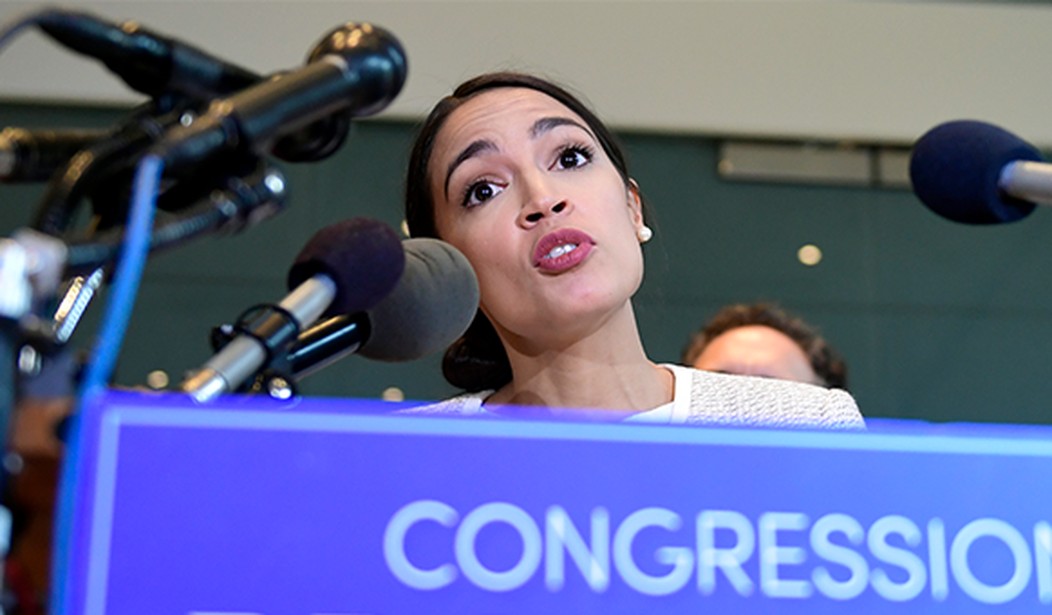
Speaking to The Intercept’s “Deconstructed” podcast on Monday, Democratic Rep. Alexandria Ocasio-Cortez (N.Y.) said people must acknowledge their privileges to be able to right past wrongs. As an example of her own privilege, AOC identified being a “cisgendered women.”
“If you haven’t had a transition in your life where, you know, you were maybe born poor or born without certain privileges and then especially as you transition into having certain privileges in your life, you actually see and feel and sense and taste and smell all of the differences,” she explained. “If you’ve never experienced different treatment in your life, you wouldn’t know what different treatment feels like or looks like. And it’s really, really hard.”
AOC argued that nearly every person in the U.S. should be able to identify a privilege.
“I’m a cisgendered woman,” she declared. “I will never know the trauma of feeling like I’m not born in the right body. And that is a privilege that I have, no matter how poor my family was when I was born. But it’s really hard for some people to admit that they — you know, it’s part of this weird American Dream mythology that we have, that for a lot of — in a lot of circumstances isn’t as true or isn’t as clearly communicated as we’d like for it, or we wish it was.”
.@AOC: I acknowledge my "privilege" in being born "cisgendered"
— Tom Elliott (@tomselliott) January 30, 2019
"I'm a cisgendered woman, I will never know the trauma of feeling like I'm not born in the right body. That is a privilege I have no matter how poor my family was when I was born." pic.twitter.com/QkviNMtLmv
Entire transcript via Grabien:
OCASIO-CORTEZ: “They’re like, and we need to — you know, they say discrimination or unfair incarceration of black men, and then they pause and the crowd cheers, and it’s like, in their mind, they’re like ‘you’re welcome’ for acknowledging it. And it’s like, okay, acknowledging racism is a really big step. It’s a really big step from where we were. But you’re right, it’s nowhere near enough and the solutions are so painful. Frankly, I find it — I find the solutions for white communities to be very painful because it’s very painful for a community to understand and have go through this — like, you can be — the idea that you can be poor and benefit from the color of your skin does not compute for a lot of people. And going through that realization is very painful or even just economically for people that were born with silver spoons. It’s very painful to admit that you had advantages and it’s just — “
GRIM: “Look what happened to Brett Kavanaugh when he was confronted. He melted down in front of the whole country.”
OCASIO-CORTEZ: “Oh my God — it literally is an identity meltdown, it’s a fundamental — “
GRIM: “I worked for everything I ever had.”
OCASIO-CORTEZ: “Yeah. And, like, that is the majority of a lot of communities, how a lot of communities feel. And it’s because, if you haven’t had a transition in your life where, you know, you were maybe born poor or born without certain privileges and then especially as you transition into having certain privileges in your life, you actually see and feel and sense and taste and smell all of the differences. If you’ve never experienced different treatment in your life, you wouldn’t know what different treatment feels like or looks like. And it’s really, really hard. I mean, it’s like — and we can all, almost every single person in this country can acknowledge some privilege of some of some type, you know. I’m a cisgendered woman. I will never know the trauma of feeling like I’m not born in the right body. And that is a privilege that I have, no matter how poor my family was when I was born. But it’s really hard for some people to admit that they — you know, it’s part of this weird American Dream mythology that we have, that for a lot of — in a lot of circumstances isn’t as true or isn’t as clearly communicated as we’d like for it, or we wish it was.”
GRAY: “Yeah, I’m working on it maybe. Maybe next piece on privileged dialogues on how to make it more constructive.”
GRIM: “Look forward to that one.”
GRAY: “My mentions don’t.”
OCASIO-CORTEZ: “It’s hard. I don’t envy you.”



Join the Conversation
VIP members get the ability to comment on articles.