




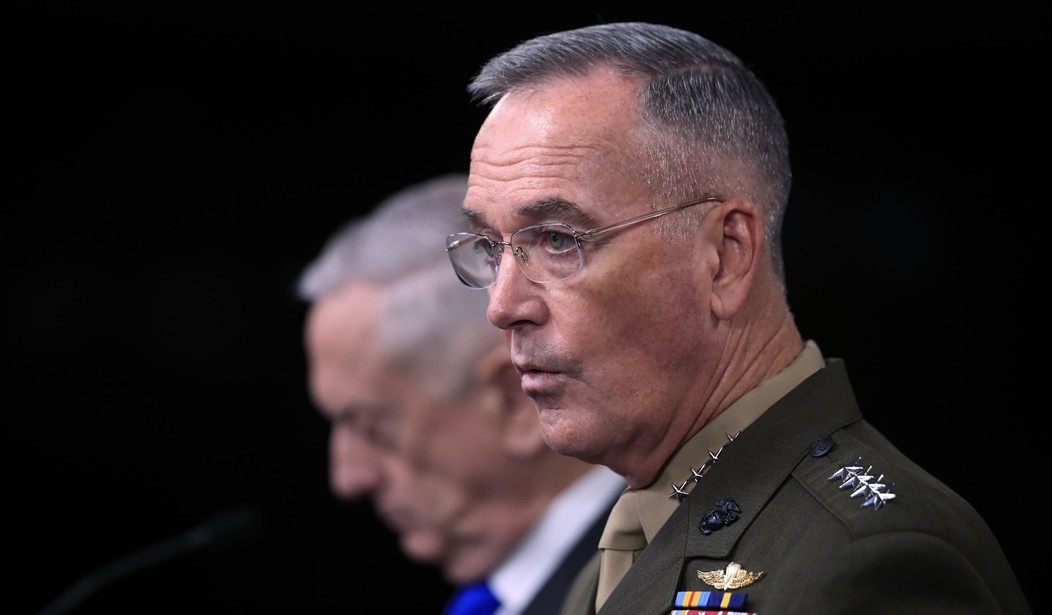
During his appearance at the Halifax International Security Forum, Gen. Joe Dunford, Chairman of the Joint Chiefs of Staff, said the United States is currently in a stalemate with the Taliban in Afghanistan.
"They are not losing right now, I think that is fair to say," he said. "We used the term stalemate a year ago and, relatively speaking, it has not changed much."
Dunford also stated there is no sole military solution to ending the conflict in the country, which is why the U.S. is following a multifaceted approach.
"Without going into detail here, we do believe the Taliban know that, at some point, they do have to reconcile," Dunford continued, adding the coalition is going to have to increase military and religious pressure to have the terror group come to the negotiating table.
#GenDunford tells me US strategy in #Afghanistan is to pressure the Taliban militarily to accept a political settlement. He says they’re not winning, but acknowledges they’re also not losing @thejointstaff @HFXforum - you can watch the full interview here https://t.co/lopkxaEBKJ pic.twitter.com/8WYzkwVZUq
— Yalda Hakim (@BBCYaldaHakim) November 18, 2018
“The key to success is to combine all that pressure to incentivize the Taliban for again, that Afghan-led reconciliation,” he said.
“Also this quarter, the Trump Administration’s South Asia strategy passed its one year mark. Under the strategy, the U.S. Government has increased the amount of troops and equipment in Afghanistan, increased offensive strikes against the Taliban, expanded training and assistance for Afghan forces, and sought to pressure Pakistan to eliminate terrorist safe havens,” according to the DOD Inspector General’s report. “Overall, the strategy seeks to drive the Taliban to enter into negotiations for a political settlement.”
The path for the Afghan-led reconciliation has been costly for the Afghans, not just the United States and its coalition partners.
New @DoD_IG report on Afghanistan:
— Dan Lamothe (@DanLamothe) November 19, 2018
-- @ResoluteSupport and the UN say civilian casualties are up
-- Casualties among Afghan forces are up over this quarter in 2017. Numbers classified per Kabul request.
-- 4 U.S. and 3 Czech soldiers killed this quarterhttps://t.co/1mXffhMe0E
The New York Times reported Afghan President Ashraf Ghani revealed to his country over 28,000 of their own police officers and soldiers have been killed since 2015.
Which means the “current death rate is on average about 25 police officers and soldiers a day, or 175 a week — more than 9,000 a year.”
“Is the state at risk of collapse?” Ghani stated. “No. Why? Because as long as we have our commando forces and our air force, we will be able to retake. Are the losses horrific? Yes.”






Join the conversation as a VIP Member