





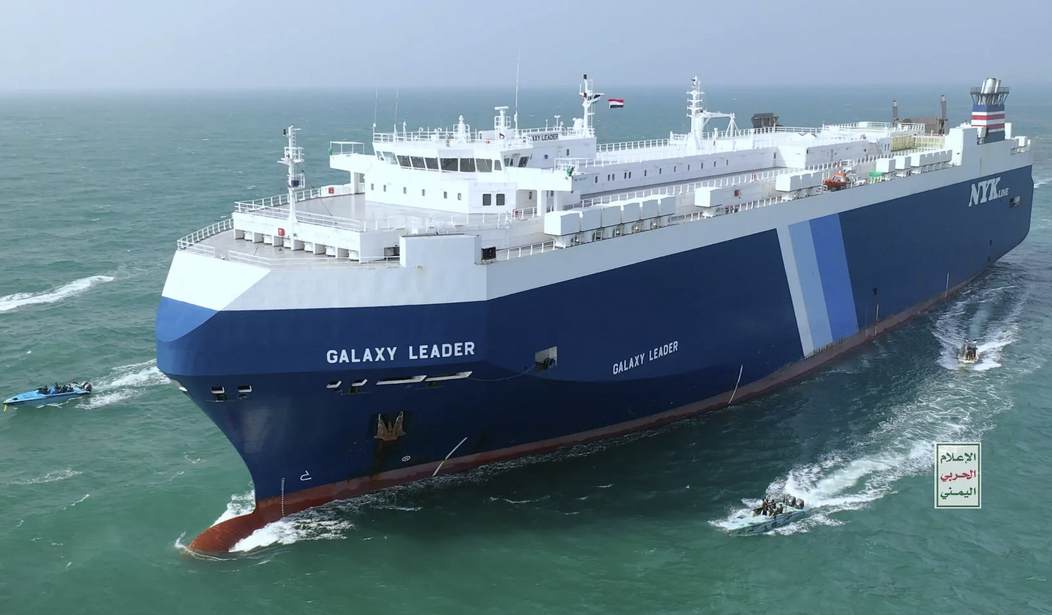
President Donald Trump announced on Tuesday that the Houthi rebels in Yemen have thrown in the towel and will stop attacking ships going through the Red Sea.
The news comes after the president ordered almost two months of constant bombing attacks against the Houthis. “We will stop the bombings,” Trump told reporters during a press conference. “They have capitulated…we will take their word that they will not be blowing up ships anymore, and that’s the purpose of what we were doing.”
Secretary of State Marco Rubio explained that “this was always a freedom of navigation issue.”
“You had a band of individuals with advanced weaponry that were threatening global shipping, and the job was to get that to stop, and if it’s going to stop, then we can stop,” Rubio continued.
BREAKING: President Trump just announced that the United States will stop the bombings of the Houthis in Yemen, effective IMMEDIATELY, after they called and conceded defeat.
— George (@BehizyTweets) May 6, 2025
"The Houthis have announced to us at least that they don't want to fight anymore. They just don't want to… pic.twitter.com/J2H5QchqMC
Houthis have taught the world a masterclass in FAFO.
— Marina Medvin 🇺🇸 (@MarinaMedvin) May 6, 2025
It was a clean 10:10 FAFO. pic.twitter.com/rJ85Q2ZKzw
The US attacks on the Iran-backed Houthis were quite extensive, as detailed by Struan Stevenson,
Next, the U.S. commander-in-chief ordered a blitz of more than 100 precision air strikes on Houthi targets in Yemen, destroying command and control facilities, weapons manufacturing facilities, and advanced weapons storage locations. The U.S. also confirmed the air strikes had led to the death of several Houthi leaders, without providing additional details on who exactly was killed. The crushing of the Houthis has effectively wrecked the last remnants of the mullahs’ ‘Axis of Resistance’ and the theocratic regime is now in its weakest state since the 1979 revolution that brought them to power.
The top U.S. military general for the Middle East, Gen. Erik Kurilla, met with senior Yemeni military officials last week during a trip to Saudi Arabia. Kurilla and his Yemeni counterparts discussed the ongoing U.S. campaign against the Houthis, “designed to restore freedom of navigation,” according to the United States Central Command (CENTCOM). President Trump’s Defense Secretary, Pete Hegseth, warned on April 14 that the American campaign, costing an estimated $1 billion so far, is far from over. “It’s about to get worse,” he said, describing intensified operations ahead. In a further show of force, Hegseth ordered additional squadrons and air defense assets to the region. A second aircraft carrier was redirected from the Indo-Pacific to bolster the U.S. presence in the Middle East, alongside deployments of Patriot missile batteries and a Terminal High Altitude Area Defense (THAAD) system. Although the enhanced military posture has primarily targeted the Houthis, officials say it is also meant to send a clear signal to Iran.
While the Houthis have agreed to stop targeting ships traveling through the Red Sea, it has not yet indicated whether it will halt its missile attacks against Israel.
Join the Conversation
VIP members get the ability to comment on articles.