





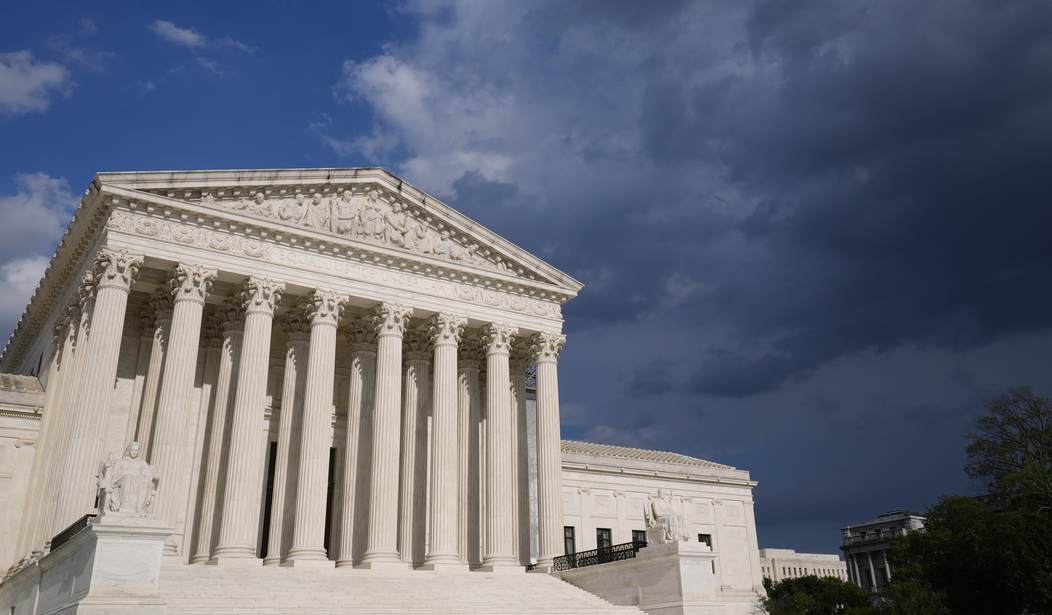
Oral arguments ensued on Wednesday as the Supreme Court heard arguments for and against President Trump's "Liberation Day" tariffs. The hearing lasted almost three hours.
The Court was weighing whether the president had the authority under the International Emergency Economic Powers Act (IEEPA) to enact global tariffs without Congressional approval.
According to the Wall Street Journal, the Court appeared skeptical of Trump’s authority, with only Justice Samuel Alito showing any openness to upholding the global tariffs, and even he raised concerns about the legal reasoning presented by Trump’s lawyers. He argued that the president must have the authority to respond swiftly to foreign emergencies, and that Trump’s use of the IEEPA was a legitimate exercise of that authority.
Solicitor General John Sauer received flak from all sides as he argued that the president’s power to regulate trade when he declares an emergency includes the authority to impose sweeping tariffs.
All nine Justices seemed to agree that tariffs are equivalent to taxation, and questioned if Congress even had the ability to delegate its core Constitutional power of raising revenue to the executive.
Justice Sonia Sotomayor emphasized the constitutional process for taxation, stating, “The Constitution is structured so that if I’m going to be asked to pay for something as a citizen, that it’s through a bill that is generated through Congress,” adding, “But I’m not going to be taxed unless both houses” of Congress and the president “have made that choice.”
As for the rest of the Justices, Chief Justice John Roberts, while quiet for the majority of the hearing, expressed skepticism early on, describing a "misfit" between the tariff authority President Trump has claimed and the language in the IEEPA.
Justice Gorsuch, one of the Court’s most conservative members and a well-known critic of executive power, pressed Sauer extensively on the separation of powers, repeatedly emphasizing that the authority to tax, and by extension, to impose tariffs, rests with Congress, not the president.
Justice Amy Coney Barrett was the first Justice to ask whether sweeping global tariffs were a proportional response to the trade-deficit emergency that Trump declared. While she admitted she could see it as an argument to impose tariffs on some countries, she did not appear favorable to the idea that it allowed President Trump to impose tariffs as widely as he did.
She also noted that the IEEPA never uses the word tariff, and that the statutory language granting the president authority to regulate imports has seldom, if ever, been invoked to justify imposing them.
Both Justices Kavanaugh and Thomas appeared mixed on their views.
Justice Kavanaugh voiced issues with both sides. He said at one point that if the IEEPA gave President Trump the ability to impose tariffs, other presidents would have surely used the statute in the same way. But at times, he would voice agreement with Justice Alito and the president's ability to deal with emergencies. He appeared concerned about minimizing “the president’s suite of tools” during an international crisis.
Justice Thomas was impossible to read, as he is well known for asking straightforward questions and rarely arguing with lawyers before the Court. Wednesday's hearing was no different.
All of the liberal justices were not receptive to the Trump administration's arguments, as was to be expected. At a minimum, six justices already appear unfriendly to President Trump's use of the IEEPA.
While it typically takes the Court three to six months to arrive at a decision, the ruling in this case is expected to arrive before the end of the year.
President Trump appeared to react positively to the hearing, telling Fox News's Bret Baier on Wednesday, “I heard the court case went well today, but I just heard that a little while ago. I will say this, it would be devastating to our country if we lost that.”
Bret Baier: “How worried are you about the Supreme Court decision on your emergency power on tariffs?
— RedWave Press (@RedWave_Press) November 5, 2025
President Trump: “I heard the court case went well, but I just heard that a little while ago… But I will say, this—it would be devastating for our country if we lost that,… pic.twitter.com/ibCBNBrYie
The Trump administration has signaled that they have other paths to enact Trump's tariff policy if the Court rules against it.
Editor’s Note: The Schumer Shutdown is here. Rather than put the American people first, Chuck Schumer and the radical Democrats forced a government shutdown for healthcare for illegals. They own this.
Help us continue to report the truth about the Schumer Shutdown. Use promo code POTUS47 to get 74% off your VIP membership.


Join the Conversation
VIP members get the ability to comment on articles.