




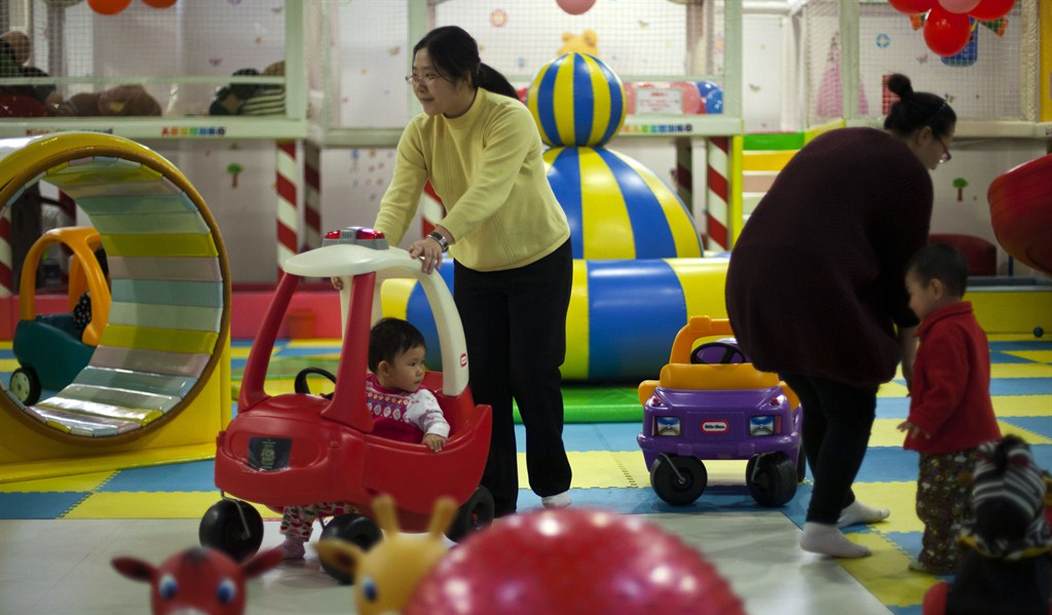
Is this an empty peace offering to the United Nations Human Rights Council or a genuine effort, on behalf of the Chinese government, to reform an antiquated and barbarous public policy?
By the way, I wonder what Joe Biden thinks about all this:
China's leaders agreed to loosen the nation's one-child policy and to give market forces a greater role in the world's No. 2 economy, according to new details of a blueprint for reform released on Friday.
The proposals follow the end on Tuesday of a four-day meeting of top Chinese Communist Party leaders, and they represent the first comprehensive road map for reform under new Chinese President Xi Jinping. …
The document said China would significantly ease its one-child policy, allowing couples to have two children if one of the parents is an only child. Currently, Chinese couples are restricted to one child except under some circumstances, such as rural dwellers, pilot programs in a number of areas and among ethnic minorities.
Enacted in 1980, the policy has been lauded by officials for taming a surging population from a years-earlier baby boom. But economists say it risks eroding China's competitive advantage, draining its labor pool of future workers as the population ages and puts a greater strain on China's emerging social safety net.
The policy has also come under fire for local-level abuses such as forced abortions and sterilizations—practices that are illegal in China but are sometimes used by local officials to meet their family-planning quotas.
Recommended

The Chinese government will also reportedly do away with its labor camp system:
China also plans to abolish a controversial labor camp system in what Xinhua described as "part of efforts to improve human rights and judicial practices." Under the system, which has been in place since 1957, police are allowed to imprison people in labor camps for up to four years without formal arrest or trial.
Public outrage over the system swelled earlier this year, after a woman named Tang Hui was sent to a labor camp after petitioning authorities for tougher penalties for the men convicted of abducting and raping her daughter. Ostensibly set up to as a way to keep petty crimes from clogging the courts, in practice it is used to imprison petitioners and other politically disruptive people.
Steven Ertelt over at LifeNews.com reminds us that China tends to pull these public relations stunts from time to time. Therefore, it’s hard to take these reports too seriously:
Such reports surfaced every so often as the Chinese communist government attempts to repair its public image abroad, but the reforms either turn out to be untrue or are so minor that they really do nothing to curb the massive human rights abuses associated with the policy and its forced abortions and sterilizations.
Nevertheless, per the NYT, this does seem like a positive development:
“This is the first time that a central document has clearly proposed allowing two children when a husband or wife is an only child,” said Wang Guangzhou, a demographer at the Chinese Academy of Social Sciences in Beijing. “Now it’s just talking about launching this, but the specific policies have to be developed at the operational level.”
If carried through, the relaxation would mark the first significant nationwide easing of family-size restrictions that have been in place since the 1970s, said Wang Feng, a demographer who teaches at both the University of California, Irvine, and Fudan University in Shanghai. He estimated the policy could lead to 1 to 2 million more births in China every year, on top of the approximately 15 million births a year now.
“This step is really, I think, the middle step toward allowing all couples to have two children, and eventually taking away the state’s hand,” said Professor Wang. “But this shift is historical, it’s fundamental. To change the mentality of the society of policy makers has taken people more than a decade.”
Is this "fundamental" shift in policy attributed to the government finally recognizing the rights of individuals, or because they had no other choice? Take a wild guess. It’s no secret that China has an aging population problem, which left unaddressed, will upend their economy at some point in the not-too-distant future.
This problem was exacerbated by China’s one child policy, of course. This is probably the biggest (if not the only) reason why the Chinese leadership is starting to reconsider it.











Join the conversation as a VIP Member