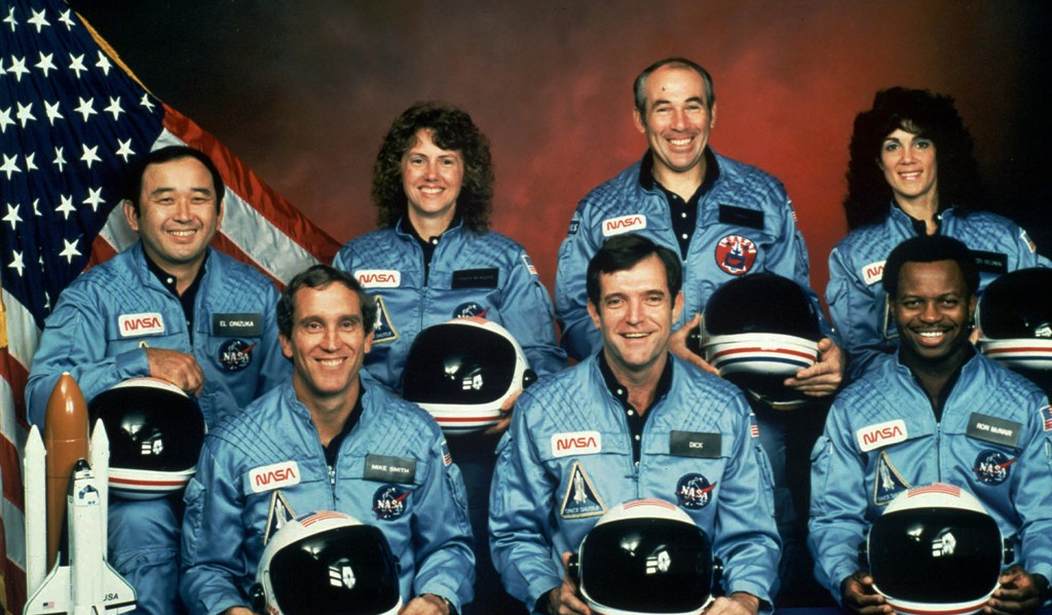

Today marks the 40th anniversary of the Challenger explosion, when the world watched in horror as the shuttle exploded just 73 seconds after liftoff. This included countless schoolchildren who had turned in to watch teacher Christa McAuliffe make the journey as part of NASA's "Teacher in Space" project.
ON THIS DAY: Forty years ago, the space shuttle Challenger exploded 73 seconds after liftoff from Cape Canaveral, killing all seven crew members. https://t.co/lOmd9quuZM pic.twitter.com/KKF5Vjj6SC
— ABC News (@ABC) January 28, 2026
The other crew members killed were Commander Francis "Dick" Scobee, Michael Smith, Judith Resnik, Ronald McNair, Ellison Onizuka, and Gregory Jarvis. My heart goes out to their families and loved ones today.
Investigations into the tragedy discovered it was caused by a rubber O-ring seal that failed due to extreme cold. That failure let hot rocket gas escape the solid rocket booster, igniting the external fuel tank.
Thanks to space exploration, we have GPS navigation, weather forecasting, and hurricane tracking. On the medical side, NASA's work also helped develop CT and MRI imaging, insulin pumps and heart-monitoring technology, and improved prosthetics. Things like memory foam, fire-resistant fabrics, and home insulation also exist thanks to space travel, as well as technological advances for computers, software, and robotics.
The men and women who joined NASA knew the risks. On January 27, 1967, three astronauts — Roger B. Chaffee, Virgil "Gus" Grissom, and Edward H. White — were killed in a fire that swept through the Apollo 1 command module during a pre-launch simulation. Three years later, the crew of the Apollo 13 was almost lost after faulty wiring caused an explosion of the service module. In 2003, the crew of the Columbia was lost when the shuttle broke up on reentry, likely due to a damaged heat shield on the wing.
The men and women of the Challenger crew represented the very best of us, brave pioneers who wanted to expand the reach of human knowledge. Much like the explorers of old, who hopped on ships and sailed into unknown waters, astronauts hopped onto spaceships to explore an even more vast unknown.
Somewhere along the way, we lost that desire and curiosity to expand our horizons and the depth of human knowledge. Indeed, these days the explorers of old are derided as little more than "colonizers" who deserve nothing but condemnation.
Despite my small-government leanings and my desire to see significant cuts to government spending, I have a soft spot for NASA. In December, I spent a weekend at the beach in North Carolina, where, although faint, I could make out the Milky Way. There is something both awe-inspiring and humbling about realizing how small we truly are in this vast universe.
In that broad expanse of space, imagine all the things we can and will learn. The knowledge is as limitless as the galaxy, but finding it will require the bravery and sacrifice of men and women like those who gave their lives to NASA.
The night of the Challenger disaster, Ronald Reagan addressed the nation, saying, "The crew of the space shuttle Challenger honored us by the manner in which they lived their lives."
The best way to honor the memory of every single astronaut who risked, and gave, their lives as part of NASA is to return to space. I'm thrilled NASA's Artemis program will return us to the moon in my lifetime, for the first time, as this will be the first lunar landing since Apollo 17 in 1972 (nine years before I was born). The goal of the Artemis program is not just return to the moon but to establish a presence in space and set our sights towards reaching Mars.