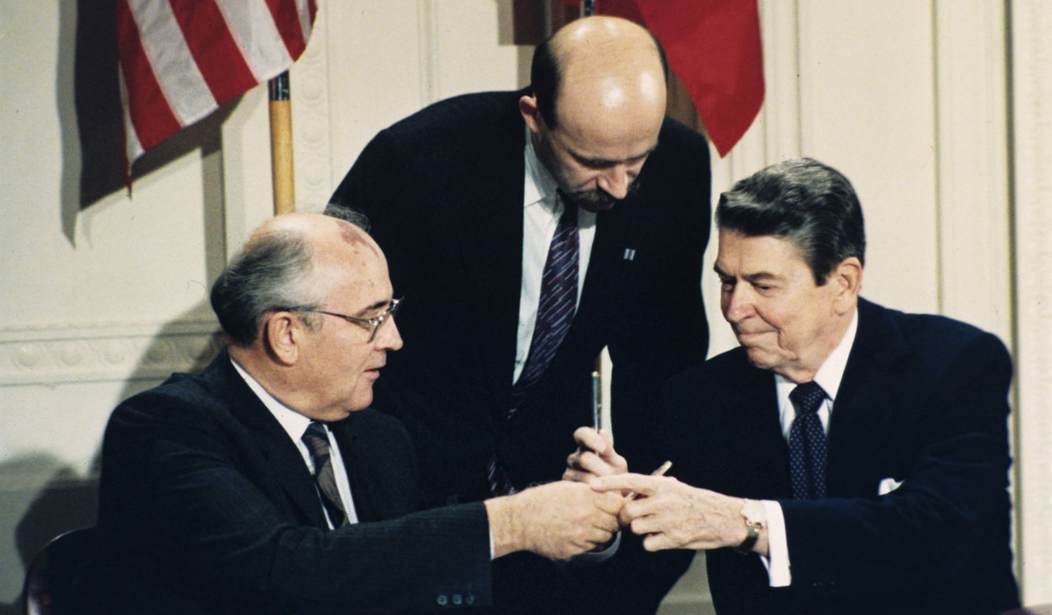

In 1986, President Ronald Reagan went to Reykjavik, Iceland, to meet with Mikhail Gorbachev, the Secretary General of the Soviet Communist Party. The two nations were still deep in the Cold War, and the purpose of the meeting was to talk about how both could de-escalate nuclear tensions.
"If we fail here, there will be war," warned Secretary of State George Shultz (J.K. Simmons). We all know how that story ends, of course: while Russia and the U.S. never reached nuclear zero, there also was no war, and the Soviet Union collapsed just three years later.
Going into the film, especially with Jeff Daniels cast as Reagan, many had trepidation about how the movie would portray the Gipper. He's not exactly a favorite in Hollywood, despite being an actor, and he's certainly got no fans on the Left. But, and I'll get into more details on this later, he did well.
The Atlantic, of course, had to lament that the film portrayed Reagan in too positive a light, especially in regards to how he dealt with Soviet Russia.
The radical left wing “news” media is trying to downplay the impact of Ronald Reagan and how he dealt with the Soviet Union.
— Wall Street Mav (@WallStreetMav) August 15, 2026
They are trying to downplay a new movie about it, “The Brink of War”.https://t.co/4P58XOhRkk
In October 1986, Reagan and Soviet General Secretary Mikhail Gorbachev met to discuss nuclear-arms control in Reykjavik, Iceland. At the time, I was a young scholar in Washington, training in Soviet affairs and international relations at Georgetown University and working at the Center for Strategic and International Studies. (I was also a two-time Reagan voter.) When the Reykjavik meeting took place, no one was looking ahead to the collapse of the Soviet Union; Kremlin watchers were, mostly, relieved to see a Soviet general secretary and an American president talking with each other.
The Brink of War, a new film released nationwide today, tries to bring texture and detail to those two days in Iceland. The movie relies on transcripts and other documents from the time, along with interviews with a former secretary of state, the late George Shultz (to whom the movie is dedicated). The film is a welcome corrective to the liberal orthodoxy about Reagan—specifically, that he was a disconnected simpleton who didn’t understand the complexities of the arms race. But it leans too much in the opposite direction: It is too kind to the Gipper, and takes too many liberties with the historical record.
I get it: anything that shows America in a better light than the communists is just "too kind," given the ascendancy of communism in America again. And, of course, Hollywood has never taken too many liberties with the historical record in the past, has it?
This comes down to a case of "methinks the lady doth protest too much," and because The Atlantic piece was written by Tom Nichols, that's an apt quote. Ronald Reagan, along with Margaret Thatcher and even Pope John Paul II, are the reason the Soviet Union collapsed in 1989. I get why Republicans and conservatives looking good would irritate Nichols.
As a film, "The Brink of War" is solid, if not always entertaining. There are moments when Reagan's casual, charming humor shines through, but the script could have used a brush-up from dialogue master Aaron Sorkin, who does the political walk-and-talk (or, in this case, the sit-and-talk) better than anyone. In a film where the majority of the story is two politicians sitting in a room, the dialogue must sparkle.
The film also has two small sub-plots: Raisa Gorbachev (Branka Katic), Mikhail Gorbachev's (Jared Harris) wife, accompanies him to Reykjavik, while Nancy Reagan does not. The two first ladies snipe at one another with the aid of Cleo (Aya Cash) and Alexander (Guy Burnet), an NPR journalist and a reporter for The Times, respectively. Those are used to cut away from the meeting in the Reykjavik house, but they don't quite land. Raisa Gorbachev takes a shot at Nancy Reagan's health, and Nancy Reagan responds by launching a breast cancer initiative, something the real Nancy Reagan didn't do (although she did use her 1987 cancer diagnosis and mastectomy to push for earlier detection). That announcement annoys Mrs. Gorbachev. There's also an implied budding relationship between Cleo and Alexander that is never resolved.
There is also reference to Reagan's 1981 assassination attempt, but it's played off as being more recent to the 1986 meeting. Reagan is seen having flashbacks and tremors tied to the assassination attempt, and there's a scene where Reagan is changing his shirt, and Shultz sees the scars from where John Hinckley Jr. shot him. That, too, seems like dramatic license.
While those subplots don't quite land, they do help break up the main story. The main story is framed by starting out at the end of the meeting. Reagan has annoyed Gorbachev over his stance on the Strategic Defense Initiative, and that threatens to scupper any possible deal. Then the story jumps back 30 hours. It's an oft-used framing device, but it doesn't help build tension in a film where we not only know the historical outcome, but learn the movie's outcome in the first couple of minutes.
Better framing would have been to blast the so-called experts who said such a meeting between the world's biggest superpowers wouldn't have happened or worked. It not only would have been a timely message (experts aren't exactly popular these days) but it would have built tension as Gorbachev and Reagan defy their advisors to hold this meeting.
But, at the end of the movie, I didn't want my money back. Both Jeff Daniels and Jared Harris give tremendous performances as Reagan and Gorbachev, without turning their portrayals into SNL-style parodies. The supporting cast is also solid, and J.K. Simmons can do no wrong in whatever role he's cast. I would be surprised if none of them received a Golden Globe or Oscar nod, especially Jared Harris, who gets lost in the role of Gorbachev.
And to answer the question posed: No, the film is not too "pro-Reagan." That's the squawking of someone who dislikes all Republicans. It shows that Reagan was willing to both talk to and stand up to the Soviet Communist regime, and we need more people willing to do that today.