


Oxfam reports that the richest one percent of people in the world own 48 percent of the world's wealth. Many claim that we should be alarmed by income inequality because it hampers upward mobility. Others argue that because income is distributed so unevenly, justice and fairness require income redistribution. Let's look at fairness and justice.
What constitutes fairness and justice has been debated for centuries. Widespread agreement has proved to be elusive at best. However, I think that an important part of an intelligent discussion about fairness and justice is the recognition that knowing results of a process cannot establish whether there is fairness or justice.
Take a simple example. Suppose Tom, Dick and Harry play a weekly game of poker. The game's result is that Tom wins 75 percent of the time. Dick and Harry, respectively, win 15 percent and 10 percent of the time. Knowing the results of the game permits us to say absolutely nothing about whether there has been poker fairness or justice. Tom's disproportionate winnings may be a result of his being an astute player or a clever cheater.
To determine whether there has been poker justice, we must ask process questions. Was there obedience to neutral game rules, such as those of Hoyle's? Were the cards unmarked and dealt from the top of the deck? Did the players play voluntarily? If the answers to these questions are affirmative, there was poker justice, regardless of the outcome, including Tom's winning 75 percent of the time.
Similarly, a person's income is a result of something. Knowing that one person's yearly income is $500,000 and another's is $12,000 tells us nothing about economic justice or fairness. To determine whether there has been economic justice, one has to ask process questions. Most people -- including economists, much to their shame -- who discuss income inequality fail to acknowledge or make explicit that income is a result of something. As such, a result cannot be used to determine fairness or justice. To determine whether there has been economic justice or fairness, we must go beyond results and examine processes.
Recommended

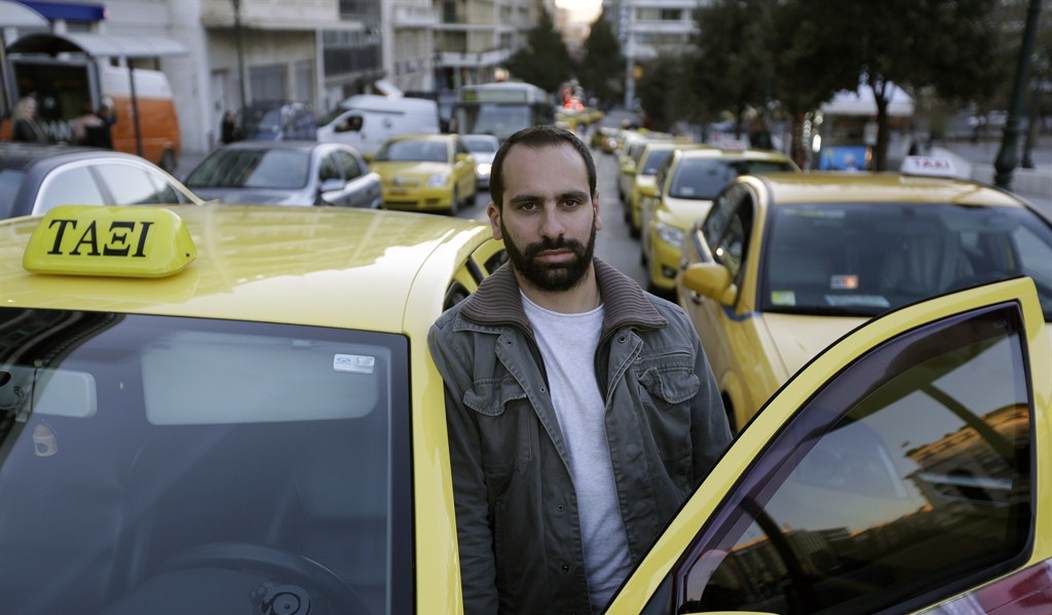
Let's look at a couple of examples, among hundreds, of processes that cause economic unfairness. Taxi owner-operators can earn an annual income of $70,000 or more. Many people can manage to buy a car and the necessary items to become an owner-operator for less than $30,000. Here's the unfairness: In order for someone to operate a taxi legally, many cities require the owner to purchase a license, or medallion. In Philadelphia, Chicago, Boston and New York, medallions cost between $350,000 and $700,000. The effect of these licensing requirements is to close the market to most prospective entrants and thereby create economic injustice.
There have been instances in which managers of Housing and Urban Development low-income housing projects have wanted to repair dilapidated units by employing residents to perform some of the unskilled work, such as pulling out unsalvageable parts of the building and assisting skilled craftsmen. However, the Davis-Bacon Act, which covers federally financed or assisted construction, requires that the workers be paid union wages. If high union wages must be paid, the manager is forced to hire only skilled laborers, very few of whom are residents of the project. That means these workers earn less. It is economic injustice to deny a person who is ready, willing and able to work the opportunity to do so.
There are hundreds, possibly thousands, of examples in which the economic game is rigged. Instead of focusing on what's claimed to be an unfair income distribution, we need to examine whether there is injustice in the rules of the economic game. But that's whistlin' "Dixie." Politicians receive large financial contributions from vested interests to write laws that rig the economic game.








Join the conversation as a VIP Member