





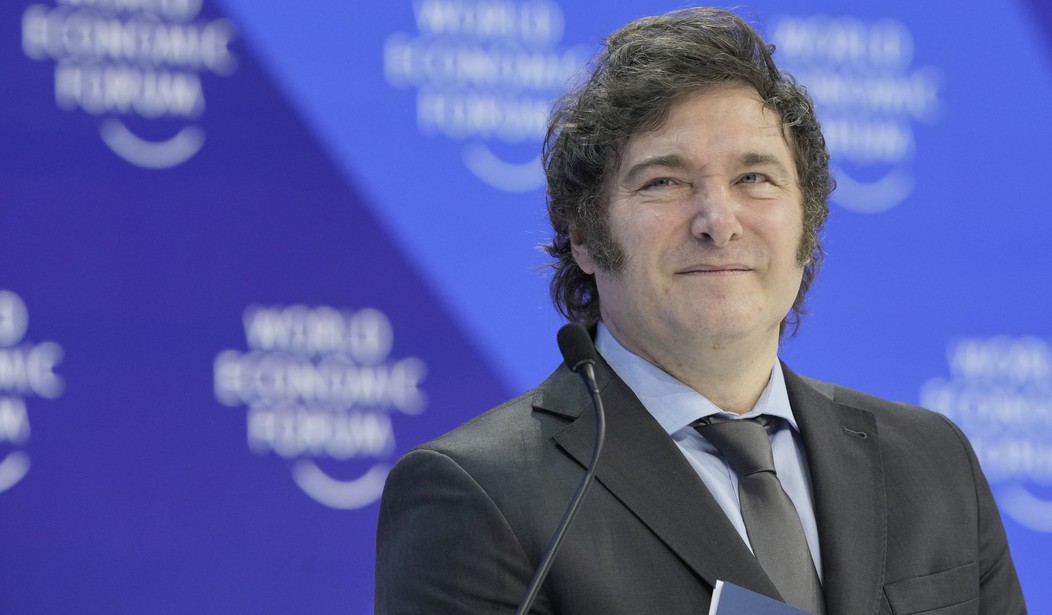
In a thrilling address at the World Economic Forum, Javier Milei, President of Argentina, presented a robust defense of capitalism and a critical examination of all forms of collectivism. His speech, rich in historical context and economic analysis, offers some vital lessons that are particularly relevant for today's globalized economy. Sadly, these lessons have long been ignored by American politicians on the right and left, whether in Washington or on the campaign trail.
Milei began with a stark warning about the dangers of collectivist policies based on Argentina's own, sometimes sad, history. Once a beacon of prosperity under a capitalist framework, Argentina's shift toward collectivism over the past century caused its prosperity to plummet from a leading global position to a much lower rank. Its story illustrates how losing sight of free-market principles can result in economic stagnation or even absolute poverty.
This point is crucial. Milei reminds us that no matter how noble the intentions are behind collectivist policies, whether it's fighting climate change, obtaining justice for all, or enhancing national security -- and whether they are pushed, as Milei says, by "communist fascist, socialist, social democrats, national socialists, Christian democrats, neo-Keynesians, progressives, populists, nationalists or globalists" -- attempting to solve problems in this way harms the very people who are meant to be helped.
Readers may think this historical lesson is irrelevant for the United States. After all, Argentina has been an economic basket case, and America in 2024 is still one of the wealthiest nations in the world. Anyone who has taken, as I have, the naturalization test also knows that the expected answer to "What is the economic system of the United States?" is "free market." That one made me smile.
Unfortunately, Milei's warning is relevant to us. While much of our economy remains relatively free, every part of it is subjected to an increasingly intrusive regulatory regime and ineffective, burdensome and unfair tax code. Furthermore, while Democrats and Republicans fight constantly, their economic policies are strikingly, similarly and increasingly collectivist.
Both parties have recently become so populist that they could justly be described as modern Peronists who believe that politicians, better than people operating in a free market, can direct investment and determine which industries should succeed and which should fail. It's no exaggeration to say that America has traveled a significant distance down the "road to serfdom" that Milei warns about.
Milei, an economist by training, doesn't only criticize collectivism; he offers a compelling, positive case for capitalism. By tracing global economic history, he highlights a pivotal moment: the advent of capitalism and the Industrial Revolution. This period marked a departure from centuries of economic stagnation, ushering in unprecedented growth in global per capita GDP and a significant reduction in poverty.
The data offered by Milei is striking. The transformation from a near-zero growth world to a rapid economic expansion under capitalism testifies not just to the free market's efficiency, but to its capacity to improve people's lives on a massive scale subsequently. The fact that poverty and inequality still exist makes Milei's insights more pertinent, not less. They suggest that the path lies not in abandoning capitalism but in more effectively harnessing its immense potential.
Even better, Economic growth isn't just an engine of wealth production but also of peace and tolerance. More of that, please.
Milei's perspective challenges the growing worldwide trend of increased government involvement in economic affairs. He advocates for limited government intervention, where economic freedom, respect for private property and market mechanisms are paramount. It's a reminder that the road to prosperity is paved with policies that empower individuals and businesses alike, fostering an environment in which innovation, entrepreneurship and opportunities for all kinds of people thrive.
Better yet, Milei ended his memorable speech with a poignant "Long live freedom, dammit." It's a rallying cry for our times, a reminder of the value of liberty, and a call to defend it against encroaching forces. As we navigate the complexities of the 21st century, his words serve as a beacon, guiding us towards a future where freedom is cherished in the abstract and actively protected and nurtured in practice.
Don't think of Javier Milei's address in Davos as a historical analysis or economic lecture; it's a call to action. Let's reevaluate our approach to economic policy, remember and recognize the proven strengths of capitalism, and be wary of the inescapable pitfalls and proven failures of collectivism. Embracing economic freedom while ensuring responsible governance is surely the key to sustainable prosperity and continued global progress.
Veronique de Rugy is the George Gibbs Chair in Political Economy and a senior research fellow at the Mercatus Center at George Mason University. To find out more about Veronique de Rugy and read features by other Creators Syndicate writers and cartoonists, visit the Creators Syndicate Web page at www.creators.com.



Join the Conversation
VIP members get the ability to comment on articles.