





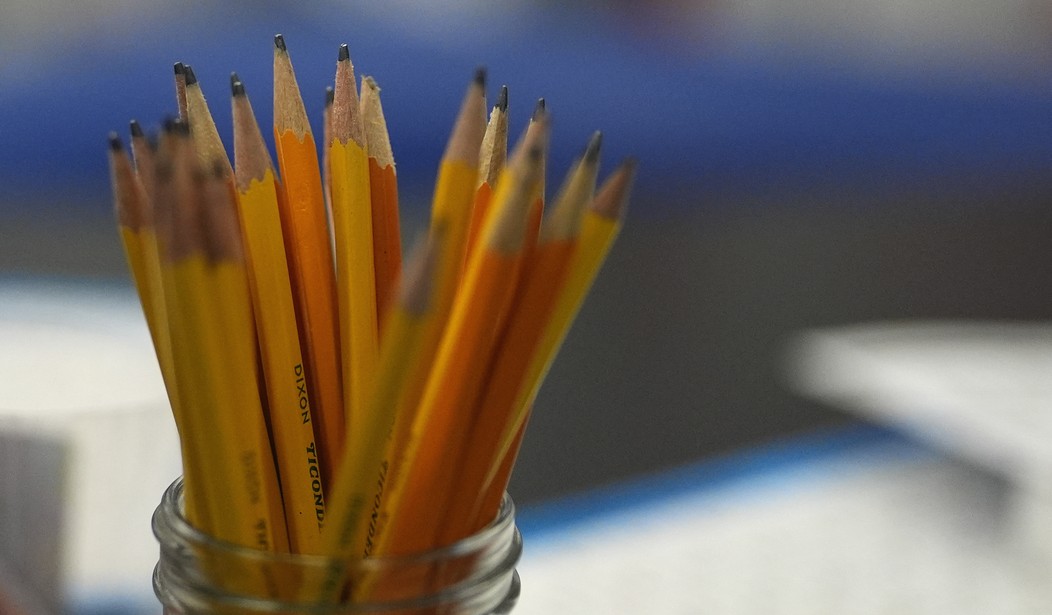
It is always a good time to revisit Leonard Read’s classic 1958 essay, “I, Pencil,” in which he examines how a pencil is made — and how miraculous it is that a pencil is even made at all.
The standard pencil begins when a cedar is cut down. Ropes and gear tug it onto the bed of a truck or a rail car.
Think of the countless people and skills involved in mining ore to produce steel and refine the steel into saws, axes and motors, Read wrote.
Think of all the people who grow hemp, then transform it, through various stages, into a strong rope.
Think of the untold thousands of people who produce the coffee the loggers drink!
The logs are shipped to a mill and cut into slats. The slats are kiln-dried, tinted, waxed, then kiln-dried again.
How many skills were needed to produce the tint and the kilns, Read wondered. What about the electric power? What about the belts, motors, and other parts at the mill?
The pencil slats are shipped to a factory. A complex machine cuts grooves into each. A second machine lays lead into every other slat. Glue is applied. Two slats are sealed together as one, then cut into lengths that form pencils.
The lead alone is complex, he explains. It’s not really lead. To produce it, graphite is mined in Sri Lanka. The graphite is packed and shipped, then mixed with clay from Mississippi. It is treated with wetting agents — such as sulfonated tallow, which is formed when animal fats chemically react with sulfuric acid.
The pencil receives six coats of lacquer. Lacquer has numerous ingredients, including castor oil. Think of all the chemists needed to create the paint — think of all the castor bean growers needed to produce, refine, and ship the oil.
The brass end that holds the eraser in place is a marvel. Miners first extract zinc and copper from the earth. Experts transform those materials into sheet brass, which is then cut, stamped, and affixed to the pencil.
That brings us to the eraser. It is made from “factice” — a rubber-like product produced when rapeseed oil from the Dutch East Indies reacts with sulfur chloride, Read wrote.
To be sure, an awe-inspiring amount of work goes into producing a pencil. Millions of people collaborate to produce it — millions ply their unique trades and skills — yet they have no idea they are collaborating.
Each is merely exchanging his small piece of know-how for the money he needs to buy the goods and services he wants, Read wrote.
More amazing is this: No one person is capable of making a pencil. Not even the president of the pencil company.
No one person could possibly manage the millions of people — and the millions of decisions they make — who produce the ingredients that become a pencil.
Despite the absence of a mastermind, billions of pencils are made every year. They’re produced with such humdrum efficiency that every one of us takes pencils for granted.
The pencil, explained Read, is the triumph of human freedom — a triumph of creative human energies spontaneously responding to human necessity and desire.
There never was a need for a presidential commission on the production of pencils.
Without one government program, the need for pencils arose. Without any meddling from an Ivy League bureaucrat, the pencil was invented, produced, and sold — the demand for pencils was met.
It is a folly for any man, or group of men, to think of producing something as incredibly complex as a pencil. How much harder must it be to produce a car — one that consumers will want to buy, anyhow?
Read concluded his essay with this advice: The best thing our government can do is leave our creative energies uninhibited — the government should remove the obstacles that prevent human creativity and innovation from flowing freely.
Thank goodness our government hasn’t taken over any pencil companies yet. It would be that much more costly and difficult to write to our congressmen.
Find Tom Purcell’s syndicated column, humor books, and funny videos of his dog, Thurber, at TomPurcell.com. Email him at Tom@TomPurcell.com.
Editor's Note: Do you enjoy Townhall's conservative reporting that takes on the radical Left and woke media? Support our work so that we can continue to bring you the truth.
Join Townhall VIP and use promo code FIGHT to receive 60% off your membership.



Join the Conversation
VIP members get the ability to comment on articles.