





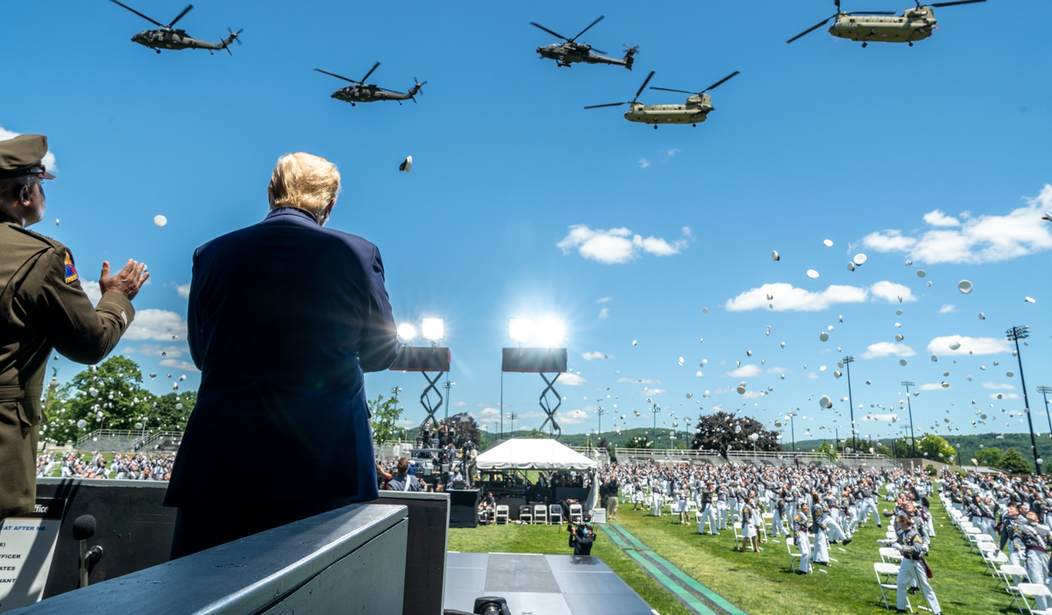
Most people won’t take the time to read President Trump’s June 13 address to West Point’s graduating class of 1,107 new Army officers.
That’s unfortunate.
They may instead be tempted to believe reviews, such as the one by Robin Wright in The New Yorker, who termed the address “vacuous,” finding fault with the lack of mention of racial injustice, the omission of any discussion of a perceived growing civil-military divide, or any discussion of ongoing military operations in Iraq or Afghanistan. Nor, Wright notes, did the president note the ongoing coronavirus pandemic, or other world events.
No, instead the speech focused on the responsibilities of being an Army officer and how the men and women on the field will likely be called upon to protect and defend their nation, thanking them for answering the nation’s call, and their parents and faculty for getting the graduates to this distinguished point in their lives.
The president noted the great history of West Point graduates — leaders like McArthur, Patton, Eisenhower and Bradley — who helped defeat Nazi Germany and Tojo’s imperial Japan. He noted how General Matthew Ridgway helped end the “terrible injustice of segregation” present in the Army. Trump charged the graduates to be as visionary as Patton, as bold and determined as McArthur and as relentless as Grant. He closed by reminding the graduates that their most noble task is the one to “preserve American liberty.”
The speech is notable for its lack of partisanship and for its patriotic tone. Speaking as a parent who has endured college commencement speakers who felt compelled to inject politics into what should have been a celebratory event, that was refreshing.
In his remarks, the president also mentioned how the U.S. military, in the last few years, has undergone a “colossal rebuilding” after years of “devastating budget cuts.”
Even though The New York Times “fact-checker” stated that President Trump was “wrong” when he said the military he inherited was depleted, and the previously mentioned New Yorker article quoted Andrew Bacevich as saying such claims are “nonsense.” On this point the record is crystal clear.
In 2017, Defense Secretary James Mattis, at his first hearing before Congress as Secretary, testified that on his return to the Pentagon he was “shocked” at the poor state of the U.S. military’s readiness.
The Army, of which I was a member in 2016, had “historically low levels” of readiness, and its end strength was being rapidly cut to accommodate a plummeting budget. In 2015, the Army Chief of Staff, General Ray Odierno, testified that “today, only 33 percent of our brigades are ready, when our sustained readiness levels should be closer to 70 percent."
"We have fewer soldiers, the majority of whom are in units that are not ready, and they are manning aging equipment at a time when the demand for Army forces is much higher than anticipated," he said.
Other services faced similar challenges.
The Navy was experiencing a serious readiness crisis. When the commander of the Japan-based 7th Fleet took over in 2015, he found “the fleet was short of sailors, and those it had were often poorly trained and worked to exhaustion. Its warships were falling apart, and a bruising, ceaseless pace of operations meant there was little chance to get necessary repairs done.”
In 2016, due to budget shortages, Marines were forced to scavenge spare parts for aircraft from museums and had to buy necessary supplies, like pens and paper towels, with money out of their own pockets.
While not completely rebuilt, the military today is in a much better place. The Army has met its internal readiness goals. Then Army Chief of Staff General Mark Milley testified in 2019 that the Army has begun to “restore its competitive advantage.” The Navy “has made strides in arresting its readiness decline,” while in the Air Force maintenance shortfalls and supplies of munitions have improved considerably.
Pointing out to the graduates that the military they are about to join is improving and that they will be a part of a noble profession may not make the headlines. As these graduates now move to take their places in the Army all over the globe, maybe — and I’m going out on a limb here — it’s enough to remind them of their institution’s proud 245-year old history, to charge them to uphold the highest standards, and to thank them for their service.
Thomas Spoehr is the Director of the Center for National Defense at The Heritage Foundation heritage.org.

Join the Conversation
VIP members get the ability to comment on articles.