







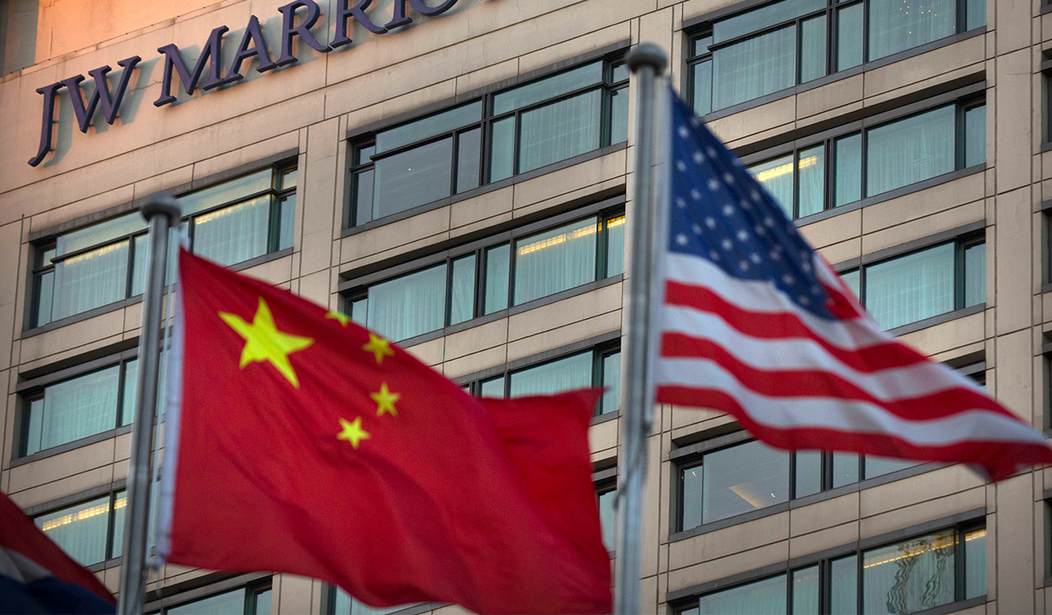
California, Florida and Michigan may be geographically distant from one another and have somewhat different cultures, but when they engage in trade with one another, it is free.
The business owners and workers in these states all work under the same federal laws. The Constitution gives the federal Congress, not state governments, the power to "regulate Commerce with foreign Nations, and among the several States."
If a worker or entrepreneur does not like the laws of the state they now inhabit, they are free to move to another part of the United States -- or they can vote their state politicians out of office.
The United States is both a free country and a free-trade zone.
The Constitution, as originally ratified, gave the federal government the power to impose tariffs on foreign goods coming into the United States but effectively barred the imposition of a direct federal tax on the incomes of individual Americans.
When the first Congress met in 1789, one of the first laws it passed -- on July 4 -- was expressly designed for "the encouragement and protection of manufactures." It was the Tariff Act.
"Whereas, it is necessary," said this law, "for the support of government, for the discharge of debts of the United States, and the encouragement and protection of manufactures that duties be laid on goods, wares and merchandise imported: Be it enacted by the Senate and House of Representatives of the United States of America in Congress assembled, That from and after the first day of August next ensuing, the several duties hereinafter mentioned shall be laid on the following goods, wares and merchandise imported into the United States from any foreign port or place."
The act then went on to list specific items and what the tariff on them would be. "On soap, per pound, two cents," it said. "On boots, per pair, fifty cents."
Members of Congress today should look back to the vision of the Founders when they approach U.S. policy toward the People's Republic of China.
Manufacturing employment in the United States hit its all-time peak in June 1979, when, according to the Bureau of Labor Statistics, it climbed to 19,553,000.
Local, state and federal government in the United States that same month employed only a combined 16,045,000.
So, the manufacturing sector in the United States employed 3,508,000 more than government as we started the summer season 43 years ago.
In January, according to BLS, there were 22,144,000 people employed in government in the United States and only 12,559,000 in manufacturing. Government employees now outnumber manufacturing employees by 9,585,000, or 76.3%.
What would the Founders have thought of that?
One of the reasons for the decline in manufacturing jobs in the United States can be seen in the 2021 international merchandise trade data released this week by the Census Bureau.
The People's Republic of China was by far the leading contributor to our merchandise trade deficit for the year. The United States imported $506.3 billion in goods from China in 2021, but China bought only $151 billion in goods from the United States. That resulted in a bilateral trade deficit of $355.3 billion.
Our next highest trade deficit was with Mexico, but it was less than one-third the deficit with China. The United States imported $384.7 billion in goods from Mexico and exported $276.4 billion in goods to Mexico, resulting in a trade deficit of $108.2 billion.
What did America buy from China?
According to the date released by the Census Bureau, the top product the United States imported from China was $75.18 billion worth of "cell phones and other household goods." Ranking second was "computers" at $59.2 billion. The top two products the United States sold to China were soybeans ($14.1 billion) and semiconductors ($13.4 billion).
The workers in China who make the products that China exports to the United States are not free people. Their government denies them their God-given rights.
In its latest report on human rights in China, the State Department said that China is "an authoritarian state," where the "Chinese Communist Party is the paramount authority." "Significant human rights issues," it said, "included: ... forced labor and trafficking in persons; severe restrictions on labor rights, including a ban on workers organizing or joining unions of their own choosing; and child labor."
Perhaps Congress should move to protect the jobs -- and cut the taxes -- of American workers by imposing on Chinese imports the sort of tariffs that the Founders had in mind when they convened the first Congress.
Terence P. Jeffrey is the editor-in-chief of CNSnews.com.

Join the Conversation
VIP members get the ability to comment on articles.