





The impulse was understandable. Gasoline is an essential commodity for most people. When the cost rises, it imposes a heavy burden on consumers, most of whom have few transportation options.
In 1971, in an attempt to tame inflation, Republican President Richard Nixon imposed controls on almost all prices. By 1974, he had lifted most of them. But those on gas remained. Under Democratic President Jimmy Carter, they led to widespread shortages and long lines at service stations -- and didn't keep prices from rising. But the controls lasted until his successor, Ronald Reagan, lifted them in 1981.
Liberals learned an unforgettable lesson: Price controls on gasoline don't work. In recent decades, when gas prices have soared, Democrats have shown no desire to repeat the lesson.
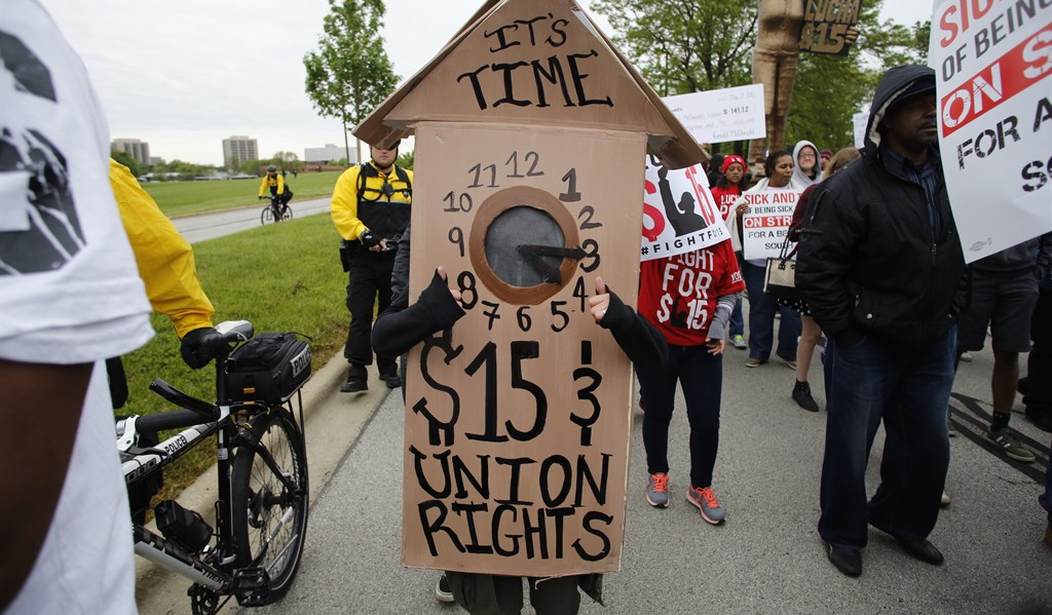
But they embrace a similar approach for another problem: low pay for many workers. Chicago decided last year to boost the minimum wage to $13 an hour by the middle of 2019. Seattle, San Francisco and Los Angeles have gone even higher, raising the floor to $15 an hour in the next few years, and other cities may follow suit. It's a price control on labor.
Their intentions are good. Full-time employment at the current federal minimum of $7.25 an hour provides an income of just $14,500 a year. For an adult supporting one child, that's well below the poverty line of $15,930.
The problem is that a higher legal minimum wage is at odds with the prevailing supply of and demand for labor. If you set the minimum too high, you will get a shortage of jobs. Forbidding employers from paying $9 or $12 an hour means that many of their workers won't get $13 or $15 an hour. They will get zero per hour, because those jobs will disappear.
Recommended

Some businesses will reduce staffing or hours. Some will scrub expansions they had planned. Some will install machines to handle tasks previously assigned to humans. Some will shut down.
Not all employers will take steps that will curb employment, but many will. Raising the minimum wage collides with one of the basic laws of economics: the higher the cost of something the lower the demand. In the employment realm, the effects may not be immediate, but they are inexorable.
An editorial in The New York Times wished away unwanted responses. It promised that the change will yield "savings from lower labor turnover and higher labor productivity." Higher pay can "be offset by modestly higher prices" and by "paying executives and shareholders less."
But if giving raises paid for itself, companies wouldn't need to be forced to do it. Raising prices means fewer customers will buy what these companies are selling, which reduces the number of employees they need. Executives and shareholders who get paid less can turn to companies that can pay more because they don't rely on low-wage labor.
Some of these consequences have already occurred in Seattle. One pizzeria owner, employing 12 people, told NPR her choice was to go back to working 60 to 80 hours a week or close. She's closing.
"Even Seattle's best-known chef, Tom Douglas, says he may have to close some of his 15 restaurants," it reported. If a famous restaurateur can't make it work, how will obscure ones fare?
Restaurants have other options besides shutting down. They can automate orders with modern technology. They can require diners to pick up their food at a counter instead of having it brought to them. They can use disposable plates and utensils. And if you worry about robots taking your job...
All of these changes reduce the need for employees. Maybe the higher pay to the workers who have jobs will make up, by some calculus, for the unemployment visited on the others. Maybe not. Either way, there's no escaping the tradeoff.
Back in the 1970s, people imagined that stations would supply plenty of gas even if we restrict what they could charge. Today, they imagine businesses will supply plenty of jobs even if we dictate what they must pay. But the laws of economics are not so easy to repeal.







Join the conversation as a VIP Member