





Biblical truth is proclaimed in many ways. We see it with missionaries spreading the Gospel in far-flung regions of the world, soapbox preachers on busy street corners, and clergy ministering to congregations large and small, from pulpits in ornate cathedrals and rented cinder block buildings.
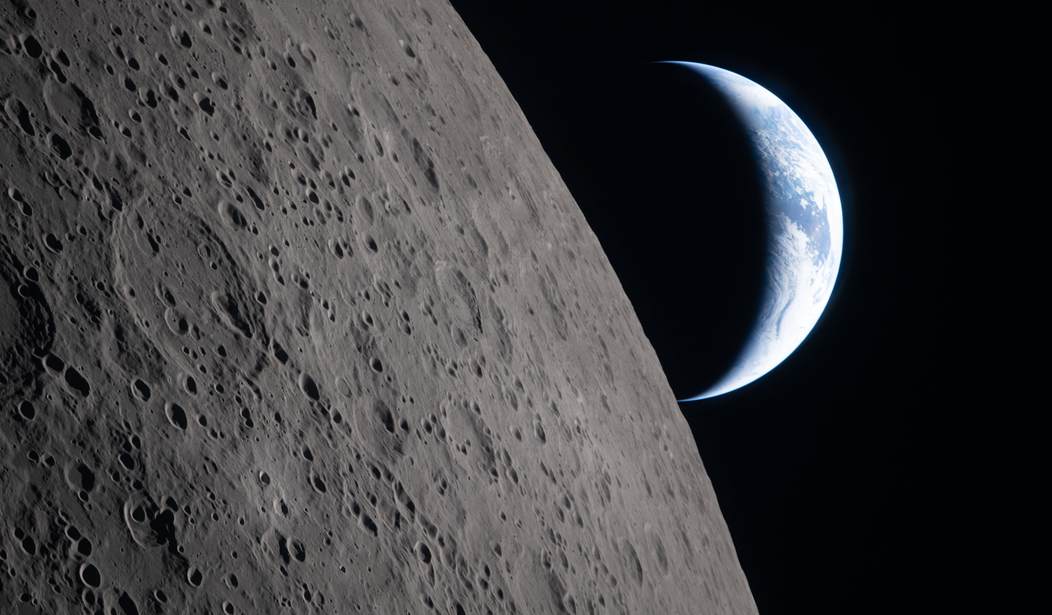
The works of God are also witnessed through science and technology, which were reflected in the observations of Navy Captain Victor Glover, who piloted the Artemis II spacecraft in its successful mission to orbit the moon. During his April 5 CBS News interview with Mark Strassmann, Glover linked God, science, and humanity together from the rare perspective of a man nearly a quarter-million miles from home.
“When I read the Bible and I look at all the amazing things that were done for us… You guys are talking to us because we’re in a spaceship really far from Earth, but you’re on a spaceship called Earth that was created to give us a place to live in the universe and the cosmos,” Glover said, reflecting some of what science tells us about our planet.
Astronomy and physics corroborate the creation account in the book of Genesis. The placement of Earth within the universe, our orientation to the sun and the planets in our solar system, combined with Earth’s behavior as it orbits through space, suggests it came into being on purpose and isn’t some random byproduct of a massive explosion eons ago. The truth of what we’re able to see is compelling, but there is another dimension to our place in the universe. That is the premise of the movie “The Invisible Everywhere,” which premiered on April 8.
Written and produced by former ABC News Science Editor Dr. Michael Guillen, “The Invisible Everywhere” goes where no film has gone before. Using imagery entirely generated by artificial intelligence, Guillen’s film seeks to reveal that part of the universe we cannot see, which, as it happens, is nearly all of it.
The Psalmist David wrote, “The heavens declare the glory of God, and the sky above proclaims His handiwork.” All we have to do is look for it. But science tells us we can see only five percent of the universe; the remaining 95 percent is a mystery. Exploring this is daunting, and Guillen tackles it with aplomb. He holds a doctoral degree in mathematics, astronomy, and physics from Cornell University, and taught physics for eight years at Harvard, so Guillen is not just a pretty face. In merging his knowledge of science with his Emmy Award-winning storytelling skills, Guillen makes the complex understandable and, in doing so, describes how science led him from atheism to Christianity.
Faith, by definition, involves believing things we cannot see or prove. The faith of a Bible-believing Christian is little different from that of a physicist who believes the universe was born during the rapid expansion of a vacuum that created everything out of nothing. But when scientific discovery consistently provides evidence supporting a particular thesis, confidence in that thesis grows. Such was the case with Guillen, who came to his belief not through some Damascene conversion but years of scientific inquiry.
In explaining the current state of science, Guillen serves as an intellectual sherpa, guiding viewers toward a destination he says changed his life. Few of us can grasp the abstractions of quantum mechanics, the cosmic horizon or the effects of spacetime, but they matter a great deal and help lift a veil on the existence of God.
Nobel laureate and quantum physics pioneer Werner Heisenberg famously said, “The first gulp from the glass of natural sciences will turn you into an atheist, but at the bottom of the glass God is waiting for you.” Heisenberg encapsulates the profundity of both God and science, and tells us the two are not contradictory but complementary.
Heisenberg also echoes the subtitle of “The Invisible Everywhere: Believing is Seeing.” It is more than a simple inversion of the oft-used expression “seeing is believing.” It explains how belief in God enables us to see that which is ordinarily unobservable. And whether by accident or design, Guillen’s film debuted on the anniversary of the 2024 total eclipse of the sun visible across the United States, which further illustrated the utterly elegant order of the cosmos.
Increasingly, science is paving the way toward a better understanding of and belief in God and His creation. Some people will always be dogmatically opposed to any scientific inference of a supreme creator, but they might be wise to heed the advice of Albert Einstein. “No amount of experimentation can ever prove me right,” said Einstein while noting, “a single experiment can prove me wrong.” No experiment over 2,000 years has proved the Bible wrong. And while no amount of experimentation can prove the existence of God, the evidence of His hand in creation and everything else only grows.
Editor’s Note: Do you enjoy Townhall’s conservative reporting that takes on the radical Left and woke media? Support our work so that we can continue to bring you the truth.
Join Townhall VIP and use promo code FIGHT to receive 60% off your membership.



Join the Conversation
VIP members get the ability to comment on articles.