







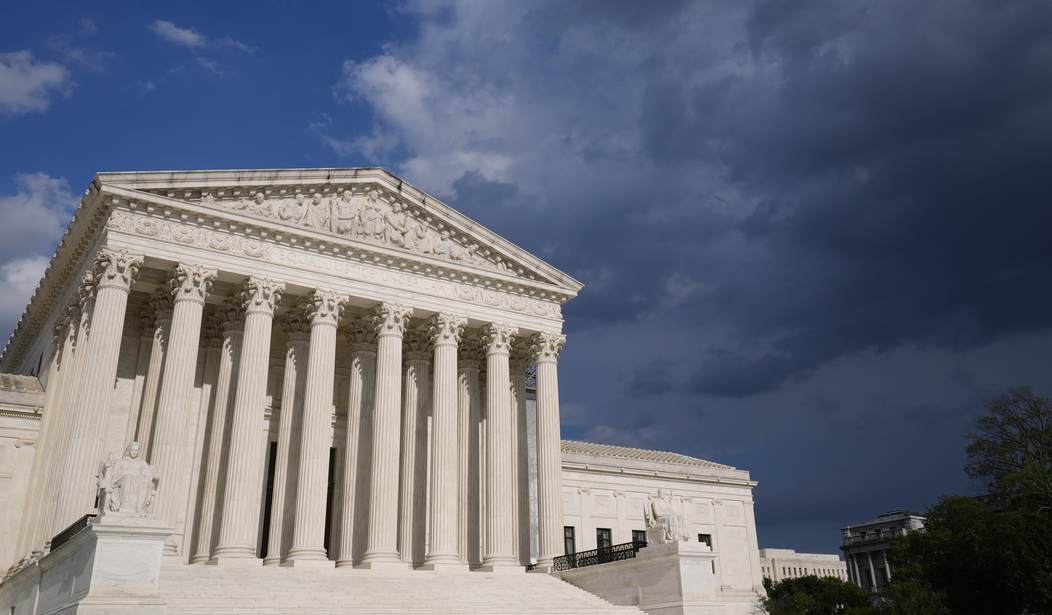
For several years, establishment media coverage of the Supreme Court has been dominated by claims that the court is “conservative” and governed by a “6-3 conservative majority.”
But the actual decisions from the term just ended—like the decisions in other recent terms—tell a very different story.
In the term just ended, the media’s mythical “conservative bloc” prevailed over dissents from the three liberal justices only nine percent of the time. By contrast, the justices were unanimous 42 percent of the time. Moreover, on some issues, there was a working 6-3 liberal majority—a majority that sometimes swelled to 7-2. Ketanji Brown Jackson, the justice usually considered most liberal, was in the deciding majority 72 percent of the time.
As demonstrated below, this is a bench whose members differ in judicial philosophy, but where the center of gravity is near the political middle. It is not as liberal as the activist courts of the 20th century, but neither is it really conservative.
Shifting Majorities
One of the cases that fed the media’s “6-3 conservative” narrative—and accordingly received heavy coverage—was United States v. Skrmetti. There, the justices ruled 6-3 that the State of Tennessee could ban transgender medical procedures on children. Also garnering heavy attention was Trump v. CASA, which curbed universal (sometimes misnamed “nationwide”) injunctions. Ditto for Mahmoud v. Taylor, which held that a public school could not force-feed kids with LGBTQ+ propaganda over their parents’ religious objections. Another ditto for Free Speech Coalition v. Paxton, which upheld a Texas law requiring age-verification for viewers of pornographic websites. (For reasons too complicated to go into here, you can characterize this as a centrist rather than as a conservative decision.)
On the other hand, a 6-3 liberal majority prevailed in Kennedy v. Braidwood. In that case, the court once again intervened to preserve a portion of Obamacare from constitutional challenge. The court pieced together disparate parts of federal law to rule that Congress had constitutionally vested the appointment of a powerful commission in the secretary of Health and Human Services rather in the president. The same 6-3 liberal majority decided Federal Communications Commission v. Consumers’ Research. There, the court held that even though the power to tax is a quintessential legislative power, Congress could delegate it to an executive agency without any numerical limits on the tax rate or the amount of money collected.
Both of these cases were significant victories for the administrative state, but the media gave them relatively little attention.
In Bondi v. VanDerStok—the “ghost gun case”—the liberal majority was even more pronounced. Despite what seems to be clear statutory language to the contrary, the court upheld the power of the Bureau of Alcohol, Firearms, Tobacco and Explosives (ATF) to regulate the sale of gun assembly kits. The case was decided 7-2, with only Justices Thomas and Alito dissenting. It was a smashing victory for the administrative state.
The same liberal 7-2 majority ruled against President Donald J. Trump in A.A.R.P. v. Trump. The court held that an illegal alien was entitled to certain due process rights before being deported. (Disclosure: I probably would have joined the liberals on this one.)
Unanimous Results
Further debunking the fairy tale of the “6-3 conservative majority” were the many cases in which the justices were unanimous. One of the most important was TikTok v. Garland, essentially holding that a company controlled by a foreign government may not spy with impunity because it also engages in activities protected by the First Amendment. In Ames v. Ohio, the court ruled that in a discrimination claim, the government could not impose a heavier burden on members of “majority groups” than on members of minority groups. That ruling was unanimous as well.
Also unanimous was Catholic Charities v. Wisconsin, where the justices agreed that a state could not grant or withhold a religious tax exemption because of a church’s religious doctrine. (Strictly speaking, you might classify this as a liberal rather than a conservative decision because it applied jurisprudence invented by liberal justices during the 20th century.)
Conclusion
The media’s narrative of a “6-3 conservative majority” is obviously defective. But it does serve a purpose: By tarring the more traditional justices as “conservatives,” the narrative enables liberal commentators to claim rulings they don’t like are driven by right-wing ideology rather than by the law.
Robert G. Natelson, a former constitutional law professor who is senior fellow in constitutional jurisprudence at the Independence Institute in Denver, authored “The Original Constitution” (4th ed., 2025). He is a contributor to the Heritage Foundation’s “Heritage Guide to the Constitution.”



Join the Conversation
VIP members get the ability to comment on articles.