





“March comes in like a lion, goes out like a lamb.”
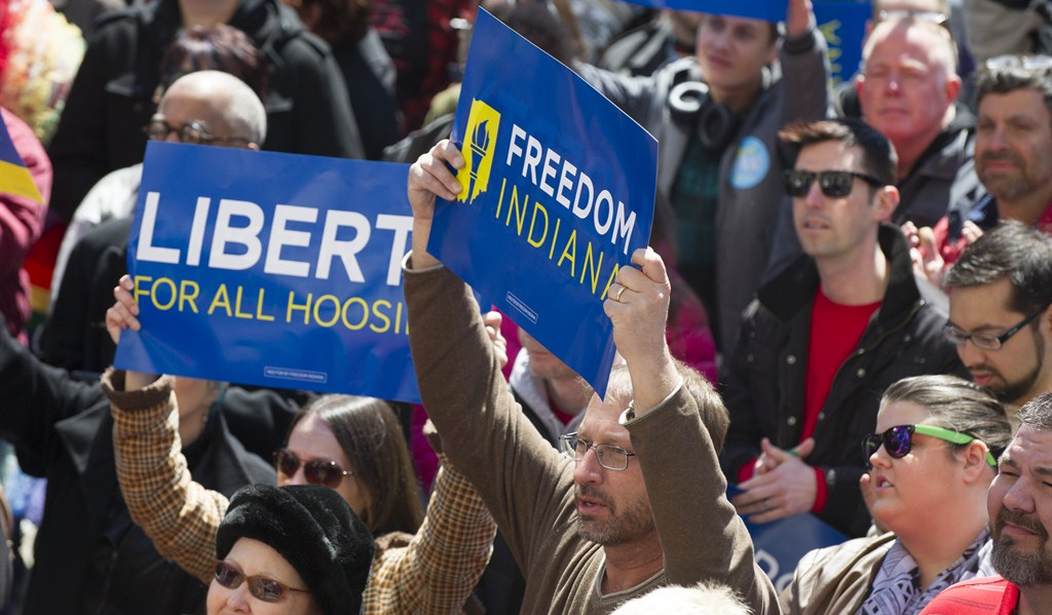
Just try telling that to Indiana Governor Mike Pence, whose signing of the Religious Freedom Restoration Act (RFRA) into law at the end of March touched off a roaring controversy.
So much so that Governor Pence and the state legislature, with its massive GOP majorities in both chambers, sheepishly scurried back to amend the statute, to specifically add protections against discrimination related to “sexual orientation” and “gender identity.”
All of which begs the question: Do RFRA laws enable discrimination? Or protect religious freedom? Or both?
“A person whose exercise of religion has been substantially burdened, or is likely to be substantially burdened . . .” reads the essential portion of the Indiana law, “may assert the violation or impending violation as a claim or defense in a judicial or administrative proceeding.”
Yet, as an Associated Press report explains: “Religious freedom laws like the one causing an uproar in Indiana have never been successfully used to defend discrimination against gays — and have rarely been used at all, legal experts say.”
Nonetheless, discrimination against homosexuals continues. Lawfully. In 2014, a Texas restaurateur refused service to a gay couple. As a FindLaw.com article explains, the 1964 Civil Rights Act “only prohibits discrimination on the basis of color, race, religion, or national origin, and says nothing about sexual orientation.”
So some states, such as New Mexico and Oregon (and now Indiana), added legal protections for sexual orientation. But that’s led to cases of reverse violations of rights.
- Facing a $150,000 fine, an Oregon bakery closed its shop after the state’s Bureau of Labor and Industries ruled it violated a lesbian couple’s civil rights by declining to make a custom wedding cake
- A New Mexico photographer was found guilty of defying the state’s Human Rights law after passing on the opportunity to snap photographs of a gay couple’s commitment ceremony
- A florist in Washington state was sued by the attorney general and found guilty of violating that state’s Consumer Protection Act for refusing to arrange flowers at a gay wedding.
“I think that it’s bad business and bad public relations to discriminate for any reason,” said Jimmy LaSalvia with GOProud, a group representing gay Republicans, “but the market should be able to determine the consequences of the florist’s discrimination.”
Back in January, a Christian activist launched a lawsuit claiming he is being discriminated against by a Denver bakery, after the shop refused to make a Bible-shaped cake and inscribe it with frosting to read: “God hates gays.” Now, that seems to me to be a service no Christian would care to provide, either — or for that matter, any decent person, regardless of religious faith or sexual orientation.
In times’ past, both state and private violence enforced invidious racial discrimination. Thankfully, those days are gone — cafes, hotels and stores are open to all.
But civil rights laws that prohibit discrimination in public accommodations cases are different than laws forcing photographers or florists or flutists to personally participate in ceremonies they choose not to. The former services are part of a set routine, the provision of a discrete set of goods to the public, just one step up from selling widgets. The latter services are involved and collaborative and creative, entailing intimate cooperation with rituals that have been of a religious nature for eons.
They seem quite distinct.
It is now apparent that RFRA laws do not even serve to protect that distinction. They do not protect religious freedom at all, when it comes into conflict with anti-discrimination law as understood wholly from the public accommodations perspective.
And the ability of people to keep their heads while contemplating these issues has not exactly been demonstrated.
What is missing here is any conception of a right to freely associate. The current ethos sure seems to be that no businessperson or professional possesses a right to choose his or her clientele, even when it comes to religious matters. By the right of free association, this is wrong. But figuring this out socially will require some rational thought and good manners. Less anger, vituperation, and . . . roaring.
Or sheepish following of the motion of the flock.


Join the Conversation
VIP members get the ability to comment on articles.